MTPA horn thieves had to have had inside info
Modipane said that about 30 per cent of the stolen horns were procured from poaching scenes; harvested from rhino which died natural deaths, or were handed in by private game reserve owners for safekeeping. There was no explanation why the horns were in "so many pieces"
NELSPRUIT – Whoever broke into the safe of Mpumalanga Tourism and Parks Agency (MTPA) earlier this week, came for one purpose only – rhino horn.
They did not take one of the 140 elephant tusks, firearms or any of the ammunition in that safe. This is quite significant since elephant poaching has increased dramatically in other parts of Africa and conservationists have warned that it will soon spill over into South Africa’s parks and reserves.
A former high-ranking police official and criminology expert, said these thieves obviously had a very specific modus operandi. “They are not opportunists, otherwise they would have helped themselves to the weapons and ivory with the intent to sell those too, in order to make a quick buck,” he explained. “A criminal with a modus operandi is actually easier to catch than an opportunistic one. The perpetrators in question will most likely steal rhino horn again. I don’t think they will try to sell the horns all at once and I am of the opinion that these horns have not yet left the country,” he added.
An inside job?
MTPA officials took Lowvelder through the crime scene on Wednesday and although they were careful not to speculate whether one of their own might have been involved, it was clear that the suspects had access to detailed inside information.
“We had received information before, that attempts would be made to steal the rhino horns in the MTPA’s possession. This time we received no tip-off, no intelligence at all and that is very worrisome,” a source remarked.
Mr Jacques Modipane, CEO of the MTPA board, was also reluctant to say whether he felt that MTPA officials might have been involved and said that would only become apparent as the investigation progressed.
The crime scene
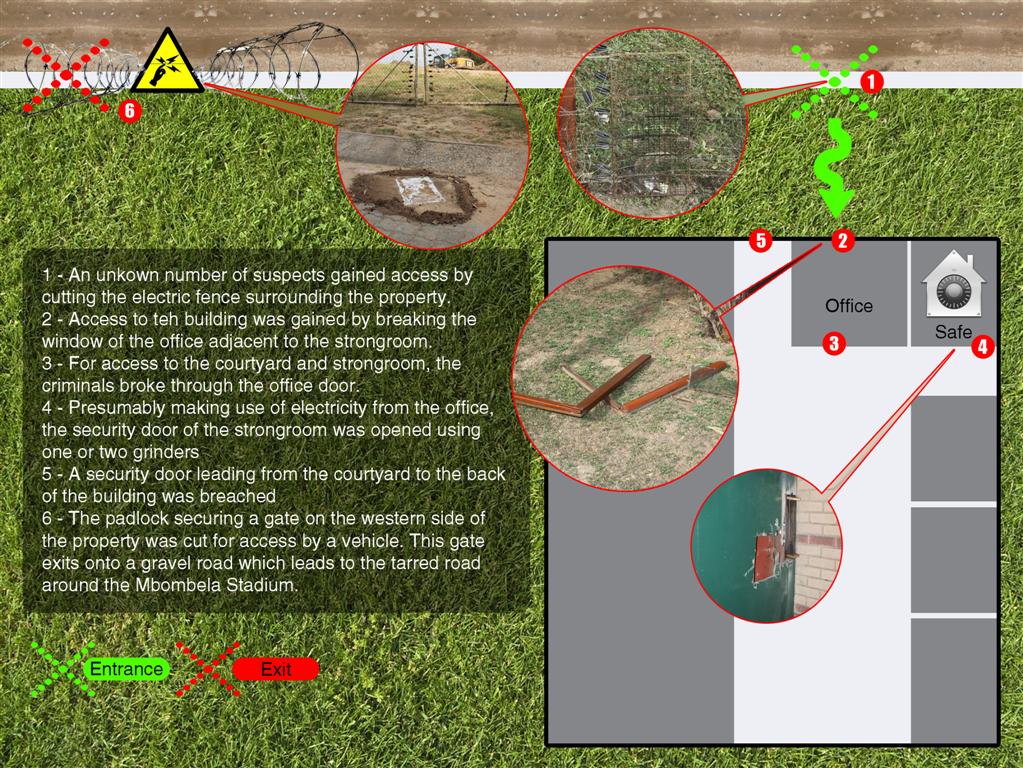
The suspects first gained entry to the MTPA premises by cutting through an electric fence. They then broke the window of an office adjacent to the safe. All they had to do next was break open the office door and they had access to the safe. They most probably made use of electrical plugs in the adjacent office to operate the grinders with which they cut open the safe.
It is a so-called strongroom with a Class 2-door made of 10 milimetre thick steel. The walls of the safe also contain slabs of concrete. The perpetrators managed to cut open a double lock and helped themselves. According to MTPA spokesman Ms Kholofelo Nkambule, 112 pieces of rhino horn with a total weight of 80,13 kilograms were taken.
The padlock to a gate was also cut open through which the suspects brought in a vehicle to transport the horns. The theft was discovered at 05:30.
An MTPA official who was alerted of the break-in, and one of the first to arrive on the scene, told Lowvelder that he couldn’t describe the feeling of desperation and helplessness he felt when he saw that the horns had been taken. “When I saw the broken window, I thought it was nothing serious. But when I saw the office’s door had also been broken open, I realised that there was more to this break-in. The safe’s door was left open and when I looked in and saw the horns were gone, my heart dropped to my feet,” he said.
The CEO of the MTPA board, explains
Modipane said that about 30 per cent of the stolen horns were procured from poaching scenes; harvested from rhino which died natural deaths, or were handed in by private game reserve owners for safekeeping. There was no explanation why the horns were in “so many pieces”.
“Not many of the horns were privately owned, the majority was our own,” he added. The horns were being stored at the MTPA offices with the purpose of microchipping them and gathering DNA samples.
According to Modipane, these processes were completed on about 90 per cent of the horns. After that they were moved to a permanent, secure location. When asked how long the horns were temporarily stored at the MTPA offices, he said it could vary from weeks to months.
Security at MTPA
According to a media statement issued by the MTPA, its perimeter is well secured with controlled access and security personnel are on guard 24 hours, with regular patrol intervals of the premises. However, Modipane added that the area in which the safe is located, was not fitted with an alarm.
The guards who perform duty at the MTPA are from Lutsango Security Services. The perpetrators ground through the safe without any of Lutsango’s guards hearing them. Lowvelder attempted to locate someone at Lutsango’s offices for comment, but none of the numbers listed were in use.
The investigation into the theft
Modipane could not say whether Interpol had been involved in the investigation or whether border posts, harbours and airports in South Africa and neighbouring countries have been asked to be on the lookout for the loot. “The Hawks and the Convention on International Trade in Endangered Species of Wild Fauna and Flora (Cites) have been informed and they have structures in place to filter this type of information through.”
Capt Paul Ramaloko, spokesman for the Hawks, didn’t answer his cellphone or react to Lowvelder’s messages.
Two weeks ago, prior to this incident, the paper also sent him questions on how the Hawks, who have been mandated to investigate rhino-poaching cases, were rendering support to curb this escalating crime. He hasn’t responded.
Rhino horn stockpile management, some facts and opinions
• Rhino horn stockpiles are derived from natural rhino deaths, dehorning operations, breaking of horns, trophy hunting, historic stockpiles (pre-CITES ban) and confiscation
• In Terms of the Threatened or Protected Species Regulations of 2007 drafted in terms of the National Environmental Management and Biodiversity Act, no person may, without a valid permit, hunt, capture, kill, convey, import, export, keep live rhino in captivity, or possess a rhino horn. Horns must be measured, weighed, micro-chipped and registered by a conservation official. The onus is on the owner to keep the horn safe.
• The Department of Environmental Affairs (DEA) has announced that from 2008 leakage of both legal and illegal rhino horns held in the various private and government stockpiles has escalated with no indication of decreasing (National Strategy for the Safety and Security of rhinoceros populations in South Africa).
• Rhino-horn stockpiles in South Africa currently total more than 18 tons, the DEA stated at a press conference in July, 2013. These included 16 347 kilograms in government stockpiles and 2 091 in private hands, according to the department’s deputy director general for biodiversity, Mr Fundisile Mketeni.
• Several conservationists as well as NGOs believe that stockpiles create the impression that rhino horn is valuable. Rather, says Outraged SA Citizens Against Poaching (Oscap) director Ms Allison Thomson, destroy the stock
and ban private ownership of horn.
The Humane Society International states that the existence of large quantities of rhino horn, particularly in private hands, poses a serious threat to rhino populations, since they are difficult to monitor and their potential entry onto the illegal market will only stimulate demand further.
• According to Jo Shaw of the World Wildlife Fund (WWF), a theft of this kind should indicate the need for better standard operating procedures, especially around staff and the risk of insider information.
• Minimum standards for rhino-horn stockpile management, including that followed by the MTPA:
Centralisation: Storing large quantities of rhino horns at reserve level, increases the risk of theft. South Africa has different points of centralisation:
(i) reserve, the first point of handing over from a field patrol
(ii) reserve/provincial level,
(iii) a central vault. Ensuring an auditable paper trail helps to ensure centralisation occurs in a timely manner, with the burden of responsibility borne by the last person to sign off. If there is a need to maintain stockpiles within smaller administrative units (like the MTPA), then this may be justified only if
• Significant volumes of horn have been accumulated and/or are likely to be accumulated in the future
• Stockpile management meets national standards.
Storage and security minimum standards for head-office: Horns should be stored in a reinforced and approved safe, equipped with an alarm system if possible.
A register/log book for recording all persons entering and viewing the stockpile should be maintained for each safe.
Paper-based recording systems are less effective, especially for stockpiles accumulating on a regular basis. An electronic database should be implemented for stockpiles greater
than 50.