Anti-poaching giant champions women
After 40 years as a ranger Albert Machaba said goodbye. His legacy speaks for itself.
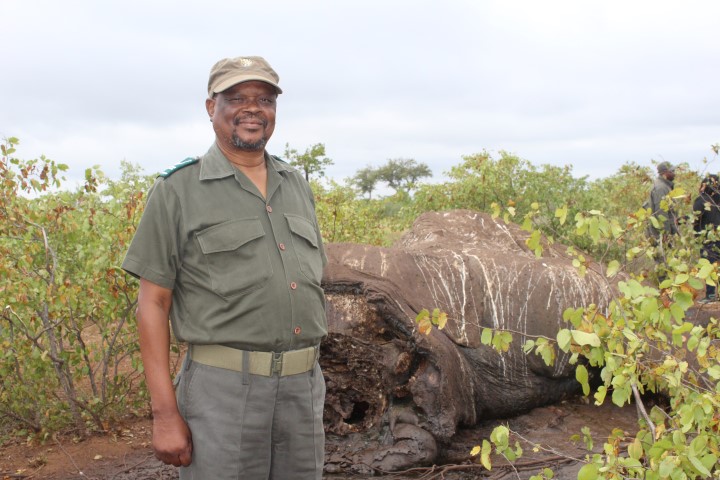
SKUKUZA – Following his illustrious career in conservation spanning 40 years, Albert Machaba, regional ranger in the north of the Nxanatseni Region of the Kruger National Park (KNP), hung up his boots at the end of last year.
Recalling his early days working in the park, Albert said he grew up in Makhado on a farm.
“In that time I used to see people killing animals. I was not happy about that. I used to see people who arrest people who killed animals. I decided that is something worth doing.”
He was given the opportunity to act on this idea at a young age.
Albert joined the former Venda government’s agriculture and forestry department as a junior conservationist in 1975 after graduating from Qwaka Agricultural College in KwaZulu-Natal with a diploma in nature conservation.
During his time as a conservationist, he worked mostly in communities, and his duties included arresting villagers who were involved in subsistence poaching.
This eventually led to his well-established career in anti-poaching with regard to rhinos and elephants; Albert made a name for himself as a fearless and courageous protector of our national heritage.
In 1996 he applied for the advertised position of regional ranger in the park. He got the job, and in 1997 started working at Punda Maria in northern Kruger as regional ranger.
“When I started out at the KNP, I had a lot to learn. They soon made me very clever!” said Albert.
In 1998 he was transferred to Satara in the central part of the park, where he worked until 2005. He then asked to be transferred to the north so that he could be closer to home.
Albert said when he took over the reins as regional ranger for the northern part of the park, he realised that intensive training of the rangers could be the key to the success of anti-poaching teams. He has always had a real interest in the development of human potential.
“I believe in ranger wellness and that a specific programme must be in place to help rangers do their job with honour and integrity. I am proud to say that with help from various organisations we have been able to put sport equipment in place for sports teams and to institute other recreational activities.”
This ranger established soccer and netball teams. After he settled into his position, he also worked with a special focus on the advancement of women.
At that time women could not advance past the position of field ranger. He persisted in his efforts to achieve equality, and became the first regional ranger to appoint women as section rangers.
“I had a passion for the training of female field rangers. I made it possible for them to be trained with men. They managed and passed the training. I also persisted on and fought for the women to be appointed as section rangers. They managed to succeed in the likes of Sandra Visagie of Pafuri section, Tinyiko Golele of Punda Maria section, Agnes Tibane now stationed at Satara section, and Karien Keet who is now manning Phalaborwa section. All these women have been encouraged to join the ranger corps because I fought for this.”
He is proud of their achievements, as they are putting many poachers behind bars.
“The pressure is continuous. You need to be on your toes all the time.”
He is still deeply affected when he is called out to the carcass of an illegally-killed elephant.
“You never get used to it. We need to curb this scourge of poaching by establishing and adapting anti-poaching tactics as we go along. We need to protect the animals so that our children and grandchildren have access to experience wildlife first-hand in nature as it should be.”
Albert’s four children grew up in the park. “We had many highlights together in this sacred place we call the Kruger National Park. It was such a privilege for them. That is also why I am so serious about the guarding of our heritage. The overseas visitors are important to us all, but it is important to protect what we have for South Africans.”
During his retirement he will keep the KNP flag flying high.
“For a conservationist, Kruger is the best place to work. It will always have a special place in my heart.”
His wish is that his position will be filled by a woman. If that happens, it will be the first time that a woman will take up the position of regional ranger.
You could hardly find a more fitting legacy to this champion and pioneer of conservation.