Rhino poaching figures look better but we are still losing three rhinos a day
Is the declining rhino poaching statistics for 2016 a real reversal in the fortunes of South Africa's rhino population?

PRETORIA – The 2016 statistics released by the Minister of Environmental Affairs, Dr Edna Molewa, yesterday indicate a decline in the number of rhino poached, both for the country as a whole and for the Kruger National Park (KNP).
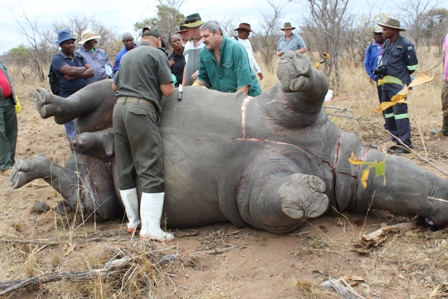
According to the 2016 poaching figures released, over 1 000 or the equivalent of three rhinos a day however continue to be lost to poaching and smuggling syndicates.
A total of 1054 rhino were poached in 2016 compared to 1175 in the same period for 2015, a decline of 10.3 per cent.
In the KNP, a total of 662 rhino carcasses were found in 2016 compared to 826 in 2015. This represent a reduction of 19,85 per cent in 2016.
Ms Andrea Weiss, spokesperson for the World Wide Fund for Nature of South Africa (WWF) said that while it is reassuring to the WWF that the rhino poaching statistics for 2016 show there has been a continued decline in the number of animals that have been illegally killed in South Africa over the last two years, it would be premature to regard this as a reversal in the fortunes for South Africa’s rhino population.
She said the reported reduction of nearly 20% in the number of rhino carcasses found in KNP is applauded by the WWF in the face of the increased number of illegal incursions into the park.
“We note that criminal syndicates have shifted their focus in response to these law enforcement actions, and the impacts of poaching have swept across South Africa,” said Weiss.
She emphasised that whilst the WWF find it is to be commended that the focussed efforts of the SAPS show an increase in arrests, the rate of successful prosecutions still remains to be seen.
Ms Allison Thomson of the anti-poaching lobbying and activist group, Outraged South African Citizens against Poaching (OSCAP), said to Lowvelder that the slight decrease in poaching for 2016 is not significant enough to warrant a fanfare.
“The population size is a 1000 smaller than it was last year and so the percentage of the population that has been poached is what needs to be analysed more carefully.”
Several roleplayers have pointed out that statistics should also be given as a percentage of population to demonstrate the full impact of the situation. This will make it clear that the numbers may have fallen because there are less rhino to poach.
Looking at these figures for the KNP the picture is less rosy.
KNP Sensus statistics for 2015 of rhino numbers in the park are between 8365 to 9337. If the amount poached were 826, 826 as a percentage of 8365 is 9.87 per cent and 826 as a percentage of 9337 is 8.85 per cent.
This means in 2015 an average of 9 per cent of rhinos in the KNP were poached.
KNP sensus statistics for 2016 of rhino numbers are 6649 to 7830 rhinos. If the number poached were 662, 662 as a percentage of 6649 is 9.96 per cent and 662 as a percentage of 7830 is 8.45 per cent.
This again means an average of 9 per cent of rhinos in the KNP were poached.
Thomson also had a few other concerns. “We are not winning this war as the drop in poaching in KNP has just meant that other provinces have become targets. KZN is a prime example of an area experiencing significantly more poaching in 2016,”said Thomson.
Minister Molewa also pointed out that the DEA’s multi-sectoral, interdisciplinary approach involving role players like SAPS, the Hawks and the SANDF delivered “satisfying results.”
Watch members of SAPS being trained to do CSI on a rhino carcass
Lt Col Piet Paxton of the Operational Communication Joint Operational Headquarters of the SANDF said to Lowvelder that even though the SANDF role in the KNP is that of support, the SANDF team added to the success of the KNP anti-poaching team especially since September 2016 when a game plan was introduced which concentrated on intelligence-led operations.
“We have been working smarter and more strategic since September. We are doing these intelligence gathering operations in areas that used to be poacher friendly. By doing this we were able to give more definite information to patrols and we could use more observation and listening posts. We are thus deploying our supporting troops in a far better way,”said Paxton.
William Mabasa, acting head of communications of SANParks, said that the poaching numbers have been levelling out since 2014.
“We have turned a corner and the statistics are showing that our strategies which we are constantly implementing, are bearing fruit,” said Mabasa.