Conditional export of two rhino horns per person if draft regulations get passed
The Department of Environmental Affairs has published draft regulations that could open the door for legally acquired rhino horn to be bought and sold‚ including exporting it from the country.
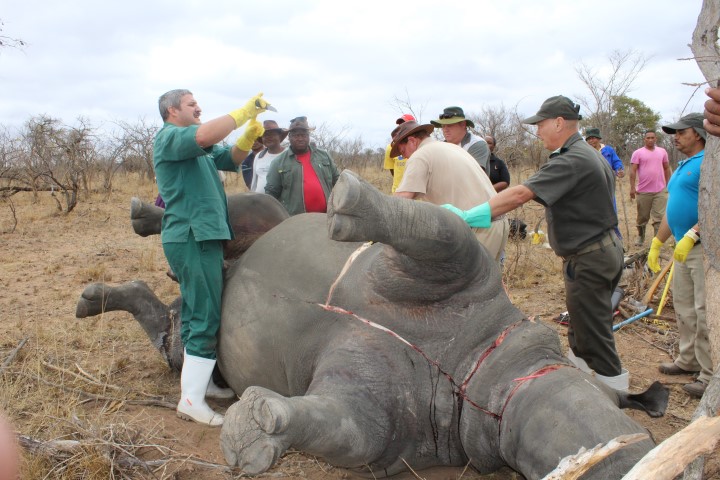
PRETORIA – Despite years of defending their position on the Moratorium of domestic trade and stating in court documents that domestic trade will lead to horn entering into the illegal market, the minister of Environmental Affairs, Mrs Edna Molewa, Wednesday gazetted draft regulations for domestic trade in rhino horn.
This happened after resistance from her department for years and several court cases against applications by local rhino farmers to trade horn on the domestic market.
It also happened despite the fact that 100 CITES nation members voted overwhelming 100 to 26 against an international trade in rhino horn at CoP17 in Johannesburg a mere 4 months ago.
The draft regulations also make provision for the conditional issuance of a permit in respect of the export of rhino horn.

If the legislation gets the go-ahead, it will inter alia allow for the export of horn for personal purposes, limited to two horns per person. Individuals will still need to obtain the necessary permits and the rhino horn will have to be DNA-profiled by a scientific institution. Non-South Africans and residents can conditionally apply for permits.
Ms Allison Thompson from Outraged Citizens Against Poaching called the decision “reckless and irresponsible”.
“We need to remember that the rhino-poaching crisis is a transnational organised-crime issue which flourishes in South Africa thanks to rampant corruption. Trading in rhino horn does not solve the problem, it exacerbates it.
“The fact that the minister is unable to even put out regular poaching stats is testament to their total inability to carry out the simplest of functions, but now they want to enter into trade which could push our rhinos closer to extinction, faster. South Africa is creating the perfect storm for extinction,” Thompson stated.
Mr Dex Kotze from Youth 4 Wild Life Africa and a conservationist who led the Global March for Elephants and Rhinos in Pretoria in 2016, said it is not clear to him how the DEA is going to circumvent CITES regulations.
“The draft document does not prescribe heavier penalties for people convicted of rhino crimes, maintaining an imprisonment period not exceeding five years or a fine not surpassing R5 million, or both. For repeat offenders a fine of R10 million and/or 10 years are prescribed,” he explained.
South Africa recently deported two Chinese nationals who were arrested for being in possession of rhino horn and ivory.
“One can only deduce that political influence and potential corruption caused these foreign criminals to get away scot-free, while unofficial statistics claim that 622 rhinos were killed in the Kruger in 2016. Although 204 lower than 2015, it appears to be an increase if surviving population totals are taken into consideration. Any trade in rhino horn goes against the grain of international opinion and will stimulate loopholes and corruption, which have been rife in the country since the advent of the rhino-poaching crisis,” said Kotze
* No comment was received from the DEA at time of going online.
* Interested parties have 30 days to make representations or to object. Enquiries: Ms Magdel Boshoff at mboshoff@environment.org.za.
See a video about about solving rhino crimes
Read the draft regulations here