The battling nights with African Horse Sickness
As a horse owner living in a remote area, the thought of African horse sickness (AHS) lingers in your mind, but it was never a reality until it unexpectedly struck.
As a journalist for Steelburger/Lydenburg News, I never expected one of my horses would get infected with this deadly illness, but it happened, and now I can share what exactly an owner and horse go through in a fight for the animal’s life.
My sister and I own three horses on a farm outside town.
On the evening of Thursday April 18, our Arabian mare named Karo, did not come home for her evening feed. We walked into the field searching for her. When we found her she seemed lethargic and depressed. Her head and neck were covered with ticks. We contacted a local vet and got medication for biliary (tick bite fever).

That evening two friends, Cathy and Lena de Jager, came by to have a look at Karo. Cathy, also a horse owner, remarked that Karo’s head looked swollen.
We noticed that her eyes also seemed swollen. We sent photos to the vet and the horrible news was confirmed: Karo had Dikkop AHS.
The next morning, Cathy fetched medicine from the vet and the fight to save Karo’s life began. Her neck, head and chest were swollen to almost double the normal size.
She had a blazing temperature, her heart was beating twice the normal rate and her breathing became heavy.
Somehow I ended up on a WhatsApp group for AHS supporters. People across the country reached out to me on the group. I was sent a recipe of mixed herbs to boost her immune system.

On Thursday April 25, I started her on the herb mix. A woman, Wendy Wozny, contacted me about a new immune-boosting product containing the intelligent molecule called transfer factor,” which she had imported from Germany.
It had been used successfully against all sorts of viruses and diseases in the world, but never before against AHS. She had a bottle available and would send it to me. Thursday night, April 25, was the longest night of not only mine, but Karo’s life as well.
She had to get the herb mix every two hours throughout the night with a syringe. Her vitals also had to be taken every two hours, which included breathing, heart rate and temperature.
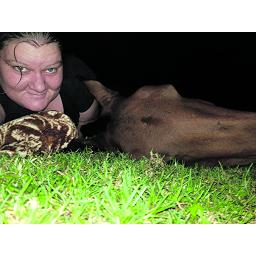
By 01:00, she was exhausted. She collapsed on the grass with her head laying flat on the ground. I sat by her talking to her and caressing her face. I could see that she was tired. After two hours of sleeping on my lap I had to give her the herbs again and for that she needed to get up. I was tugging, pulling and pushing her and ended up talking to her, telling her she needs to get up. She eventually got to her feet and I was able to force the mix down her throat. I spent the whole night lying beside her in the cold next to a river stream until the sun came up.

Supporters on the WhatsApp group, including Wendy, stayed up the whole night with me, asking for vitals, asking how she is doing and making sure I did not fall asleep.
For the duration of April 26 I was with her until I heard the medicine from overseas had arrived at my house.
I left her for a couple of hours to fetch it in town and on my return she was in bad shape. She was stiff, could not walk and her eyes looked bloody. I immediately gave her the recommended dose with her herb mix. Five hours later all her vitals came down and she started to walk around. Two hours later we gave her some more of the transfer factor and her vitals slowly decreased some more.

We still gave her the herb mix daily for the next five days. After 14 days we let her out to be with her fellow horses and she is doing better each day.
Blood has been taken and sent for testing to discover which strain of the virus she had. Karo has recovered completely from the disease and is her old self again.