
Destructive pest threatens Barberton macadamia orchards and 20 000 jobs
A tiny sap-sucking insect first spotted in the Barberton Valley nearly a decade ago is causing severe canopy dieback and mounting financial strain for Lowveld growers.
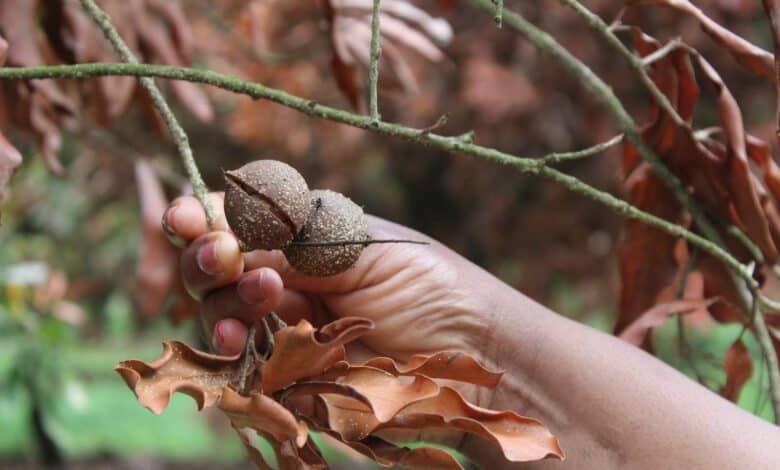
Farmers in the Lowveld fear losing their macadamia trees as they battle a pest known as macadamia felted coccid (MFC), Acanthococcus ironsidei.
The pest was first recorded in the Barberton Valley in April 2017, when severe infestations were observed on about 16 hectares of mature macadamia orchards. Nearly a decade later, the valley remains at the centre of the problem.
The issue was recently escalated by the Barberton Agri Farmers’ Union to the Department of Agriculture after a Vosmac farmer asked for help. The department visited the farm on August 17 to inspect the damage caused to the orchards.
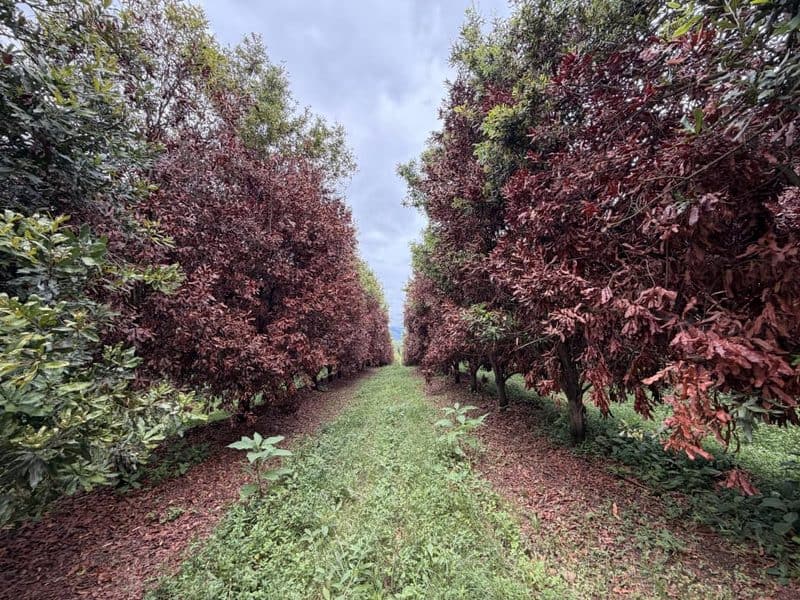
On November 10, Barberton Agri hosted a second visit by the Department of Agriculture, accompanied by stakeholders from Macadamias South Africa (SAMAC), BioSyntrix and Agricultural Innovation for Tropical and Subtropical Africa (AITSA).
The delegation visited Vosmac Farms, Barberton Valley Plantations and Community Farm on Trio Road. The purpose was to give decision-makers a direct view of the damage in commercial orchards and to establish the impact of MFC on growers, farm businesses and the industry.
Severe orchard damage
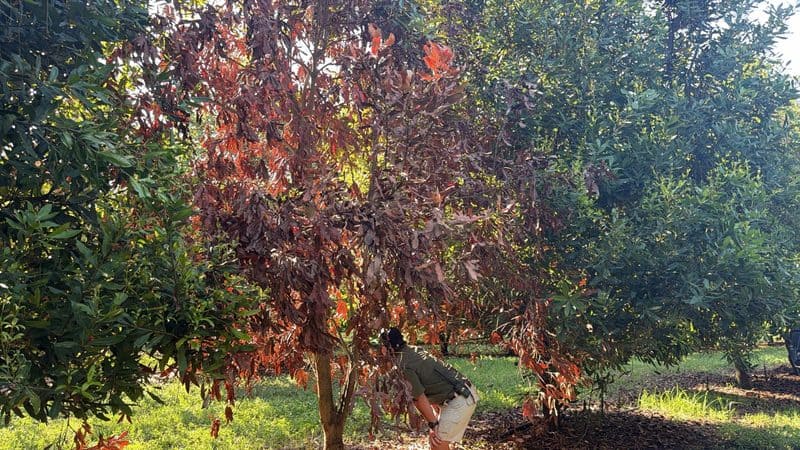
According to AITSA, the pattern across the farms was consistent with heavy scale encrustations on main branches, stems and twigs, and leaf necrosis in the inner canopy areas. In some severe cases, dieback affected more than 80% of the canopy on the orchards.
ALSO READ: Kruger National Park uses drones and AI for wildlife survey
One particularly concerning observation that stood out during the visit was the severe infestation on the somewhat more hardy Beaumont cultivar.
“Because MFC was introduced without its natural enemies, populations were able to increase rapidly. Infested trees experience considerable physiological stress and may be affected by secondary problems such as Botryosphaeria dieback and bark and ambrosia beetles. This can create a downward spiral in tree health and productivity,” AITSA explained.
While other trees may recover over time, in the most severe cases, trees may not recover and have to be staghorned, which removes production for up to eight years, putting an enormous financial strain on farmers.
Economic and job impact
AITSA outlined loss of production costs of between R85 000 and R110 000 per hectare, while prices have dropped to about US$2.20 (around R38.75) per kilogram.
“On that basis, a grower would need about 2.4 tonnes per hectare to break even at the lower production-cost level, and about 3 tonnes per hectare at the higher level.”
Macadamias are among the Lowveld’s more labour-intensive crops. When orchards stop producing, farm workers’ livelihoods are at risk.
An AITSA model reflected an estimated 32 500 hectares of macadamias in the province (about 40% of South Africa’s roughly 81 302 hectares in 2024). Applied to Mpumalanga and in conjunction with SAMAC employment data from 2019, the model estimates that the industry supports around 20 000 jobs, including about 9 200 permanent farm workers, 8 100 seasonal workers, 2 300 factory workers and 360 nursery workers.
Search for solutions
After the farm visits, the Department of Agriculture convened a stakeholder meeting to discuss an action plan and possible solutions, focusing on three immediate priorities: subsidies or support for production inputs, relief measures to help affected farms remain operational while control is re-established, and access to effective chemical and biological control agents.
ALSO READ: Kruger National Park tests digital indemnity form at Crocodile Bridge Gate
“A newly identified and patented MFC pheromone is being prepared for regulatory submission. It may improve monitoring and spray timing. Until then, post-spray scouting remains essential to determine whether a follow-up application is needed and when it should take place,” AITSA said.
“Barberton Agri remains committed to representing local growers, ensuring that the realities on our farms are heard, and working constructively with government and industry stakeholders,” said union chairperson Org Lindeque.
The department’s comment on possible solutions had not been received by the time of going to press.