
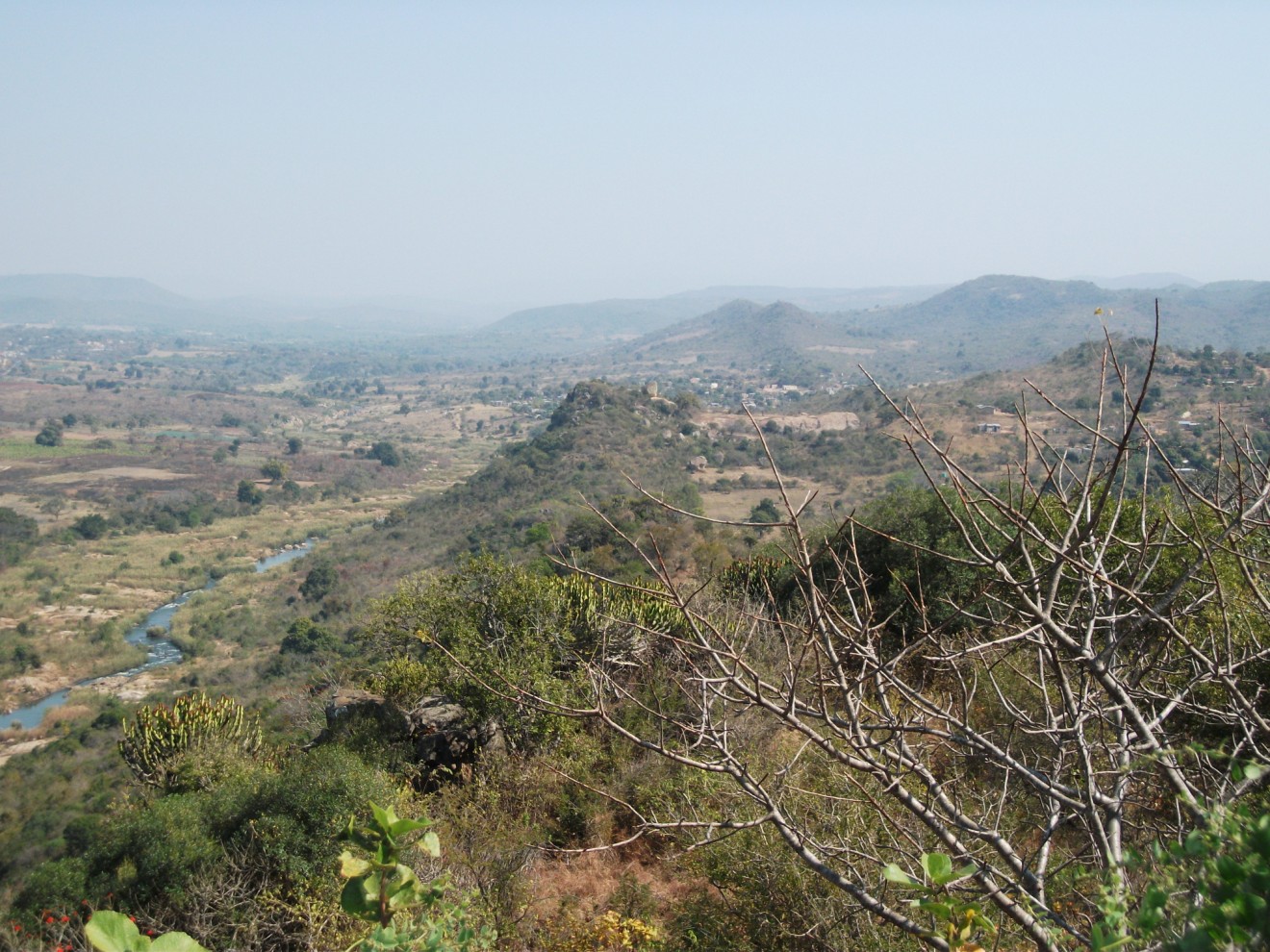
Our Koppies and mountain ridges are islands of biodiversity in a sea of man made landscapes. Being unworkable and inaccesable they have little value for our modern culture and economy.
They cannot be used for farming, forestry or any other profitable business. They are also unsuitable for residential development. Even people in the tourism business are hesitant to invade this terrain.
Ironically, these leftover pieces of civillization are botanically very rich, compared to the species poor lands surrounding them. Our koppies contain most of our busveld trees species, and even a few forest ones, making them little botanical gardens.
One reason could be that the rocky terrain create so much variation in terms of drainage and moisture content, two important growing factors for plants.
Another explanation could be that rocky terrain provide some degree of protection against fires. Regular hot fires, started by humans reduce plant diversity.
Apart from the beautiful paperbark thorn, most of our bushveld trees can be found somewhere on a koppie. The whole range is there, from the decidious kiaat, silver cluster- leaf and marula of the dry, well drained soils to the more evergreen trees of the lowlands.
From a distance the diversity is obvious in a variety of colours. In the dry season evergreen trees like jackal berry, Natal mahogany and red ivory stand out among the grey.
There are also some trees which prefer to grow on koppies and mountains. The attractive lowveld chestnut is dominant on our koppies, and almost absent on the flat lands.
It is endemic to our area, found only here and nowhere else! The nutritious fruit tastes like macadamia nuts and its dispersal probably depends on animals like monkeys, baboons, porcupines and squirrels.
The paperbark thorn, although common in our area is rare on koppies It is a pioneer species and therefor common on farmland. Koppies and mountains also have the aspect factor, which is about the position of the sun.
A northern or western slope is hot and dry and harbours the hardy decidious bushveld species, while a southern or eastern slope is cooler and moister and may harbour some forest species.
Another fascinating part of our granite koppies is the rock specialists, plants that are so specialised that they can only grow on rocks. These include rock figs, certain aloes, euphorbias, bobbejaanstert (black-stick lily) and even an orchid species which only grow on the barren rock (on a thin layer of soil).
The ecology of seed dispersal is a poorly researched but interesting topic. Despite its specialised growing method with amazing roots, the rock fig still depends on a bird for dispersal, because only a bird or small aimal can plant a seed on top of a rock! So our koppies are more than botanical gardens, they are very old and complex ecosystems.



