
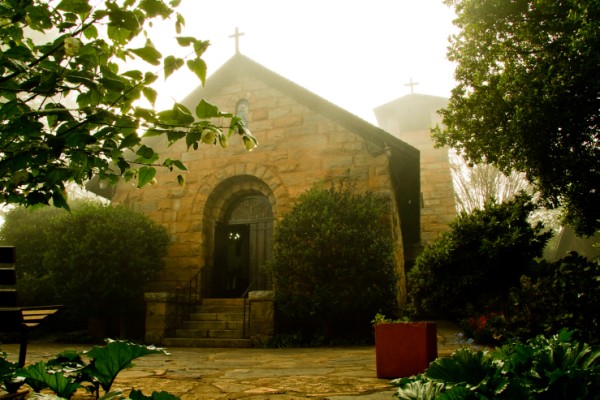
Sir Herbert Baker was an extremely busy man in his time. The architect of a large number of South Africa’s most iconic buildings, most notably the Union Buildings in Pretoria, he also designed a few Anglican churches of surprising modesty, but equal charm. St Peter’s was one of them.
“One can always recognise his buildings,” says Lawrence Burton, current rector of the parish. “They’re always made from sandstone and designed in the shape of a cross.”
The history of the church is somewhat vague, but seems to date to the late 1800s, when one of the few Anglican priests in the Transvaal, Reverend A Roberts, used to hold services every three or four months on the veranda of Huntingdon Hall, residence of the historic Glynn family, owners of Glynn’s Lydenburg Ltd, the largest goldmine in the district. By the early 1900s, the need for a permanent structure had been under discussion for some time.
After a visit by a Bishop Furze, the Glynn family donated a piece of land and funds were raised through dances, plays and tennis parties. Maurice Ponsonby, rector of Sabie and Pilgrim’s Rest in 1912, approached Baker to draw up plans for the church. Once these were available, tenders for construction were called in.
In the end, a group of unemployed Italian stonemasons built it. Originally brought in to construct a railway bridge over the Sabie River with stone quarried from the surrounding mountains, the stone was found unsuitable for its original purpose. The masons were temporarily out of work while they waited for suitable stone to be delivered.
The leader of the group, a Mr Gemignani, quoted £400 plus 20 bags of cement for building the walls and £145 for the carpentry work. The architect’s fee, you’ll be interested to know, came in at £22.10.0 for the church, £3.3.0 for designing the pews, plus six shillings for disbursements. Electricity was installed in January 1914 for the sum of £12. Virtually everything else (furniture, carpets, the altar, bell and sanctuary lamp) were gifted to the church. The overall cost came to £1 024.
Work started early in 1913 and by March the foundation stone was laid. On June 29, 1913, the church was dedicated by Furze. A confirmation service was held, at which two of the 10 confirmands were daughters of the Glynns. The church’s centenary will be formally celebrated on June 30 this year.
Impossibly small by today’s standards, being able to accommodate only about 80 people at a stretch, Lawrence gently points out historical photographs displayed at the entrance – at the time, there was no town. The church sat up serenely alone on a hill, unencumbered by surrounding buildings. With its beautiful stone walls and shingle roof, it was a landmark at the time and congregants came from far and wide to attend services.
Back to today. During the centenary celebrations, a new rector will be ordained at the church, although Lawrence will remain on as assistant priest. Chris Luyt is the new man – young, soft-spoken, enthusiastic. Previously in Nelspruit, he is visibly excited at the prospect of putting down roots at the church. “I’m a romantic at heart,” he laughs. “I love the beautiful gardens, the symbolism…” He points out the two magnificent 80-year-old jacaranda trees. “I’m in my element.”
Sir Herbert Baker was an extremely busy man in his time. The architect of a large number of South Africa’s most iconic buildings, most notably the Union Buildings in Pretoria, he also designed a few Anglican churches of surprising modesty, but equal charm. St Peter’s was one of them.
“One can always recognise his buildings,” says Lawrence Burton, current rector of the parish. “They’re always made from sandstone and designed in the shape of a cross.”
The history of the church is somewhat vague, but seems to date to the late 1800s, when one of the few Anglican priests in the Transvaal, Reverend A Roberts, used to hold services every three or four months on the veranda of Huntingdon Hall, residence of the historic Glynn family, owners of Glynn’s Lydenburg Ltd, the largest goldmine in the district. By the early 1900s, the need for a permanent structure had been under discussion for some time.
After a visit by a Bishop Furze, the Glynn family donated a piece of land and funds were raised through dances, plays and tennis parties. Maurice Ponsonby, rector of Sabie and Pilgrim’s Rest in 1912, approached Baker to draw up plans for the church. Once these were available, tenders for construction were called in.
In the end, a group of unemployed Italian stonemasons built it. Originally brought in to construct a railway bridge over the Sabie River with stone quarried from the surrounding mountains, the stone was found unsuitable for its original purpose. The masons were temporarily out of work while they waited for suitable stone to be delivered.
The leader of the group, a Mr Gemignani, quoted £400 plus 20 bags of cement for building the walls and £145 for the carpentry work. The architect’s fee, you’ll be interested to know, came in at £22.10.0 for the church, £3.3.0 for designing the pews, plus six shillings for disbursements. Electricity was installed in January 1914 for the sum of £12. Virtually everything else (furniture, carpets, the altar, bell and sanctuary lamp) were gifted to the church. The overall cost came to £1 024.
Work started early in 1913 and by March the foundation stone was laid. On June 29, 1913, the church was dedicated by Furze. A confirmation service was held, at which two of the 10 confirmands were daughters of the Glynns. The church’s centenary will be formally celebrated on June 30 this year.
Impossibly small by today’s standards, being able to accommodate only about 80 people at a stretch, Lawrence gently points out historical photographs displayed at the entrance – at the time, there was no town. The church sat up serenely alone on a hill, unencumbered by surrounding buildings. With its beautiful stone walls and shingle roof, it was a landmark at the time and congregants came from far and wide to attend services.
Back to today. During the centenary celebrations, a new rector will be ordained at the church, although Lawrence will remain on as assistant priest. Chris Luyt is the new man – young, soft-spoken, enthusiastic. Previously in Nelspruit, he is visibly excited at the prospect of putting down roots at the church. “I’m a romantic at heart,” he laughs. “I love the beautiful gardens, the symbolism…” He points out the two magnificent 80-year-old jacaranda trees. “I’m in my element.”
One certainly gets a very strong sense of tradition, of serenity and peace at St Peter’s. It’s a quiet place and involuntarily forces one to breathe slower, to contemplate deeper
The congregation is described as “mixed and active” and they cautiously defend the relevance of a traditional church in modern society. “It has great potential to satisfy the spiritual need in people; to bring out love and passion,” they agree. The message is ultimately to worship a higher power rather than earthly trappings.
A piece of literature confirms this belief, “As you look at the church and itdecorations, see them not as a monument to a human architect, but rather as an act of worship, to the one true God, the architect of all the people of this place. Sit down in one of the pews, and let the love of God surround you.”
One certainly gets a very strong sense of tradition, of serenity and peace at
St Peter’s. It’s a quiet place and involuntarily forces one to breathe slower, to contemplate deeper.
In a month’s time, Lawrence will retire. He loves Sabie and will “never, ever” be able to live in a big city again, he says. “We were married in 1969 and came to the Eastern Transvaal on our honeymoon. We were coming down the hill from Graskop and I said ‘that’s where I would want to retire one day’. He smiles. “The Lord works in mysterious ways.”
Go and visit
The church is open to the public virtually every day of the week from 07:00 to 17:00. Visitors are encouraged to sit in quiet contemplation in either the church or gardens, and to light a candle in dedication to or memory of a loved one.
Services
Morning prayers (one hour): 08:00 Mondays, Tuesdays, Thursdays and Fridays
Eucharist: 09:30 on Wednesdays and 08:30 on Sundays
Interesting facts
• St Peter’s is the second oldest congregation as well as the second oldest church building in the parish. The oldest church is St Mary’s at Pilgrim’s Rest, which was built in 1884.
• The four candelabra were donated in 1964.
• The church’s original windows were replaced with stained glass in 1982.
• Original kneelers were embroidered by the Anglican Women’s Fellowship in the early ‘80s, but another 27, depicting local scenes and landscapes, were added in 1998.
• Both the building and pews were designed by Baker. They were manufactured, together with the altar, in the Glynns’ carpentry shop.
• Subject to a few requirements, any couple may be married in the church and may bring their own pastor or priest to officiate.
Get in touch
Contact the church on chrisluyt@metroweb.co.za, 072-124-7016 or 013-764-1379. You can also find them on Facebook: St Peter’s Church Sabie



