Although the Kruger is a destination most famous for the Big Five, a total of 147 mammal species reside within the two million hectare wilderness. Of the 147 mammal species, some species are nocturnal or very elusive, making them extremely rare to see on safari. We have listed some of the most sought after species and the best places to see them in the Kruger.
White Lions
Studies have shown that white lions are not albino’s but rather have a recessive gene that gives them those gorgeous blue eyes and pure white coats.
White lions are listed by the conservation authority of South Africa as “pathero leo”, which means that they are considered to be the same species as tawny lions and are therefore classified as a “vulnerable” species. Sadly, the conservation authority of South Africa plans to down-list the conservation status of lions to “least concern”, even though there are only 11 white lions left in the wild
The best places to still see white lions in the wild is the Timbavati region which forms part of the greater Kruger.
Honey Badgers
Honey Badgers are about 25 centimeters high at their shoulders and weigh approximately 12 kilograms. They have a thick grey coat, small ears, short legs, and huge claws which are used to dig underground burrows. Much like their name, honey badgers love honey and will climb if needed to get to it. Honey badgers have great stamina and usually jog when pursuing their food, in the hope that their prey tires out. They have a powerful bite and loose skin which allows them to worm their way out of any animal’s grasp.
Honey badgers are often seen around the Orpen, Satara and Tamboti rest camps of the Kruger.
Bat-eared Fox
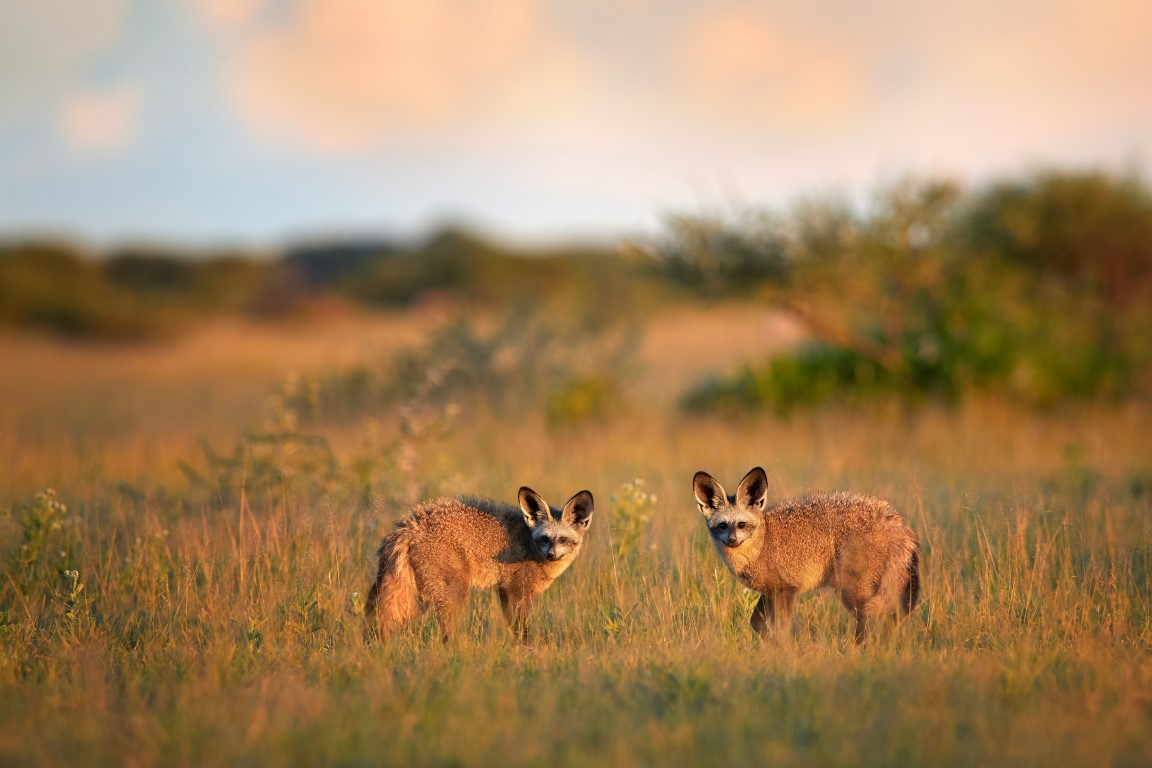
The Bat-eared Fox is 30 centimeters tall at the shoulder and weighs less than 5 kilograms. Its facial appearance resembles that of a bat and have silver-grey coats and bushy tails. Their front paws are great for digging burrows. Much Like the aardwolf, the Bat-eared Fox loves termites but also eats insects, wild fruit, lizards, and small rodents & snakes.
Bat-eared foxes are fond of arid and semi-arid areas and have been frequently seen around the Satara area of the Kruger.
Side-striped Jackal
The Side-striped jackal is a relatively hard animal to find because they are generally less active than their cousin – the Black Backed Jackal who also reside in the Kruger. Side-striped jackals are nocturnal carnivores that are 40 to 50 centimeters at the shoulder and weigh between 7 and 12 kilograms. Side-striped jackals is larger than the black-backed Jackal but have greyish colored bodies with a darker back and a white stripe along their sides.
Side-striped jackals are generally found along the Phabeni road, around Olifants Rest Camp, around Nsemani Dam, and the Sable Dam Loop.
Roan Antelope
Roan are the second largest antelope in Africa, with a mostly fawn colored coat and dark brown to black legs. They have distinctive black and white facial markings, long pointed ears, and ringed horns. The bulls weigh approximately 270 kilograms and measures 1.4 meters at the shoulder. The cows are smaller and weigh between 170 kilograms and 210 kilograms.
Although roan antelope are more elusive in the Kruger, they can usually be found around the Mopani Rest Camp and Babalala area.