
Global oil markets are entering a "new normal" of recurring price shocks
More pain at the pumps for motorists. Picture: iStock


South African motorists face a brutal October as petrol and diesel prices threaten to smash records despite a recent dip in global oil.
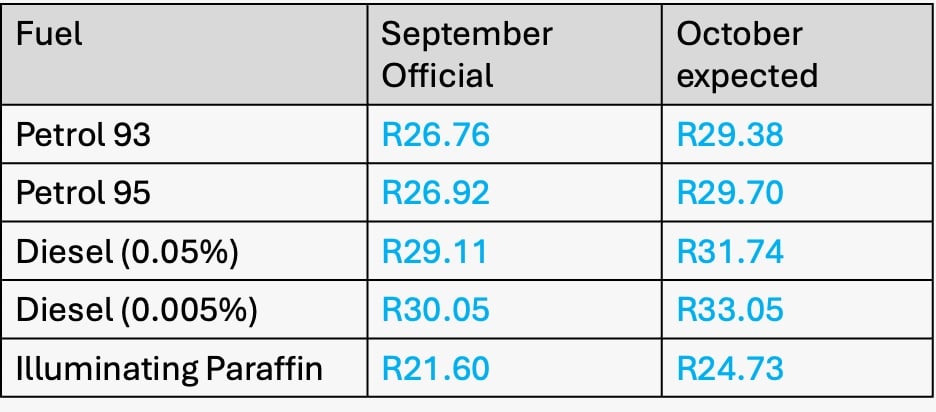
Latest figures from the Central Energy Fund (CEF) show 95 unleaded petrol could surge by nearly R2.80 a litre, pushing pump prices to around R29, eclipsing the June peak of R28.06.
Diesel is set for an even harsher blow, with hikes of almost R3 likely to drive wholesale prices beyond R33 a litre, well above the May record of R31.88.
Latest figures
With the latest CEF figures showing recoveries deep in the red, motorists have no sign of relief.
Petrol is already under‑recovering by R2.62 (93 octane) and R2.78 (95 octane) per litre. Diesel is worse, with deficits of R2.63 (0.05% sulphur) and R3.00 PER litre (0.005% sulphur).
If current conditions hold, petrol could rocket to R29.70 per litre, eclipsing the June 2026 record of R28.06 set during the Iran War shock.
Diesel is heading for its own disaster. With wholesale prices at R30.05 per litre, October could push levels to R33.05 per litre – smashing the May 2026 peak of R31.88.
Forecast
If these projections hold, motorists could pay the following in October 2026:
- Petrol 93: increase of R2.62 per litre
- Petrol 95: increase of R2.78 per litre
- Diesel 0.05% (wholesale): increase of R2.63 per litre
- Diesel 0.005% (wholesale): increase of R3.00 per litre
- Illuminating paraffin: increase of R3.13 per litre
Global conflict
Global conflict remains the fuel behind this crisis. Russia’s war in Ukraine has intensified, with drone strikes on energy infrastructure disrupting exports.
Analysts warn restrictions on Russian diesel shipments could tighten supply further, driving costs higher worldwide.
The ripple effects are clear: higher transport costs, squeezed disposable incomes, and mounting inflationary pressure.
Warning
Economists caution that households and businesses alike will feel the strain, with rising interest rates compounding the pain.
South Africa’s economy, already under pressure, now faces another wave of fuel‑driven inflation. For motorists, October could mark the most punishing month yet at the pumps.
Global oil markets are entering a “new normal” of recurring price shocks, with Brent crude expected to fluctuate between $65 and $95 per barrel.
Economists warn this volatility will weigh on growth, inflation, and household budgets, particularly in South Africa, where GDP is forecast at just 1.2%. Rising fuel costs, climate shocks, and inequality are intensifying pressure, but adaptation – from hybrid vehicles to rail transport – may open new opportunities as nations adjust to sustained energy uncertainty.