The AG has recommended consequence management after finding recurring media services were procured through separate quotation processes.
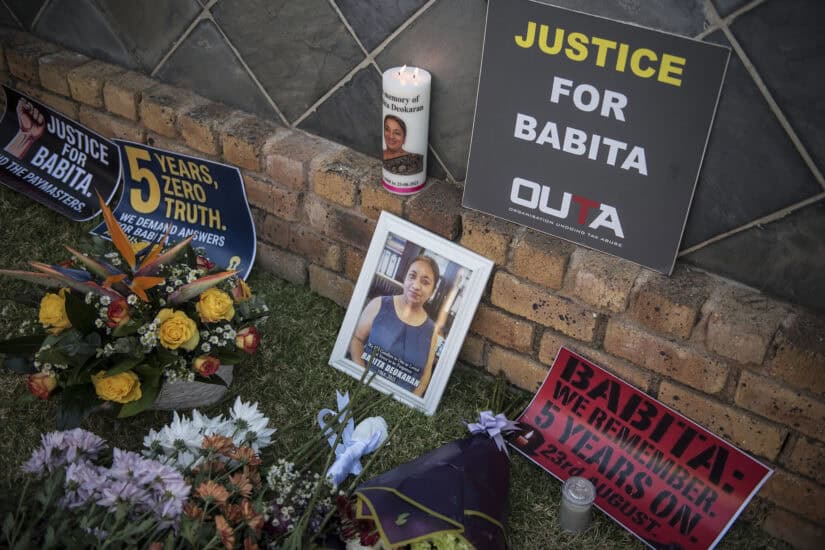
Activists demonstrate and remember Tembisa Hospital corruption whistleblower Babita Deokaran, 23 August 2026, in Mondeor, Johannesburg, on the fifth anniversary of her murder outside her home. Picture: Michel Bega/The Citizen


The auditor-general (AG) has raised questions about how the department of transport procured millions of rands in livestreaming and media services – with seven contracts each kept below the R1 million threshold that triggers an open competitive bidding process.
This is one of the tricks allegedly used in the looting of more than R2.043 billion from the Gauteng’s Tembisa Hospital uncovered by the graft-busting Special Investigating Unit (SIU) and led to the assassination of provincial health department acting financial officer and whistle-blower Babita Deokaran in 2023.
SIU previously flagged bid splitting
In its 2021 probe into Covid procurement, the SIU identified the “splitting of bids to meet the quotation and/or delegation threshold” as one of the procurement irregularities in state entities.
It also identified the use of front companies to obtain multiple contracts and cover quoting.
According to Treasury’s instruction number two of 2021-22, procurements above R1 million, inclusive of value-added tax, must go through an open competitive bidding process and “may not be deliberately split” into smaller parts to circumvent the procurement process.
However, the AG has found the transport department had procured livestreaming and related media services via seven separate requests for quotations (RFQs), with winning bids ranging from R830 000 to R997 050 and collectively worth R6.795 million.
The individual transactions may have remained below the R1 million threshold, but the AG has questioned whether they should have been treated as separate procurements in the first place.
Audit raises concerns over procurement planning
According to the AG, the department’s own 2025-26 procurement plan estimated broader media-related requirements at R9.34 million, which indicated the department knew, or should have known, the requirement was substantial enough to require consolidation and competitive procurement.
The audit also found expenditure to the identified suppliers of R5.964 million during 2025-26 and R7.311 million in the preceding financial year, putting the expenditure involving three suppliers at R13.275 million over two financial years.
The AG found the recurring nature of the services further supported its conclusion the requirements should have been consolidated for procurement planning purposes.
“The splitting of the requirements into separate RFQ’s resulted in the department avoiding the open competitive bidding process applicable to procurement above R1 million,” the audit states.
Auditor-general recommends consequence management
It classified the expenditure as irregular and recommended the department determine the full extent of irregular expenditure in the current and previous years.
It also recommended recurring livestreaming services no longer be procured via separate RFQs and the department consolidate its annual requirement and use an open competitive bidding process where the estimated value exceeds R1 million.
The AG recommended consequence management be considered for officials who permitted the splitting of procurement.
The audit findings form part of an update on the protected disclosure to Songezo Zibi, chair of the standing committee on public accounts, dated 19 August.
The department has rejected the suggestion the transactions were deliberately split to avoid competitive tendering.
Officials told the AG the RFQs related to separate events and campaigns, each with different scopes, deliverables, timing and technical requirements.
Department rejects procurement splitting claims
The department said the combined value of separate RFQs did not, on their own, establish deliberate procurement splitting and the requirements were not known upfront as one consolidated procurement, and the broader media procurement was removed from its procurement plan as requirements were evolving.
The AG also found the department could not demonstrate it had first assessed if its own communication unit had the capacity, skills and resources to provide livestreaming services internally.
Valerie Carelse, committee secretary, did not confirm receipt of the updated disclosure with the audit finding, only “the chair indicated he would respond after consultation with a legal advisor”.
Adam Masombuka, the department’s acting director-general for corporate affairs, said he was aware of the correspondence, which was also sent to Transport Minister Barbara Creecy.