Approximately 14.9 million South Africans had participated in the elections.
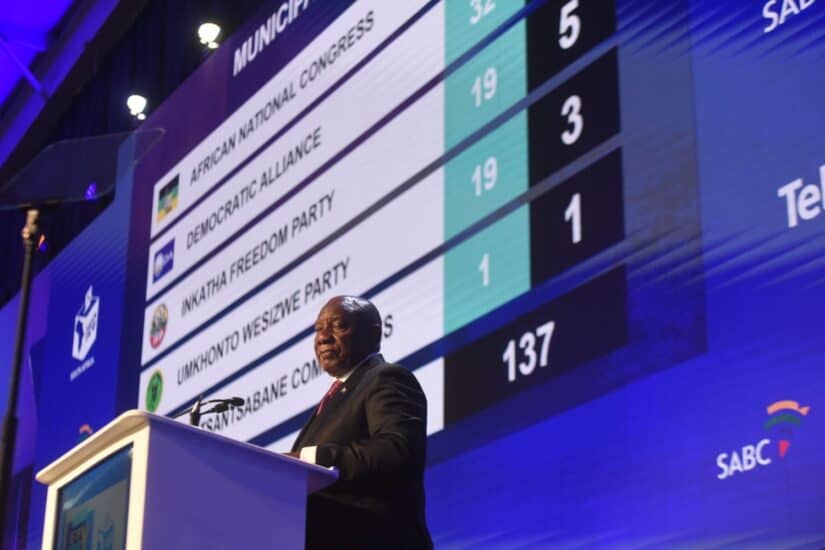
President Cyril Ramaphosa speaks at the Gallagher Convention Centre in Midrand on 8 November 2026. Picture: Nigel Sibanda / The Citizen


Despite a significant decline, the African National Congress (ANC) emerged as the leading political party in 2026 local government elections, securing 30% of the vote.
The results were announced by the Electoral Commission of South Africa (IEC) at the Gallagher Convention Centre in Midrand, Gauteng, on Sunday, 8 November 2026.
ANC tops 2026 local government election results
According to the results announced by EC chairperson Mosotho Moepya, the ANC secured 3 246 council seats, representing 30.76% of the total vote.
The Democratic Alliance (DA) came in second with 24.64%, securing 1 695 council seats, followed by the uMkhonto weSizwe (MK) party, which received 9.76% and obtained 785 seats.
The Economic Freedom Fighters (EFF) secured 6.22% of the vote, translating into 588 council seats, while ActionSA obtained 5.67% and 313 seats.
Other political parties collectively accounted for 22.97% of the vote.
In terms of municipal control, the ANC secured outright majorities in 53 municipalities and emerged as the leading party in 128 municipalities.
The DA obtained outright control in 12 municipalities and emerged as the leading party in 32 municipalities.
The Inkatha Freedom Party (IFP) secured five municipalities outright and emerged as the leading party in 19, while the MK Party obtained outright control in three municipalities and emerged as the leading party in 19.
Rise Tsantsabane Communities (RTC) also secured outright control in one municipality.
Moepya confirmed that 74 of the 213 councils had outright majorities, leaving the remaining councils without a single party holding an outright majority.
Nearly 15 million South Africans participate in elections
The IEC chairperson revealed that approximately 14.9 million South Africans had participated in the elections out of 29.2 million registered voters, placing national voter turnout at 52%.
A total of 520 political parties and 626 independent candidates contested the elections, competing for 10 526 council seats.
These included 4 485 ward seats, 4 340 Proportional Representation (PR) seats and 707 district seats.
“An additional 994 district council seats representing the remaining 60% component of district council representation will be filled through the nomination of councillors by local municipalities in accordance with the legislative framework,” Moepya said on Sunday.
However, the electoral process was not without challenges.
In Douglas, Northern Cape, ballot papers were destroyed by activists of a political party before they could be counted.
Moepya confirmed that the affected results would be subjected to a re-vote.
“The commission will do so with speed.”
Ramaphosa’s warning to parties
With coalition negotiations expected to shape the administration of several municipalities, President Cyril Ramaphosa called on political parties to put the interests of residents first.
Addressing the gathering, Ramaphosa acknowledged that the elections had taken place against a difficult socioeconomic backdrop and continued shortcomings in municipal service delivery.
“Through these elections, our people have made their political choices, freely and they will hold those that they elected to account,” the president told those in attendance.
He congratulated the newly elected councillors, reminding them that their responsibilities extended beyond securing positions in municipal councils.
According to the president, elected representatives must prioritise the needs of residents rather than personal ambitions or political interests.
“Public office is a privilege that carries a responsibility of service. The election is now over, the work of serving the people of our country must now begin.”
Ramaphosa also addressed the growing likelihood of coalition governments, arguing that hung councils should not be interpreted as a failure of the democratic process.
He urged political parties to approach coalition negotiations with a commitment to cooperation and the public good, warning that talks should not become power struggles centred on political positions, privileges and the distribution of authority.
“People did not cast their vote so that their representatives could spend the next five years fighting amongst themselves.
“They voted because they expect their lives to improve.”
He further called for the swift establishment of municipal councils, warning against delays that could undermine governance and service delivery.
“Parties must negotiate in good faith to elect office-bearers so that councils can get to work. Budgets must be passed on time.”
IEC acknowledges operational successes and shortcomings
Meanwhile, IEC Chief Electoral Officer (CEO) Sy Mamabolo used the results announcement to reflect on the commission’s performance, describing the conclusion of the elections as an opportunity to account.
“Not only for the voting process, but also for the operational capacity, technological infrastructure, human resource capacity, [and] institutional systems that made these elections possible,” he said on Sunday.
Mamabolo described the organisation of an election of this scale as one of the most complex undertakings by a public institution.
He highlighted several operational developments introduced for the 2026 elections, including the establishment of a virtual results operations centre.
The CEO also pointed to the role of voting management devices (VMDs) in facilitating voting station operations, with approximately 188 000 personnel recruited to support the electoral process.
To strengthen the commission’s technological capacity, an additional 16 000 VMDs were deployed, including 8 000 supplied by the Gauteng provincial government.
“With these additional devices, the commission’s total VMD deployment increased to 56 000 devices, comprising the 40 000 procured in 2021 and the additional 16 000 deployed for these elections.”
Ballot papers
Mamabolo further disclosed that the IEC had printed more than 100 million ballot papers for the elections.
“This was an undertaking of considerable scale, requiring detailed planning, coordination of production processes, quality assurance and distribution arrangements across the country.”
The printing process was complicated by a Constitutional Court (ConCourt) order in the ANC case, which affected 28 million ballot papers.
Mamabolo said the ruling created significant operational demands for the commission, which had to make adjustments without disrupting the established election timetable.
“This placed considerable demands on our logistical and administrative systems.
“Nevertheless, the exercise illustrated the importance of operational agility in election management.”