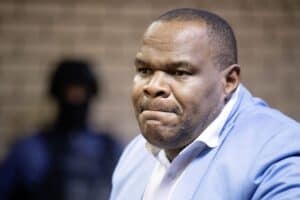
Matlala has repeatedly relied on his constitutional right against self-incrimination when confronted with certain issues.
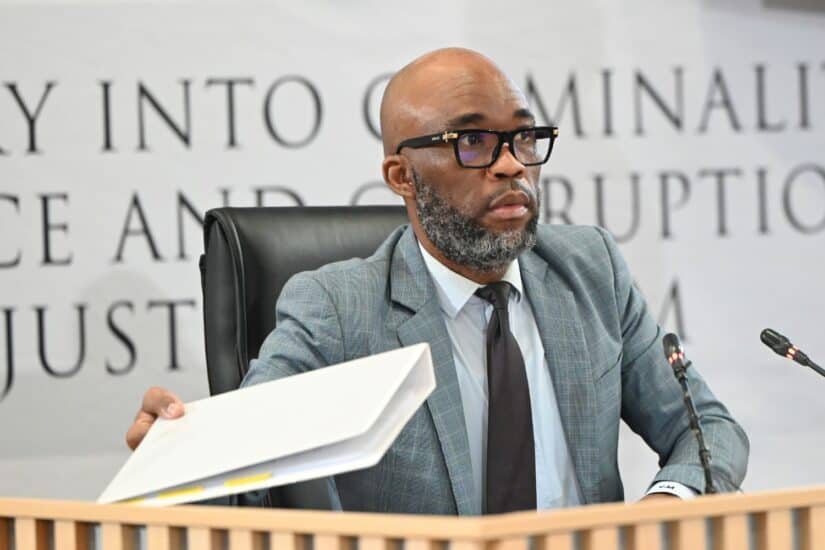
Vusimuzi ‘Cat’ Matlala appears before Madlanga commission at Brigette Mabandla Judicial College in Pretoria on 25 August 2026. Picture: Gallo Images/Frennie Shivambu


Tenderpreneur Vusimuzi “Cat” Matlala’s attempts to avoid answering questions about two contentious police recordings have come under renewed scrutiny at the Madlanga commission, with the National Prosecuting Authority (NPA) indicating that the recordings are not being used to prosecute him.
Matlala returned to the witness box at the Bridgette Mabandla Justice College in Pretoria on Tuesday, 25 August 2026, where he was questioned about the recordings, which contain a number of allegations and admissions involving his alleged dealings with senior police officials and other prominent figures.
The first recording relates to a police raid at Matlala’s home on 6 December 2024, conducted as part of the investigation into the disappearance of businessman Jerry Boshoga.
The second was made after his arrest on 14 May 2025 in connection with the attempted murder of his former girlfriend, Tebogo Thobejane.
Cat Matlala audio recordings
A portion of the May 2025 recording was previously played at the commission by Witness C.
In it, Matlala discussed his alleged relationships with Crime Intelligence official Feroz Khan and suspended Deputy National Police Commissioner Shadrack Sibiya.
He also claimed that he had contributed R500 000 to Police Minister Senzo Mchunu’s ANC presidential campaign and the party’s January 8th celebrations in Cape Town.
Matlala has disputed the recordings and, during his testimony, has repeatedly relied on his constitutional right against self-incrimination when confronted with certain issues.
This has included questions surrounding the R360 million Medicare24 health services tender.
He had also previously indicated that the matters raised in the recordings were under investigation.
NDPP’s position
However, Sello told Matlala on Tuesday that the NPA had provided assurances regarding the recordings and that he was not facing prosecution based on their contents.
“My understanding is that you were given an assurance by the NPA that you are not being investigated or that such recordings are not being utilised for purposes of investigating you, thus rendering you not a suspect as you feared.
“Are you aware of the assurances provided to you by the NPA in that regard?” Sello asked Matlala.
Matlala’s attorney, Annelene van den Heever, immediately questioned the basis for the assertion.
“Does it also include the unlawful recording that was made when he was approached in prison behind the back of his attorneys at that point in time?” Van den Heever asked.
Sello then referred to correspondence from National Director of Public Prosecutions (NDPP) Andy Mothibi dated 6 March 2026.
The letter, which dealt with Matlala’s attempted murder case, indicated that the state did not have a transcript of the recording, while noting that Matlala appeared to be seeking access to the audio recording.
Mothibi further stated that portions of the recordings previously played at the commission were already available on social media.
“It is once more reiterated that nothing in the whole interview forms part of any of the police dockets currently before court, simply because it is not relevant and, therefore, does not form part of the evidential material against your client in the matter currently before court.
“It is finally recorded that the portion not made publicly available at the commission contains sensitive information relating to an ongoing investigation and the defence is, therefore, not entitled to this information,” the letter reads.
Madlanga commission rejects broad approach
The reference to an “ongoing investigation” prompted Madlanga to seek further clarification.
But Sello explained that the NPA correspondence did not establish that Matlala was the subject of that probe.
“It doesn’t identify what investigation. It doesn’t suggest the investigation is against Mr Matlala. It could very well be investigations pertaining to other issues where he is not a suspect.
“I submit that it is not a basis simply because ‘Saps is investigating’ to then seek to invoke or assert the right not to incriminate himself,” the evidence leader said.
Madlanga expressed concern that Sello’s questioning was too “broad and general”.
The chairperson compared the approach to Matlala’s conduct on Monday, when he sought to rely broadly on his constitutional protection rather than answering specific questions.
Madlanga asked Sello to narrow her questioning and deal with particular aspects of the recordings.
Sello maintained that she had referred to Mothibi’s letter only to address Matlala’s concerns about whether the recordings could expose him to further investigation.
The chairperson nevertheless directed that Matlala could not rely on the reference to an unspecified investigation to avoid answering questions about the recordings.