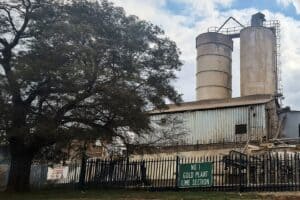
Illegal mining, extensive tunnelling, erosion and vandalism have compromised infrastructure beneath the M2 highway.
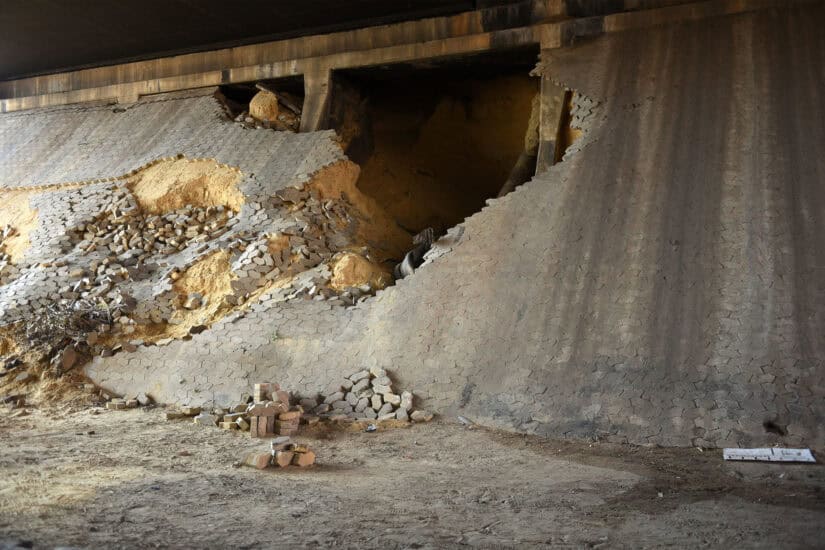
Illegal mining strips bridge supports, threatening Johannesburg CBD access. Picture: Nigel Sibanda/The Citizen


The M2 highway in Johannesburg could be on the verge of collapse due to illegal mining of the sand in bridge support structures to reclaim gold.
This has been confirmed by the authorities, including the Joburg Road Agency (JRA) and the department of mineral and petroleum resources (DMPR).
Illegal excavation threatens key infrastructure
JRA has posted on social media, blaming illegal mining happening just adjacent to the road, which is one of the routes leading into the Johannesburg CBD.
DMPR spokesperson Solly Phetla said: “Our Johannesburg team went to the area. We realised that the department of transport should handle the issue rather than DMPR.”
When asked whether there was illegal mining taking place, he said he was informed that sand was collected at bridges across the country.
Mining expert David van Wyk said the vandalism of the bridge supports at the M2 motorway was caused by the fact that those who constructed the highway used tailings waste as building material instead of using building sand.
“The bridges were constructed during the apartheid-era, and one wonders how they allowed for this,” said Van Wyk.
“The tailings waste itself contains toxic heavy metals such as lead, arsenic, cadmium and uranium. I wonder about the health of the workers whom these contractors employed at the time.
“So, the bridge supports are now compromised because the sand used contains gold, and at the current price of gold, there is probably a fortune to be made vandalising the bridges.”
Long-term environmental and geological concerns
He said all mining occurred along the Reef to the south of the M2, but the city itself is not undermined as it is situated on a granite ridge or dome, and no mining occurred below the CBD.
The closest old mine on the north was an incline shaft below the Standard Bank headquarters in Marshalltown, but its tunnels went south, and its access point is in the bank’s building.
The architects designed the bank building over and around this old mine.
Van Wyk said abandoned mines pose a risk to all suburbs and structures south of the M2 because the old mines were filling up with acidic water, which was eating away the dolomitic substructure.
“The huge volumes of acidic water accumulating in the central mining void just south of the CBD, along with the accumulation of water in the eastern and western voids, are eating away at the dolomitic geological substructure, which will cause seismic/tremor and earthquake activity and sinkholes all along Main Reef Road.”
He said when the mines were operational, water was pumped out daily, but now that they were abandoned, no one was pumping out the water.
Van Wyk added no one planned to repurpose and re-engineer these old mines, and this spells a catastrophic future for Springs, Benoni, Brakpan, Boksburg, Germiston, Johannesburg and the entire West Rand.
Damage found beneath M1 and M2 routes
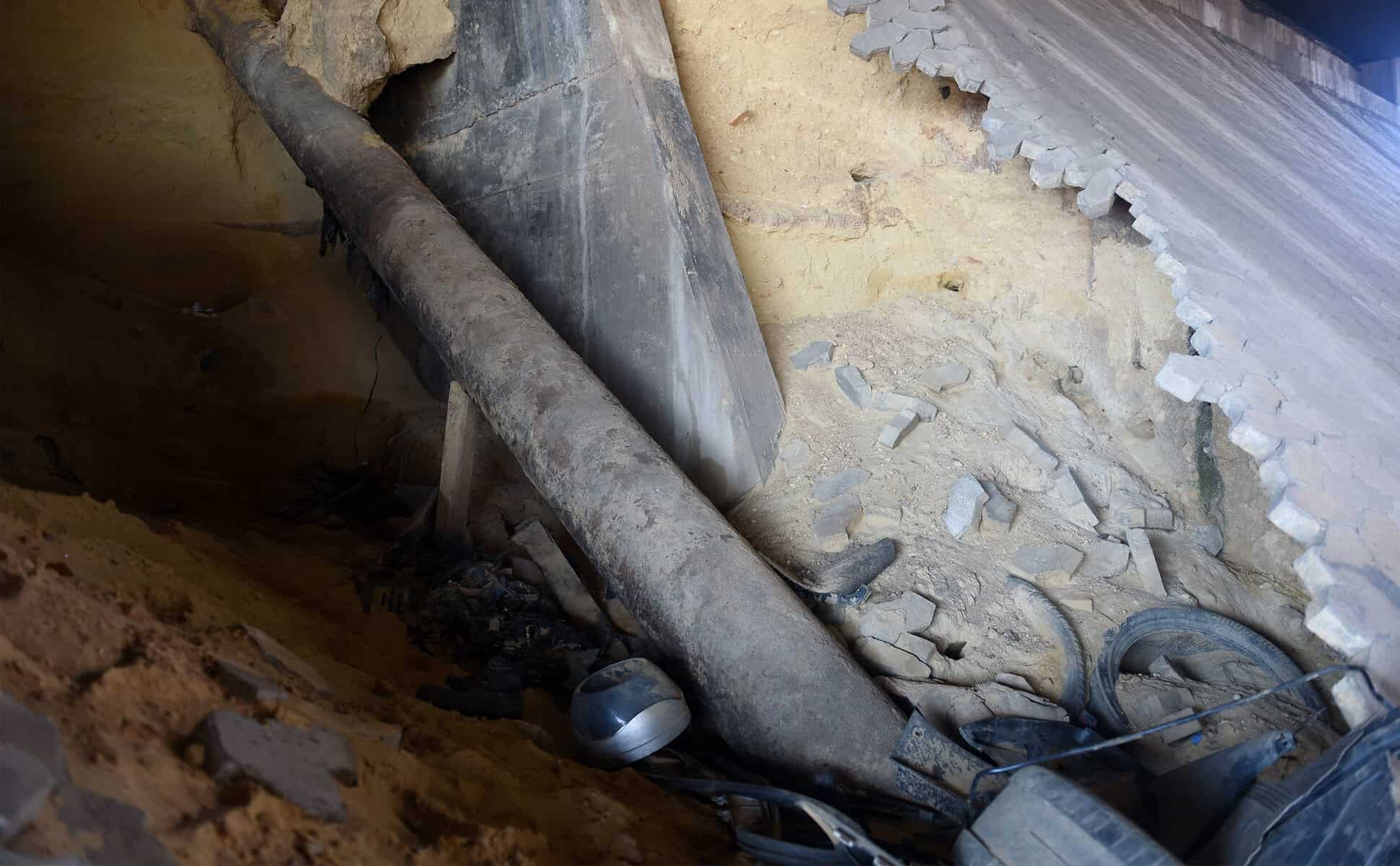
The JRA said extensive infrastructure defects have been identified beneath sections of the M1 and M2 motorways in Johannesburg’s inner-city and Selby areas.
“These include embankment erosion, collapsed paving that poses risks to pedestrians, damaged and collapsed bridge abutments, deep cavities and sinkholes linked to illegal tunnelling activities, theft and vandalism of infrastructure components, illegal dumping into stormwater systems, and the establishment of informal structures around bridge columns,” said the agency.
“Affected locations include the M2 at Heidelberg Road, Booysens Road, Pixley Ka Isaka Seme (Sauer) Street and Simmonds Street, as well as sections of the M1 North near Booysens Road.
“Similar defects have also been identified at the M2 underpasses at End Street and Heidelberg Road, and beneath the M2 East Bridge in Selby and Booysens.”
Plans to stabilise and protect the highways
JRA is collaborating with Joburg Metro Police Department to assist with monitoring hotspots and removing illegal makeshift structures in and around the bridges.
In the short-term, JRA will continue with extensive stormwater maintenance on the M1 and M2 freeways to address drainage blockages and minimise risks of localised flooding and further erosion of the bridge’s embankments.
“Our regional teams are looking into alternative materials to temporarily stabilise the affected embankment, instead of sand and paving blocks, which are sought after by criminals,” said the agency.
“As a long-term intervention, the JRA has appointed a consultant to conduct a comprehensive investigation and design permanent repair solutions for the affected abutments and parapet walls along the M1 and M2 freeways.”
JRA said the project includes the following interventions:
- Investigations have been completed, including environmental and heritage studies, hazardous materials cleaning, jetting and CCTV inspections of stormwater systems, and detailed measurements at each abutment site;
- Planned repair works will include the repair and upgrade of the abutments and parapet walls, as well as related stormwater drainage;
- Security and maintenance – post-construction, each site will require careful cleaning to remove hazardous objects and additional 24-hour security due to the site’s locality and socioeconomic issues related to displaced individuals seeking shelter; and
- JRA is also exploring alternative materials to deter theft and vandalism and will implement measures to protect the completed solutions from future damage.
Problems identified years ago
The issues were first identified in 2016, during routine inspections and maintenance activities, JRA said.
“In 2019, illegal tunnelling beneath the M1 North embankment at Booysens Road caused significant damage that required rehabilitation.
“Assessments conducted in 2023 found the southern abutment of the M1 North bridge at Booysens Road had partially collapsed, largely as a result of severe stormwater drainage blockages and ongoing erosion.”
While the exact extent of the illegal excavation varies by location, JRA said investigations have revealed extensive underground tunnelling and the formation of deep cavities beneath and adjacent to key bridge structures, creating significant risks to the road network and public safety.
“Additional damage has been recorded on surrounding infrastructure, including the theft of handrails and guardrails from the Heidelberg steel bridge and continued degradation associated with illegal dumping, vandalism, and encampments beneath the bridges,” said the agency.