Two SANDF members fell into a shaft while two others were swept away at Lebombo Border Post, sparking debate over readiness.
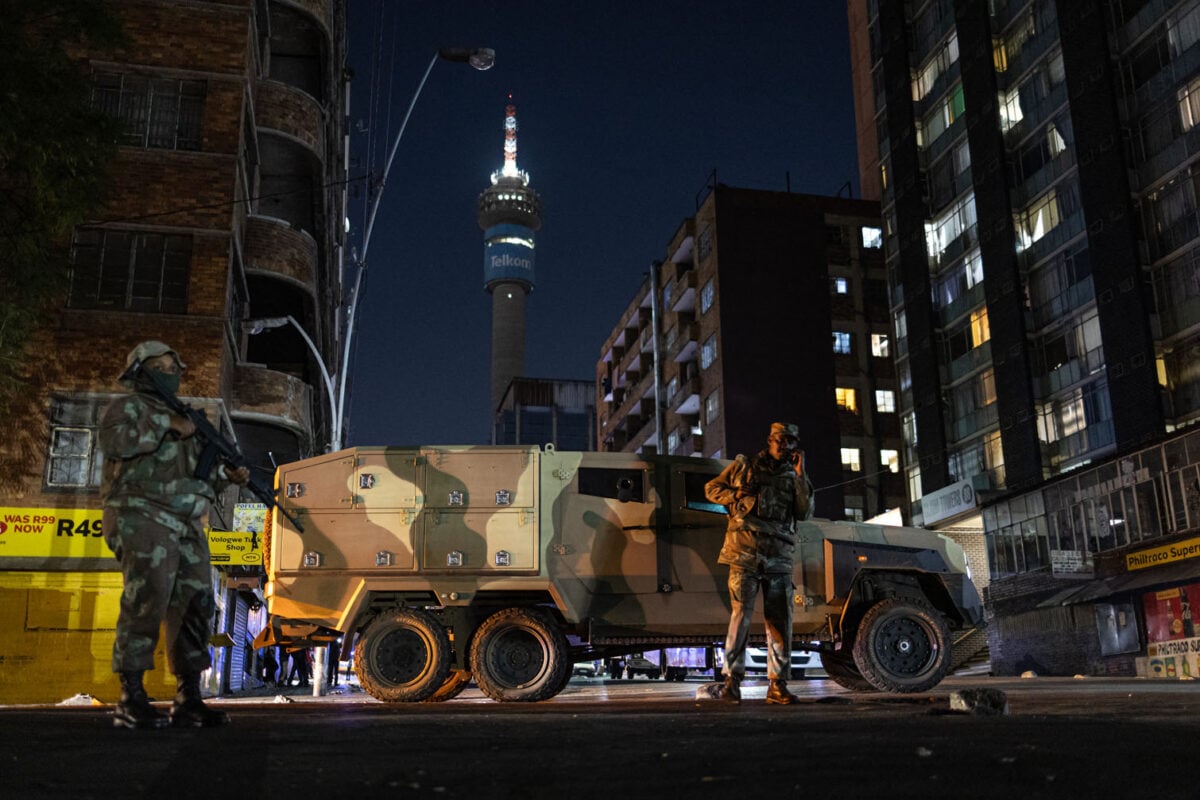
Members of the South African National Defence Force (SANDF) stand guard in Hillbrow, Johannesburg. (Photo by EMMANUEL CROSET / AFP)


Two South African National Defence Force (SANDF) soldiers died after falling into an abandoned mine shaft west of Johannesburg during an anti‑illegal mining operation – sparking debate over training standards.
But military experts insist the tragedy reflects hazardous conditions, not poor preparation.
Debate over SANDF training standards
The same competence question was initially raised after two soldiers were swept away while attempting to cross an overflowing river at the Lebombo Border Post in Mpumalanga.
Military expert Dean Wingrin said that despite decades of underfunding affecting the SANDF’s primary mission equipment and supporting systems, South African soldiers were generally well trained.
“However, that training is designed primarily to support the SANDF’s constitutional mission: defending the country’s territorial integrity and borders, and participating in peace support and peace enforcement operations,” said Wingrin.
“Accordingly, soldiers are trained for combat operations, where the objective is to identify and neutralise threats using the force necessary to accomplish the mission.”
He said this differs from the civilian policing support role, “which places greater emphasis on minimum force, restraint and de-escalation”.
Soldier training differs from civilian policing support
Wingrin said for domestic support operations such as Operation Prosper, SANDF members receive additional preparation covering issues such as operating in a civilian environment, communication and coordination with the South African Police Service (Saps) and the legal framework governing support to the police.
He said it has not been publicly disclosed what mission-specific training was provided for operations against illegal mining.
“The illegal mining environment itself presents unique challenges. In some cases, illegal miners operate from surface excavations, where the military’s role is primarily to secure and cordon off the area while the Saps conducts arrests,” he said.
“In other cases, illegal mining occurs in existing mine workings that have been extended by new‑ ly excavated tunnels and shafts. These environments are inherently hazardous.”
He added that inside the old mines, visibility was poor, ventilation may be limited, there are risks from unstable ground and concealed vertical shafts and suspects may be armed.
Troops face poor visibility, unstable ground and armed suspects
“Illegal miners also possess a significant advantage because they are familiar with the under‑ ground workings and any new excavations they have created,” said Wingrin.
“It is important to distinguish between a deliberately planned underground operation and a spontaneous pursuit following contact with fleeing suspects, such as with this tragedy.”
A planned operation would require detailed reconnaissance, a comprehensive risk assessment, clear command and control arrangements, close coordination with the Saps and, where appropriate, mining specialists, he said.
“Even then, the SANDF’s role would ordinarily be to support the police rather than conduct an independent underground operation,” he said.
Based on the information currently available, it would be premature to draw conclusions about the circumstances that led to the deaths of the two soldiers, he added.
Heitman defends training
Another military expert, Helmoed-Römer Heitman, said the training received by the soldiers was up to standard. Heitman said the troops did well in Goma fighting off M23 in a difficult situation and very well in Bangui, Central African Republic, in 2013.
“Looking back, our troops also did well in Burundi, Comoros, Darfur and the DRC [Democratic Republic of the Congo]. In the latter two, different force commanders considered the SA battalion the best unit there. The sloppy soldiers we sometimes see around cities are not from combat units,” he said.
“The incidents you mention can happen to the best soldiers. We had similar incidents in the SANDF and I can recall similar ones in foreign armies I visited.”
Heitman said the problem was problem was when there was not enough money for unit and formation field training to build competence at that level, or for enough flying hours and sea days for pilots and ship crews to become as competent as they should be.
“The bottom line is there is nothing much wrong with our soldiers, but if we keep underfunding them it will implode,” he said.