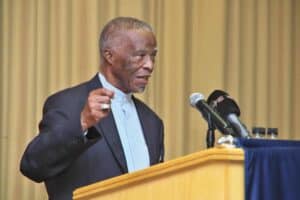
The former president said the discussion centred on how the generals would testify before the amnesty committee, not on how to avoid prosecution.
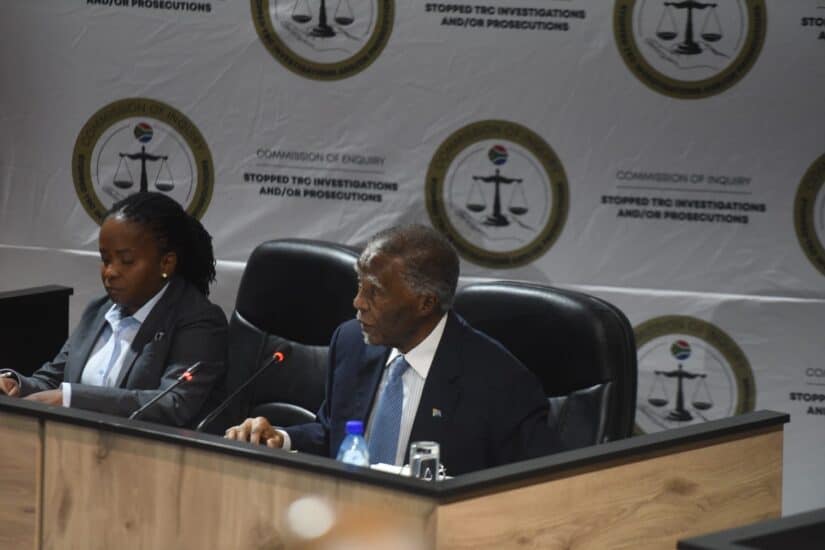
Former President Thabo Mbeki testifies before the Truth and Reconciliation Commission (TRC) in Johannesburg, 19 October 2026, as part of investigation into alleged political interference in the prosecution of apartheid-era crimes. Picture: Nigel Sibanda /The Citizen


Former president Thabo Mbeki has denied allegations that he secretly held meetings with former president FW de Klerk and the generals of the South African Defence Force (SADF) in an attempt to assist them avoid prosecutions for their apartheid-era crimes.
On Monday, Mbeki appeared before the Khampepe Commission of Inquiry, which is investigating whether efforts were made to stop the prosecution of Truth and Reconciliation Commission (TRC) cases.
The Calata Group, representing families of the victims of apartheid-era crimes, accused the government and its various administrations it led, including Mbeki’s, of failing the TRC victims’ families by failing to instruct the Minister of Justice, National Directors of Prosecution and Police Commissioners to act on the TRC reports he received during his presidency.
Mbeki also faces allegations that his administration interfered with the National Prosecuting Authority’s (NPA) work on the TRC cases.
He also had to answer allegations that he and De Klerk took part in meetings with leaders of the SADF, the South African Police (SAP), and the ANC, where they agreed to find a political solution to avoid prosecutions.
Another allegation against Mbeki was that he authorised, or was the source of authorisation for, the suspension of planned arrests in the Reverend Frank Chikane matter in 2006. Chikane was poisoned in 1989 when apartheid security branch operatives secretly laced his clothing with an organophosphate nerve agent.
Law and Order Minister Adriaan Vlok and several former high-ranking officers pleaded guilty to attempted murder and received suspended prison sentences in 2007.
‘Complete fabrication’
Responding to the allegations of secret meetings with former apartheid generals to help them avoid prosecution, Mbeki said they were a “complete fabrication”.
Mbeki said a meeting was held with the generals. However, they discussed the generals’ request that National Party leaders testify before the amnesty committee first, providing details of the orders they gave to the foot soldiers. The foot soldiers would then testify about how they carried out those orders.
“It’s a complete fabrication. There’s no such thing. There are no such meetings that took place in order to secure amnesty for them,” Mbeki told the commission.
“There was one particular meeting with both generals of the SADF and the SAP who raised a problem, the problem they faced. And they said to us that what they think needs to happen is that their political principals, De Klerk and Cabinet, ought to come to the amnesty committee to tell the truth about what they did on these matters which are addressed by the amnesty committee, as the political leadership.
“If they did that, they, the generals, would then come to the amnesty committee in order to explain to the amnesty committee what they did in order to implement decisions that would have come from their principals.
“As a consequence of both of those interventions, they were saying we avoid a situation where what was happening then, in their view, was that the foot soldier who was implementing decisions that had come from above, ‘go and kill so-and-so’, that was the person who was appearing before the amnesty committee without the context of that decision or the decision carried out by this foot soldier.”
‘ANC first’
Mbeki testified that the decision was that ANC leaders would testify before the amnesty committee first and apply for amnesty for the decisions they had made.
“The ANC would then go to the leadership of the National Party to say, ‘Please do as we have done’. So we acted on that. And the reason we went to the amnesty committee was to respond to what the senior security officers of the apartheid order had said to us, that it’s necessary that their political principals must start the process of going to the amnesty committee.
“So we said we will give them an example by ourselves going to the amnesty committee, as this leadership of the ANC, that would open the door. Therefore, that meeting between us and these security officers of the apartheid order did take place.”
‘Interference’
On allegations that his administration interfered with the NPA’s work on TRC cases, Mbeki said they raised in parliament the issue of a “significant number” of people who had not gone to the TRC but had committed offences that should normally have gone to the TRC amnesty committee.
“The question that the government was raising in that speech to Parliament in 2003 is, what do we do about that? And essentially said, why don’t we leave this matter to the NPA? And we suggest that the NPA, in addition to its work, must, in this case, with regard to these matters, try to seek the truth. It must seek the truth from these people because there are many outstanding issues that are threatening even democracy.”
The issues include the arms caches that were never disclosed, people who had disappeared, had been killed, but whose bodies were not known.
“On threats to the national security in relation to the arms cache, there was information available from Intelligence Services that there were arms caches and that there were people – a group called the Boeremag – who were determined to use force to destabilise the democratic state,” testified Mbeki.
“So that’s what that statement to Parliament in 2003 deals with, not discussions that we had with apartheid generals. Yes. It’s no instance at all, Chairperson, no instance at all, that the national executive intervened to stop the prosecution of cases referred to the NPA by the TRC. Any statement made that that happened is a lie. None of that ever happened.”
Pardons
Mbeki also testified about the pardons he initially granted apartheid-era convicts in 2002 after the TRC had completed its work. These were people who did not appear before the TRC.
In 2002, civil organisations, including the Helen Suzman Foundation, criticised Mbeki for his lack of transparency in granting pardons.
“After the TRC completed its work, my office received numerous requests for pardons from persons who claimed to have committed offences and human rights violations for political reasons and who were convicted for those offences,” explained Mbeki.
“The persons who applied for these pardons had not appeared before the TRC, and it seemed that some of these cases were relevant to the pursuit of national reconciliation. I had initially granted some of these applications for pardons.
“I had previously exercised the pardoning power in 2002 in relation to a number of prisoners who were convicted of politically motivated offences. That exercise attracted public criticism, especially from the Helen Suzman Foundation and the former chairperson of the TRC, the late Archbishop Emeritus Desmond Tutu.”
As a result, the government considered a more structured and transparent process for future applications necessary.