Protest organiser Josh Nel said residents are tired of pretending the situation is acceptable or that the city has a viable sustainable plan.
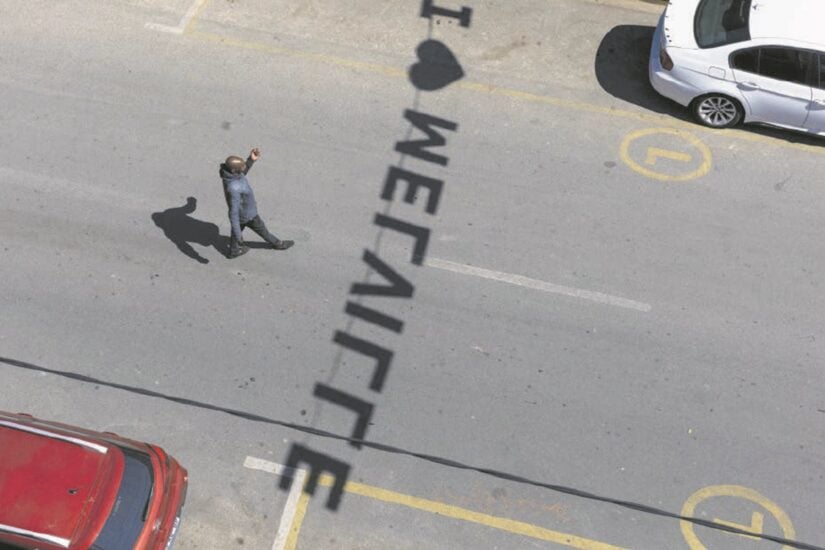
The shadow of a sign in Melville belies the feelings of residents who have no water. Picture: Our City News


Tomorrow, residents of Melville and surrounding areas will again take to the streets to protest against endless water outages that have left them without water for 50 days over an eight-month period.
That is the lived reality for communities across the Hurst Hill 2 supply zone, including Melville, Westdene, Parktown West, Brixton, Westbury, Coronationville and Emmarentia.
Melville and surrounding areas residents protest against endless outages
Protest organiser Josh Nel said residents were tired of pretending the situation was acceptable, or that the city had a viable plan for sustainable water.
He pointed to a recent underground fire at a Johannesburg power substation that forced utilities to shut down several substations, including one feeding Rand Water’s Eikenhof pumping station.
“Even though this wasn’t even a water failure, it shows how badly the system handles shocks. When something goes wrong anywhere in the City of Joburg’s wider network, the Commando system feels it and it feels like there’s no real urgency about fixing that underlying fragility,” Nel said.
Residents would not accept anything less than reliable water at every tap, demanding accountability and the removal of those responsible for the crisis.
Melville was the scene of major protests earlier this year after going without water for more than 20 days – a crisis that garnered international coverage and was highlighted in President Cyril Ramaphosa’s State of the Nation Address.
Though the water supply temporarily improved, the fundamental issues in one of Johannesburg’s oldest suburbs remain unsolved. Over the past two weeks, residents and businesses have faced renewed water and power outages.
Eikenhof power failure halts pumping
The recent power failure at Eikenhof, which supplies 60% of the city’s water, halted pumping and severely affected the vulnerable Commando system.
Brixton has suffered nine consecutive days without a stable supply, forcing residents to wake up at 2am to fill buckets.
Meanwhile, a community meeting a week ago, organised by ward 87 councillor Kyle Jacobs for residents to demand answers from Johannesburg Water, descended into a shouting match.
Residents condemned the absence of the city’s political leadership – particularly the MMC responsible for infrastructure – describing it as an insult.
At the meeting, Joburg Water stated that Eikenhof had returned to 100% pumping capacity following the power outage, but warned that large parts of the network remained under severe strain.
Water tankers were deployed, while storage levels plummeted. The Crosby reservoir dropped to 4% capacity and the Brixton water tower ran completely empty.
Local businesses fuming
The ongoing infrastructure collapse has left local businesses fuming as they fight to survive.
Cobi Meyer-Domingos, a resident, small business owner and executive member of the Melville Business Association, warned that the water crisis is a direct threat to the local economy.
“Melville is home to numerous Airbnbs, guesthouses, restaurants, bars and other hospitality businesses that depend on a reliable water supply to operate,” she said.
“Accommodation providers need water for showers, toilets, laundry, cleaning and guest facilities.
“Restaurants and bars require it for food preparation, washing dishes and glasses, hygiene and sanitation. When the water runs out, businesses can be forced to reduce operations, or close altogether.”
Meyer-Domingos noted that establishments are incurring heavy additional costs by purchasing emergency water and installing storage tanks and pumps just to remain open.
Heavy additional costs
Beyond the direct operational costs, unreliable supply leads to booking cancellations, bad reviews and long-term damage to the reputation of an area recently voted one of the world’s coolest neighbourhoods by Time Out.
Wellness practitioner Aneesa Bhyat stressed that the knock-on effects reach employees and suppliers through reduced trading shifts, lower income and staff cutbacks.
“How can I physically work close to my clients knowing I have not had a shower in eight days?
“My business is based on physical contact,” Bhyat said. She added that over the past three months, the area has experienced at least seven dry days each month.
“That’s a total shutdown for business; we can’t keep doors open. Staff are being cut because there is not enough foot traffic.”
Both Meyer-Domingos and Bhyat emphasised that reliable basic infrastructure is vital to safeguard local investments, protect jobs and sustain Melville’s post-Covid recovery.
Weak spots in Joburg
Citywide, three primary problem zones exist: the Hurst Hill 2 supply zone, the central city area (where repairs to the Hector Norris pump station and leaking pipes have caused year-long disruptions), and informal settlements dependent on tanker deliveries that are frequently disrupted by non-payment to contractors.
Delays in repairing the leaking Hurst Hill 2 reservoir – crucial to the functioning of the Commando system – are currently four months behind schedule due to municipal non-payment of the contractor.
Running on a bypass system for years, the reservoir’s failure continues to cause major outages in Albertville, Auckland Park, Claremont, Coronationville, Greenside, Newlands, Emmarentia, Parkhurst, Parktown, Westbury, and Westcliff.
Completion is now delayed until 2027.
Similarly, work at the Crosby pump station halted two weeks ago when the contractor walked off the job over unpaid bills.
The contractor, Gideon Lesia of Mapitsi Civil Works, protested outside the utility’s headquarters with his workers over non-payment. Lesia said his firm had not been paid for months.
Johannesburg Water then released partial payment on 7 August and agreed to a payment plan to resume operations.