Gauteng residents do not need heroes who refuse to talk; they need negotiators who can compromise without surrendering their principles.
 Elections 2026
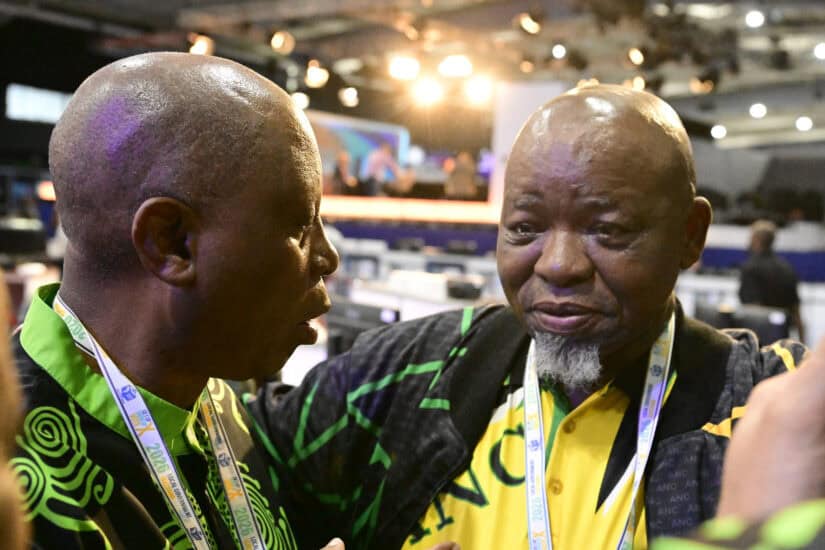
Herman Mashaba of ActionSA talks to Gwede Mantashe of the ANC at the National Results Operations Centre (ROC) at Gallagher Convention Centre on November 07, 2026 in Midrand, South Africa. Picture: Gallo Images/Sydney Seshibedi


In the two weeks since this month’s local government elections, South Africans have been served a daily diet of insults, ultimatums and bruised egos.
Parties that must soon share council chambers appear to hold one another in open contempt.
It is tempting to conclude that the country is heading for chaos. It is not and citizens must resist the panic.

Get your results on
our Election Hub
Live results
Coalition government is not an exotic experiment that South Africa has stumbled into.
The Netherlands has not been ruled by a single-party majority since 1879.
Finland has known only coalition government since it became independent in 1917.
Sweden and Germany have been governed by coalitions since the 1970s and 1960s respectively.
These are economically stable, politically viable democracies and they got there by learning to negotiate, not by avoiding it.
SA’s own coalition negotiations may be new, but the principle is anything but.
The posturing happening now is, in large part, the opening bid. Parties posture before they bargain because voters are watching and because every concession must be sold to a base.
Harsh words in the first fortnight are not a verdict on the next five years.
South Africans should not be alarmed by what looks like outright disdain between parties; common ground must – and will – be found.
Consider Herman Mashaba’s vow never to negotiate with the DA if Helen Zille remains its mayoral candidate for the City of Joburg.
The stance has cost him followers. Equally, it may have won him the admiration of those who are not Zille’s biggest fans and that is precisely the point: in a polarised electorate, red lines are as much about identity as about principle.
Voters will judge whether the line holds when the arithmetic of the council demands otherwise.
Pride is expensive and residents who need water, working traffic lights and collected refuse are the ones who pay for it.
There is, however, reason for hope and it comes from an unexpected corner.
Floyd Shivambu’s Afrika Mayibuye Movement, a new party in its first election, has secured 57 seats across 34 councils and says it intends to have a voice in how Joburg, Ekurhuleni, Tshwane, Polokwane and Emfuleni are governed.
Reports suggest it is finding common ground with ActionSA.
Two parties with very different origins and very different styles are, it seems, talking to each other rather than past each other.
If that holds, it is the kind of pragmatic engagement the country needs to see more of.
Shivambu has also argued, sensibly, that coalition failures of the past owed more to pettiness than to policy and that if the agenda is truly about the people, unity should not be difficult.
One need not agree with his politics to accept that diagnosis.
Council agreements built on service delivery commitments, rather than on grudges, are the ones most likely to last.
The lesson from the Netherlands, Finland, Sweden and Germany is not that coalitions are easy.
It is that they are survivable and often stable, when parties accept that no one wins everything.
South Africa’s voters have handed our politicians fragmented councils. They did not hand them an excuse for a standoff.
The temptation to exclude one side because “our ideologies are oil and water” work only when a party has unlimited options.
No one has unlimited options in the current municipal negotiations. So let the posturing run its course, but let it be short.
The residents of Joburg, Tshwane and Ekurhuleni do not need heroes who refuse to talk; they need negotiators who can compromise without surrendering their principles.
The early signs from Mayibuye and ActionSA suggest some are already doing so. The rest should follow.