
As leadership changes loom, Fort Hare's recent institutional progress deserves to be weighed alongside its governance challenges.
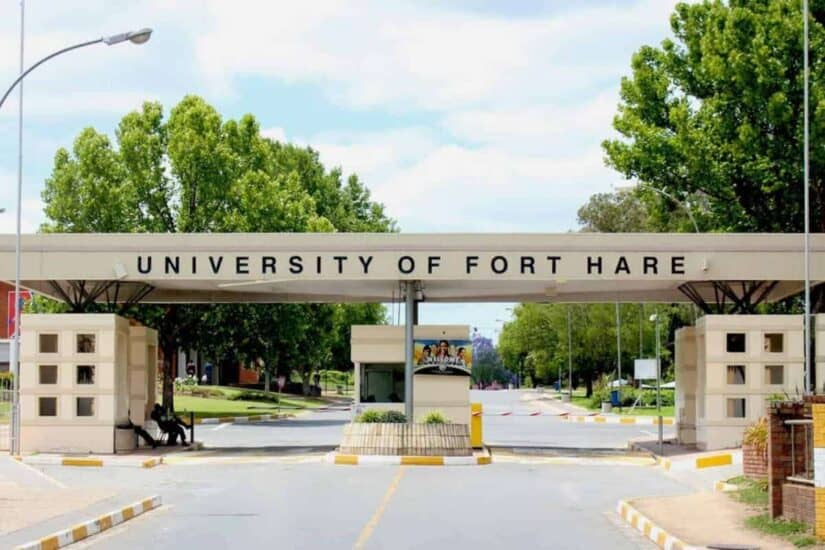
As Fort Hare navigates a leadership transition, its governance challenges, institutional renewal and academic achievements are shaping the university’s next chapter. Picture: Supplied/University of Fort Hare


The University of Fort Hare has never been merely another university. It is one of the great institutions of African history.
Its historical orbit includes heads of state – Nelson Mandela of South Africa, Julius Nyerere of Tanzania, Robert Mugabe of Zimbabwe, Seretse Khama of Botswana and Kenneth Kaunda of Zambia.
It produced liberation leaders of extraordinary courage such as Oliver Tambo, Chris Hani and Robert Sobukwe. It produced a Nobel laureate, Archbishop Desmond Tutu.
It produced intellectuals who shaped African thought like ZK Matthews. It produced leaders of government and institutions such as Mangosuthu Buthelezi, Sizwe Nxasana, Lazarus Zim and many others who carried the Fort Hare name into public service and the corporate world.
Yet, today, Fort Hare faces a pivotal moment. After years of governance challenges – procurement irregularities, academic fraud and public scandal – the institution is now under the spotlight as Prof Sakhela Buhlungu’s disciplinary hearing begins this week.
His precautionary suspension, announced on 30 March, comes just as Fort Hare’s renewal is gathering momentum.
This is not a defence, it is a recognition of a larger institutional turning point. While Fort Hare has been beset by crisis, it has also undergone a remarkable renewal.
Anchored in the strategic plan “Towards a Decade of Renewal (2022-2026)”, the university rebuilt itself on six pillars: teaching, research, student life, infrastructure, governance and financial sustainability. This strategy is now reflected in measurable outcomes.
Between 2017 and 2026, Fort Hare’s student enrolment grew from approximately 11 000 to over 17 000 – an extraordinary leap.
At postgraduate level, Fort Hare exceeded department of higher education and training targets: 1 156 master’s and 443 doctoral registrations.
Alongside this, the university achieved four consecutive unqualified audit opinions between 2021 and 2024, rebuilding trust through financial discipline.
These numbers are more than statistics. They signal an institution regaining its footing.
AngloGold Ashanti‘s R12.5 million donation to establish a dairy science chair and the proposal for a bachelor’s in dairy science are strategic investments in agriculture.
Equally significant is the proposed veterinary faculty – South Africa’s second and the Eastern Cape’s first – bridging a critical gap in livestock education and rural development.
Fort Hare is not just about statistics. It is a living archive of South Africa’s political and cultural memory, custodian not only of the ANC archives, but also of archives of other liberation movements – a rich legacy of resistance, democracy and cultural creativity.
These collections reaffirm Fort Hare’s vocation as more than a university; it is a living archive of South Africa’s political thought, intellectual tradition, and cultural memory. What endures beneath the noise is crucial.
Buhlungu inherited a university under severe strain – affected by procurement irregularities, academic fraud and entrenched institutional dysfunction.
The programme of renewal unfolded in an environment marked by intense contestation and, tragically, by violence, including the assassination of his bodyguard, Mboneli Vesele, in January 2023.
Yet, even amid these challenges, a national investment took root: the proposal to establish South Africa’s second veterinary faculty.
The Eastern Cape is South Africa’s largest livestock-producing province, yet it has never possessed a doctoral-level veterinary faculty. Fort Hare’s proposal seeks to address this strategic gap.
A bachelor of veterinary science programme has been submitted for national approval. An R80 million government allocation has been secured for the first phase of facilities at the Honeydale Research Farm.
Plans continue toward a projected R253 million Veterinary Academic Hospital. Together, these investments represent a strategic push in agricultural education, research, animal health and food security.
None of this diminishes the significance of Fort Hare’s current governance processes. Buhlungu’s hearing is underway and the university invites public perspectives on the qualities needed in its next vice-chancellor.
This is a broader institutional question: what kind of leadership will guide this historic university forward?
Fort Hare’s renewal remains unfinished. Like every great institution, it will continue to evolve as new leaders assume responsibility for its future.
A fair-minded assessment of Buhlungu’s tenure must consider the whole record: governance, infrastructure, academic renewal, research ambition and cultural preservation.
Public controversy may dominate headlines, but history will ask a quieter question: in what condition was the institution found and in what condition is it now entrusted to the next generation?