
Intraparty patronage subsequently leads to factions which ultimately cause fierce rivalry among politicians.
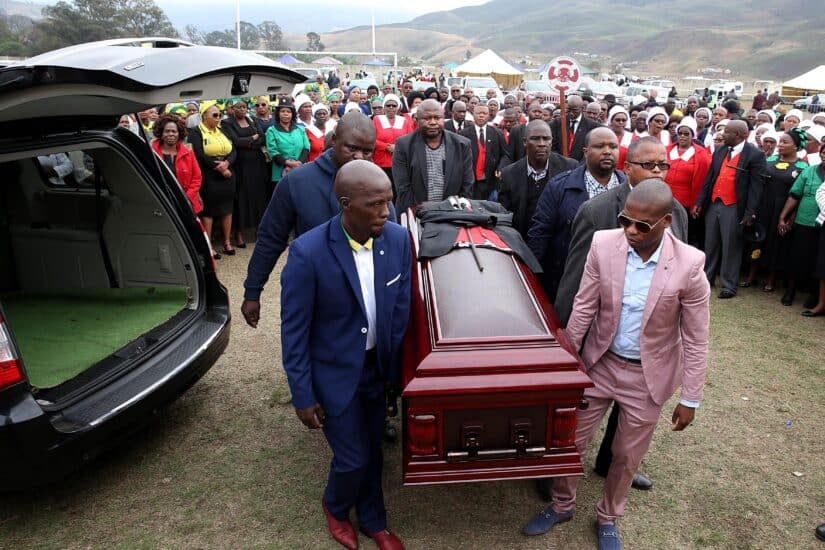
The funeral of former ANC Youth League secretary‑general Sindiso Magaqa, whose assassination in 2017 highlights the deadly toll of corruption in municipalities. Picture: Gallo Images/Sunday Times/Thuli Dlamini


South Africa’s local government sphere is perceived to be a highly contested terrain.
The high level of political contestation in municipalities is often driven by something beyond the ambition to occupy a political office.
Occupying a political office is rather seen as a gateway to accessing the financial resources which are at the municipality’s disposal.
Whoever wields political authority subsequently dictates how the resources will be utilised, either to fulfil the primary function of a municipality by delivering sustainable services to the community, or for rent-seeking purposes that gratify personal interests.
The latter has become a norm across the country, often leading to a scrambling of resources between political opponents which, in some cases, lead to political assassinations orchestrated by rival opponents.
According to the 2024 Global Initiative Against Transnational Organised Crime, a total of 186 politically motivated assassinations were recorded in all South Africa’s election years since 2000.
The report also says 56% (105) of these incidents occurred during municipal elections, while national and provincial elections account for 44% (81). These statistics are testament to the crisis that is confronting local government institutions.
Furthermore, they expose a wider problem of how deeply rooted crime has become in politics.
In July 2017, former ANC Youth League secretary-general and councillor at uMzimkhulu local municipality Sindiso Magaqa was assassinated because of his anticorruption stance in relation to the misuse of municipal funds.
A similar incident occurred at Raymond Mhlaba Local Municipality in the Eastern Cape within the same month in 2017 when council speaker Thozama Njobe was assassinated.
Njobe was also known as an anticorruption politician who spoke out against wrongdoing in the municipality.
These are but a few out of the myriad political killings that have occurred in municipalities over the past decade, revealing a systemic problem that compromises institutional integrity and accountability at the expense of life.
The recent killings of political activists Thato Molosankwe and Mokoena Letsie in North West, as well as those of Cape Town DA ward councillor candidate Sinovuyo Dyokwe and ANC ward councillor Sicelo Mleve in Nelson Mandela Bay, are illustrative of persistent political intolerance in local communities.
The timing of these political killings occurs during an election year and this raises more concerns regarding the fairness of elections insofar as contestation is concerned, including the safety of candidates during this period.
Moreover, these incidents corroborate the idea that ideology is not the only rationale underpinning contestation in local government, but having control over resources is another major factor which underlies contestation.
Intraparty patronage subsequently leads to factions which ultimately cause fierce rivalry among politicians.
This phenomenon has mostly manifested itself within the ANC where elective conferences, whether at regional, provincial or national level, are perceived as an agency to install a collective that will not only lead the party, but act as an intermediary between their followers and state resources.
This is mainly due to the fact that whoever gets elected to the top echelons of the party’s structures subsequently gets deployed into government as historically proven, creating a network that enables a seamless extraction of resources from the state to benefit party loyalists through procurement contracts.
This interrelation between government officials that are deployed by the party and their supporters within the party creates a toxic environment that causes political opponents to maliciously and proactively target one another in a ploy to eliminate each other permanently.
The objective in these cases is to thwart an opponent from being in a position where they can have control over resources that will consequently not benefit those who are supporting a rival faction.
Actions such as these undermine democratic processes and perpetuate rogue elements.
Solving political killings in municipalities requires a multiperspective approach that will focus on dealing with systemic issues in the financial ecosystem of municipalities, as well as intragovernmental relations between politicians and administrators.
Additionally, politicians need to develop a strong moral compass that will enable them to have a people-centred approach in the process of distributing resources.