


Former monitors describe collecting patients without verifying court documents, trusting assurances process was legal.
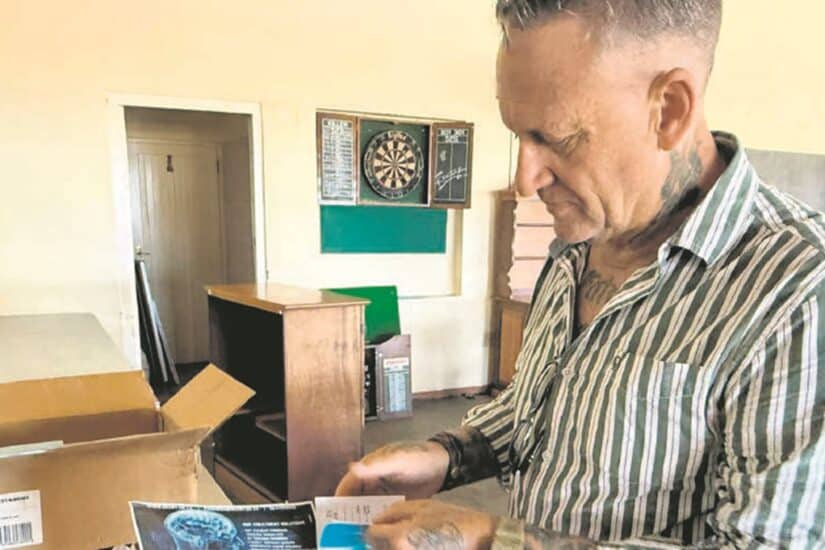
Private investigator Brad Nathanson goes through one of the boxes left behind at Tetelestai containing medical records, admission information of patients and other information. Picture: Hein Kaiser


An “uplift” or intervention in Tetelestai terms was allegedly a part of the rehab centre’s involuntary admission process. This, after purported Section 33 court orders were obtained.
However, former patients and monitors (patients in charge of others) told The Citizen that opaque paperwork or none at all was present when admitting someone into Tetelestai, in the South Coast of KwaZulu-Natal.
Ex-patients allege unlawful upliftments
Becoming a monitor was simple and you could become one as soon as a few days after admission to Tetelestai.
“The only requirement was to stop smoking, really, Donovan (de Klerk) hated smoking,” they said and added the system relied heavily on monitors.
One former patient, who remains anonymous for safety reasons, described what she called her forced uplift. She said she was uplifted by a team of monitors from Tetelestai.
“I was in my bedroom reading when there was a knock. Four people came into my home and told me I had to go with them because there was a court order.
“There was no police officer present. I asked why and they said they could not discuss it,” she said.
ALSO READ: Controversial rehab centre under fire for forced admissions
She said she then tried to flee but was caught and placed in a car. “I was terrified. I did not know where I was going.”
‘I never met a social worker’
She said she was never shown any Section 33 paperwork. “I never met a social worker to assess me. I was never in front of a magistrate before being taken there.”
This patient’s account was not isolated. Another former addict and monitor told The Citizen they frequently assisted in upliftment and shared further allegations.
“You would get a photo, a name and an address. We were told the paperwork was sorted. Donovan would say it is all legal.”
He said monitors were instructed not to discuss legalities with the person being uplifted.
‘We trusted what we were told’
“We were told not to handle paperwork in front of them and not to explain too much.” Asked if he ever verified Section 33 orders himself, he said no. “We trusted what we were told.”
ALSO READ: ‘Rehab from hell’ shut down after patient deaths
The source was personally involved in eight upliftments.
Werner Liebenberg, who was also a senior patient, confirmed the process.
He said that the intervention style removals happened quickly and were framed as being backed by court authority.
He described a culture where questioning paperwork was discouraged and where residents were told the centre was acting within the law.
ALSO READ: Rehab or cult? TRC ex-patients look towards collective civil, criminal case
Collette Croucamp, a former resident, told The Citizen that upliftments were presented to families as a lawful intervention.
She personally recorded around 30 instances of purported Section 33-related events.
Croucamp said families were often desperate and trusted what they were told about court processes and Section 33s.
According to her, many residents inside the facility believed they were legally detained and that leaving Tetelestai would bring legal consequences.
Internal punishments
Another monitor who spoke to The Citizen described internal punishments for those who resisted instructions to collect people.
These included the so-called full hold, where residents performed repetitive manual tasks for long hours and were subjected to food restrictions.
ALSO READ: Rehab centre horror: Owner allegedly seen dumping dead baby in a plastic bag
A former monitor told The Citizen that apart from punishment, the real incentive in executing upliftments was that they got to be outside Tetelestai, eat a takeaway and feel free for a moment.
Another former patient said that after upliftment she repeatedly asked to leave but was told she could not because she was there under Section 33.
“They said I was not a voluntary patient and could not just walk out,” she said.
ALSO READ: Tetelestai Recovery Centre founder denies abuse claims
Friend physically blocked at gate
She said a friend arrived to fetch her after she was told she had permission to leave, but she was physically blocked at the gate.
“Then I was stopped and told I could not go.”
All the patients and monitors The Citizen interviewed said they questioned how those processes could have been lawful if the facility itself was not registered at the time. They said they learned this after the fact.
The Citizen has seen invoices where Tetelestai charged R3 500 per upliftment. All the upliftments or interventions under Section 33 occurred before Tetelestai was legally allowed to operate.
NOW READ: ‘All in the name of God’: Murder and abuse allegations rock KZN rehab centre [VIDEO]



