Provincial and municipal governments were given deadlines to address shortcomings in trade and food compliance sectors.
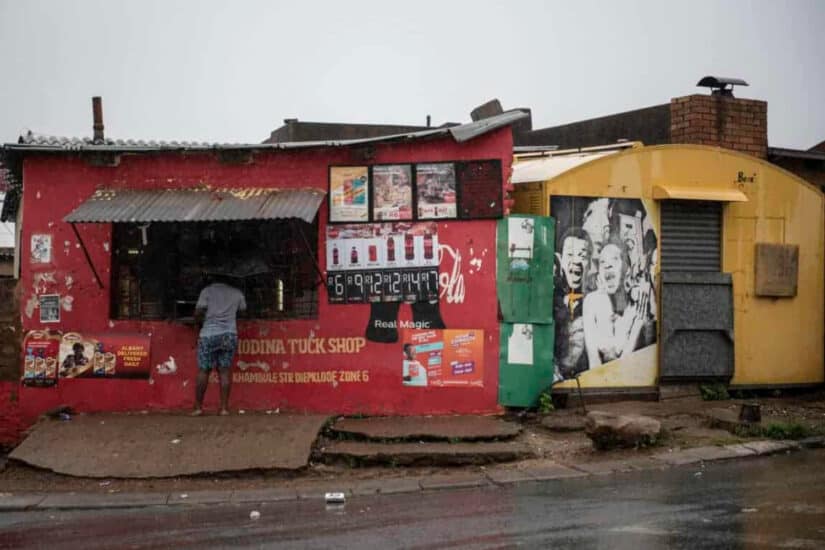
A spaza shop in Diepkloof, Soweto. Michel Bega/The Citizen


Gauteng has a critical shortage of environmental health inspectors and food safety compliance standards have plummeted as a result.
This was the key finding in an investigation report into the informal food industry released on Friday by Public Protector Kholeka Gcaleka.
The investigation was prompted after numerous food poisoning incidents in late 2024, with the report focusing on Gauteng, where at least 23 children died.
Too few inspectors
The report made a host of findings, recommendations and remedial actions.
Gcaleka said the aims of the investigation were to determine whether the Department of Health, municipal departments, the National Consumer Commission and food inspectors had failed in their respective duties.
Environmental health refers to the regulation of areas of accessible to the public and their exposure to chemical, biological, physical and social dangers, and incorporates hazardous waste, food safety, air and water quality.
The Public Protector noted that international and national norms and standards recommend at least one environmental health practitioner (EHP) per 10 000, meaning Gauteng would need 1 600 EHPs for its roughly 16 million residents.
Gcaleka noted that none of Gauteng’s municipalities had an EHP staff capacity over 50%, with the province as a whole sitting at 30.3%.
Johannesburg had the highest staff level at 50% capacity, followed by Ekurhuleni and Tshwane at 23% and 21%, respectively.
Sedibeng and the West Rand district municipality – comprising of Mogale City, Merafong and Rand West municipalities – were the lowest, with EHP employment rates of 16% and 18%, respectively.
55% of spaza shops owned by foreign nationals
A mass registration drive followed the food poisoning incidents, as well as a flood of anti-foreign national sentiment.
Spaza shops owned by foreign nationals were blamed for selling contaminated or expired foods, but the Public Protector’s findings suggest the blame was widespread.
Gcaleka stated there were roughly 12 700 spaza shops in Gauteng’s three largest municipalities, with just over 7 000 being owned by foreign nationals.
Despite the 55% foreign national ownership, licencing and compliance levels across Gauteng were at 28%.
“This means that across Gauteng, for each licensed or permitted spaza shop, there are almost three unlicensed spaza shops that are operational,” said Gcaleka.
Ekurhuleni had the lowest spaza shop compliance rate at 5%, with Johannesburg and Tshwane at 14% and 30%, respectively.
Gcaleka said responsibility should be shouldered by municipalities as they oversaw the regulations and by-laws pertaining to food sales.
“The legislative function of business registrations, including the processing of applications to operate spaza shops, resides with local government.
“Municipalities are designated as business licensing authorities and as such, execute this function through their local economic development departments.
“A designated municipality retains final authority over zoning permits, floor plans, fire compliance certificates and business land‑use rights and approvals,” the Public Protector stated.
Recommendations
Gcaleka recommend that the Gauteng provincial government address its EHP shortages and strengthen enforcement of existing laws.
This would be achieved by the establishment of a technical committee made of members from small business development, health and cooperative governance departments.
“The technical committee must, upon completion of its work, submit a comprehensive report to the Premier of Gauteng for consideration and onward engagement with the MECs,” said Gcaleka.
She added that law enforcement needed to coordinate with the small business development and home affairs departments to ensure the law was being followed.
“The evidence before me shows that even though a local citizen is a registered owner of Dana tuckshop at Naledi, under whose name the CoA was issued, the shop itself was operated by a foreign national,” said Gcaleka.
She gave the national police commissioner 120 days to liaise with the departments in compiling a report on corruption, fraud and false declarations, as well as immigration and trading violations.
Gcaleka also gave the commissioner of the South African Revenue Service (Sars) 120 days to identify businesses and owners who were dodging their tax obligations.
Remedial action
Gcaleka also stipulated directives for the municipal managers to abide by within 30 and 60 days of receiving the final report.
Municipal managers will have 30 days to audit their EHP capacities and training requirements, as well identify the staff and operational shortcomings of their local economic departments.
Municipal mangers in Gauteng will have 60 days to formulate operational plans to increase inspections and enforcement of food safety, business, trade and licencing laws.
The provincial departments of education, health, small business development and agriculture will also have 60-day deadlines to compile their own action plans on improving their own compliance mechanisms.
“These findings demand immediate, coordinated and uncompromising action from every state role player.
“The intended remedial action aims to restore the rule of law, capacitate our institutions, and ensure that the people of South Africa are never exposed to the consequences of these systemic failures again,” Gcaleka said.