Ramaphosa told parliament that African leaders believe anti-foreigner sentiments are being instigated from outside SA.
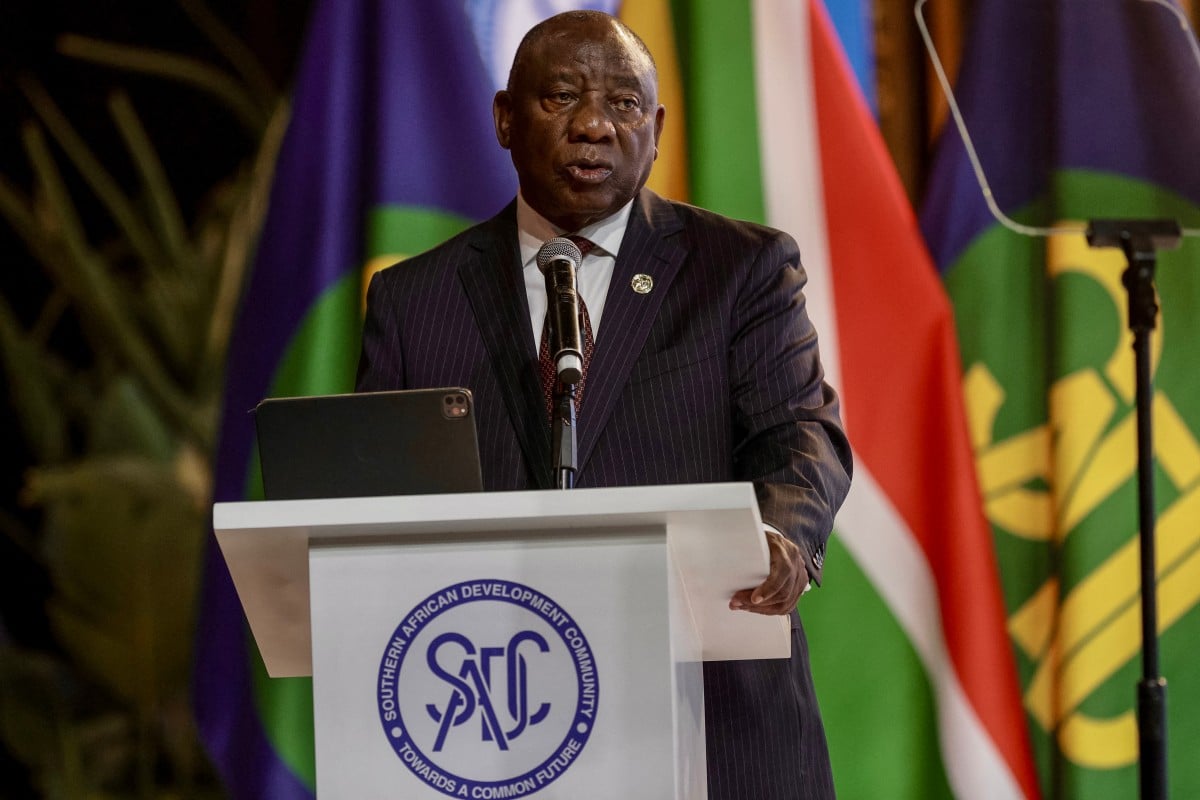
South Africa’s President and Chair of SADC (Southern African Development Community) Cyril Ramaphosa delivers the welcome statement during the 46th Southern African Development Community (SADC) Summit at the Durban International Convention Centre (ICC), in Durban on August 17, 2026. (Photo by Rajesh JANTILAL / AFP)


President Cyril Ramaphosa says some African leaders believe that some, but not all, of the current anti-foreign national activities and sentiments in South Africa are being propelled and instigated from outside the country.
The president said those leaders flagged activities by forces outside the country that are “bringing to bear their influence” and that the government is following up on those threads and threats as part of its investigation.
Ramaphosa said government is investigating external influence
“It’s a complex and multifaceted problem, but we are at work and working it through and deciphering precisely the various roles that have been played by our own people as well as those we perceive to be outsiders who want to disrupt the stability,” Ramaphosa said to the National Assembly while answering questions for oral reply on Tuesday afternoon.
The president said this in response to one of the supplementary questions after EFF leader Julius Malema asked him about the long-term interventions in place to restore South Africa’s credibility as a Pan-African voice, given the recent anti-illegal foreign national protests and subsequent violence in some areas.
Ramaphosa emphasised South Africa’s commitment to Pan-Africanism and said the country rejects xenophobia, Afrophobia, vigilantism, and all forms of discrimination against migrants.
He said the country had direct engagements with regional and continental bodies like the Southern African Development Community (SADC) and the African Union (AU) to address migration challenges through the rule of law, human dignity, and strengthening state institutions.
“Not through unlawful actions targeting foreign nationals,” the president said.
Working with SADC and AU to address migration
Ramaphosa mentioned South Africa’s comprehensive approach to migration management, including border management reforms and the implementation of the White Paper on Citizenship, Immigration and Refugee Protection.
“South Africa continues to advocate for collective African solutions to the drivers of migration, while engaging diplomatically to address concerns about developments in the country,” he said.
He added that last week, at the 46th Ordinary SADC Summit hosted in Durban, South Africa briefed regional leaders on the migration situation and called for a multidimensional dialogue.
“While other people might have thought that we are being snubbed and isolated, actually, the contrary has been the case,” he said.
“As we have sat down to explain precisely the challenges that we are going through, we have found pleasant appreciation that there is understanding and support.”
Ramaphosa said some countries are willing to work with South Africa to help resolve this problem.
Several arrests made and police following up on reports of violence
Malema also raised concerns about the lack of arrests and prosecutions of perpetrators of violence against African immigrants, suggesting state complicity.
The president said the police are following up on all reports and evidence, with several arrests already made. He said law enforcement is committed to upholding the rule of law and dealing with those who violate it.
DA member of parliament (MP) Ryan Smith criticised the government for not addressing the root causes of migration, such as dictatorial regimes in neighbouring countries.
SA favourable for better lives or fleeing danger
In response, Ramaphosa explained that South Africa’s economic opportunities attract migrants seeking better lives or fleeing danger.
“What we have to be mindful of is that we need to advance the interests of South Africans, and that is why we have taken the step that we have taken to make sure that those who are in our country are properly documented,” he said.
The president added that South Africa respects the sovereignty of other countries and emphasised that it is important to work with regional bodies to address migration challenges on the continent collectively.
He mentioned the specific cases in Lesotho, Mozambique, the Democratic Republic of Congo, Zimbabwe and Madagascar, where regional bodies have taken firm views on the challenges.
UDM MP Thandi Nontenja highlighted the need for collective action to address inter-African migration driven by failed economies and fragile states.
‘No one country can handle migration alone’
Ramaphosa reiterated South Africa’s proactive approach in raising the migration issue at the SADC Summit and calling for collective action. He emphasised the importance of addressing the reasons why migrants leave their countries, including economic and social challenges.
“Our approach there is that no one country can handle migration on its own. It needs to be a process and challenge that should be addressed by all of us, acting together without pointing a finger at any one of us,” he said.
In the last supplementary question, Malema asked for concrete steps to protest against foreign nationals and reassure the continent that South Africa does not condone xenophobia.
The president committed to ensuring that perpetrators of violence against foreign nationals are prosecuted and that the rule of law is upheld.
He also acknowledged the complexity of the issues and the need for a sensitive and determined approach.
“This is a sensitive matter, and our neighbours, fellow African heads of state and even our citizens are looking at South Africa and how we manage this process, and it is on the basis that they will be able to see us with our seriousness in terms of dealing with the issue of migration,” Ramaphosa said.