


Advocate Annelene van den Heever rigorously cross-examined Captain Pimi Sekgobela over his handling of the arrests of two accused.
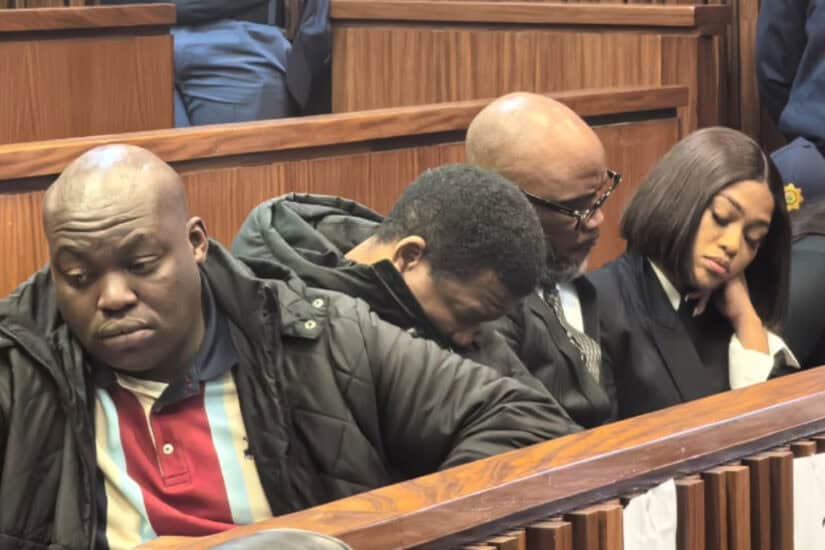
Vusumuzi “Cat’ Matlala, his wife Tsakani Matlala, Musa Kekana, Tiego Floyd Mabusela and Nthabiseng Zandile Nzama appear before the Gauteng South High Court in Johannesburg, 3 August 2026. Picture: Nigel Sibanda / The Citizen


Captain Pimi Sekgobela has been forced to concede to several instances where he may not have been in full control of the arrests of Musa Kekana and Michael Pule Tau.
The pair are two of Vusimuzi ‘Cat’ Matlala’s co-accused in the murder of Armand Swart, with Kekana seeking to have evidence against him declared inadmissible via the current trial within a trial.
Kekana and Tau were arrested in the Johannesburg suburb of Kew on 17 April 2024, several hours after Swart’s murder in Vereeniging.
Defence advocate Annelene van den Heever gave a rigorous cross-examination of the witness, at one stage needing to be reminded by Judge Cassim Moosa not to create a hostile environment in the courtroom.
Court was postponed on Friday so that Van den Heever could use South African Police Service (Saps) national protocol instructions to argue where Sekgobela had possibly infringed.
Questions over arrest procedure
Sekgobela was the Tactical Response Team Commander who oversaw the arrests and has been answering questions about his handling of the scene.
The advocate laid out the Saps protocol for handling arrested suspects, documenting incidents, and treating scenes with care.
Sekgobela stated all measures were taken to secure the crime scene – where the accused were found with an unlicensed firearm – but noted he did not remove the suspect from the scene immediately as per protocol.
Kekana had earlier claimed he was beaten by the arresting officers, with Sekgobela stating Kekana’s condition was documented when the suspect began coughing up blood.
Van den Heever disputed this as there was no record of such, with the commander clarifying that he delegated the calling of an ambulance to another officer using his state phone.
“I am only realising now that I made a mistake, that it is not written in my diary but it is contained in my statement,” Sekgobela’s translator relayed.
The commander also admitted to lapses in access control at the scene, with Van den Heever lambasting him for the “disarray and chaos” left behind by his team.
“Nothing was packed away as you’re supposed to do after you search a crime scene. Everything was dumped on the floor. Things were just moved like somebody took his arm and threw things out of the cupboards.
“Your evidence, sir, that you followed the law with precision, that you’re a commander that does things in the right way, is just not the truth,” Van den Heever shouted.
The advocate put it to the commander that even the crime intelligence he was acting on – having effected the arrest without a warrant – amounted to hearsay, to which he responded with “no comment”.
Contentious explanation of documentation
The advocate pressed Sekgobela on the charges documented in multiple areas related to police procedure.
Van den Heever asked why Bramley police station’s occurrence book and cell register make no mention of murder, only illegal possession of firearms and ammunition.
Sekgobela explained that the suspects were being held on the lesser charges at Bramley, before being moved to Vereeniging where Swart’s murder case was opened.
“In Bramley, they did not kill anyone. There is no way we are suspecting them of committing a case of murder in Bramley. The murder is a charge under Vereeniging,” the commander’s interpreter relayed.
Van den Heever appeared dismissive of the answer as she called for an adjournment, with Moosa needing to clarify whether she accepted the response.
The judge asked Van den Heever at least six times whether she was in agreement with what Sekgobela had explained about the charges, eventually drawing a reluctant acceptance.
“Yes, we are in agreement. What more can I say to the court than the record reflects what he said?” said Van den Heever.
Van den Heever cautioned
Upon returning from the adjournment, Moosa warned Van den Heever to maintain respect for the court.
“I am just raising this concern to you that I found your conduct displayed before the short adjournment to be highly unacceptable
“I am now inviting you, moving forward, to please desist in this type of conduct when the court engages you, so that we can move on, and an unnecessary atmosphere is not being created during the course of these proceedings,” said Moosa.
Before the judge could finish his warning, Van den Heever was already protesting his interpretation of events.
“What the lordship says is just not correct in so far as I dismissed or didn’t hear what the witness said.
“It is quite clear, my lord, I heard what the witness said. Again, my lord, there is a transcript, but I heard what your lordship said. May I please move on,” she requested.
A visibly irate judge was forced to ask Van den Heever twice whether she had “taken the advice and the caution from this court”, prompting another reluctant acceptance.
My lord, I – I… as the court pleases,” Van den Heever conceded.
Next on the stand will be Colonel Thomas Tsotsetsi, who was attached to the Gauteng TRT and who will be answering questions on his role in the arrests.



