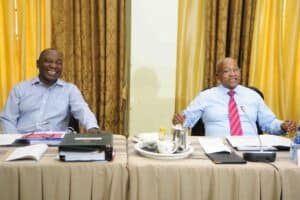
William Mokhare SC, representing the impeachment committee chair, argued that the president had 'missed the boat' to review the report.
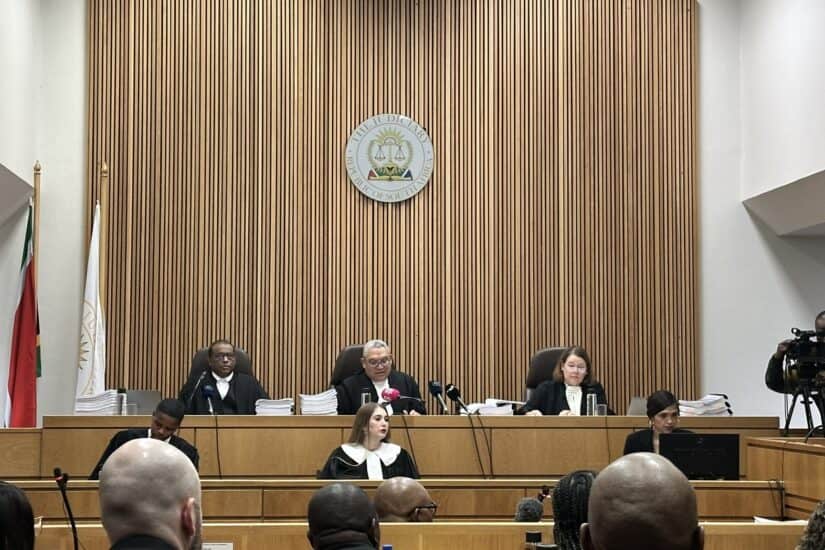
Western Cape High Court hears the urgent interdict brought by President Cyril Ramaphosa. Picture: Impeachment Committee on Section 89 Enquiry/X


President Cyril Ramaphosa insists that he will suffer irreparable harm should Parliament’s Section 89 impeachment proceedings proceed before his review application is heard.
On Wednesday, Advocate Wim Trengove SC argued the president’s case in the Western Cape High Court before judges André le Grange, Matthew Francis, and Diane Davis.
The president has filed an urgent application to halt the Section 89 impeachment proceedings pending the review of the Section 89 Independent Panel report.
This, after the Constitutional Court (ConCourt) ruled in May that the Section 89 panel’s report on the Phala Phala scandal be sent back to parliament, paving the way for an impeachment process against Ramaphosa to proceed.
In November 2022, an independent panel appointed by then-National Assembly speaker Nosiviwe Mapisa-Nqakula found that there was “prima facie” evidence that Ramaphosa may have violated sections 96(2)(a) of the constitution and 34(1) of PRECCA, with the aim of keeping the investigation of the burglary private.
The panel, led by former chief justice Sandile Ngcobo, was tasked with investigating whether the president committed an impeachable offence related to the burglary at his Phala Phala game farm in Limpopo in February 2020.
Ramaphosa has taken this report on review, and the hearing is set for September 2 to 4.
Is the evidence enough?
Trengove argued that the panel did not consider the entirety of the president’s responses before coming to the conclusion that he had a case to answer.
“The panel had to consider the incriminating evidence, consider the president’s explanation and whether there is enough of a case to go to a public inquiry. It’s a greater responsibility than merely determining whether there is a prima facie case. Prima facie case is a very mechanical exercise; this is a judgment call that they have to make,” said Trengove.
However, Judge André le Grange said the panel only had to work with affidavits, with no opportunity to interview witnesses.
“The tools available to the panel were: they had to deliver a report within 30 days, couldn’t call witnesses to testify, couldn’t cross-examine, and could only work on affidavits, which were given to the panel, including the answers by the president. Viewing that, they came to a conclusion that there is a certain gap that the president needs to answer. What’s wrong with that?”
“What’s wrong with that is that it only looks at the incriminating evidence,” responded Trengove.
“But they also looked at the responses of the president,” continued Le Grange.
‘All evidence weighed’
Trengove said the panel needed to weigh the evidence of the president’s accusers against his own explanation and determine whether there was sufficient evidence for the “punitive step” of a public inquiry.
“They never weighed up the evidence to ask themselves, ‘Is this enough of a case to warrant a public inquiry?’? I know that they looked at the evidence, but concluded by asking themselves the question, ‘Does the evidence make a prima facie case?’ That is to say: does the accusers’ evidence make a prima facie case?
“Prima facie case means, if you take this evidence at face value, does it make a case against the president? Sufficient evidence requires something more: that there is enough evidence for the punitive step of a public inquiry.”
‘Sometimes’
However, Le Grange said the evidence before the court showed that the panel just didn’t follow one set of evidence and disregarded the other set of evidence.
“There is a clear indication on the record that they did consider it and made comments on it,” said Le Grange.
“I accept that they sometimes did and sometimes didn’t. But at the end of the day, you won’t find any weighing up of the accusations; they sometimes made mention of it and sometimes not,” Trengove responded.
Le Grange said what he had gathered from Trengove’s argument was the impression that the president thinks his “evidence must weigh heavier than all these, what he terms ‘hearsay’ from his accusers.”
“I’m not suggesting that his evidence should count more than the incriminating evidence. What I am suggesting is that the panel owed it to him at least to have regard to his evidence and, in light of his evidence, to say, is there enough to go to the public inquiry?
“That’s the question they ought to have asked themselves,” responded Trengove.
Ramaphosa ‘will suffer harm’
In their opposing application, the African Transformation Movement (ATM) argued that the president will not suffer any harm during the impeachment proceedings, much like other witnesses who will appear, should the process take that route.
However, Trengove argued the president would suffer public humiliation.
“Very significant harm will be done to the president if the hearing goes ahead and it is ultimately found that the report was invalid. That harm is irrefutable. You can never undo the reputational harm done by an impeachment enquiry,” said Trengove.
“If it hadn’t been for that implication, that he is publicly tried on a charge of serious misconduct which, if he is guilty, would not only disqualify him as president, but would disqualify him for life from any public office or benefits from the Presidency.
“That public humiliation will do its harm even if the report is ultimately overturned.
“The president is saying, I’m not trying to protect the disclosure of the full facts; I’ve already disclosed them; that’s not why I’m here. What I don’t want to be exposed to is to be publicly tried for a grievous offence committed by a president in office.
“The price of that protection is the delay of two or three months.”
‘Exoneration?’
However, Judge Francis argued that the opposite could be the case.
“Why would that be a humiliation? It could be an exoneration; it could come out better than it is now,” he said.
“A public trial of a sitting president is a humiliation. Putting a sitting president on trial is a momentous step that shouldn’t be taken lightly. We submit that the purpose of the matter is to afford the president protection from frivolous allegations.
“On urgency, the president has made it clear that the urgency lies in the fact that this inquiry is imminent and if he is not protected against it, he will suffer irreparable harm,” argued Trengove.
Ramaphosa ‘missed the boat’
William Mokhare SC, representing the impeachment committee chair, argued that the president had “missed the boat” to review the report.
Mokhare said it was the committee’s responsibility to continue with its work independently, impartially and without fear, favour or prejudice.
“It is on that basis that it has decided not to engage with the merits at all because it has not gathered evidence, it has not yet made up its mind as to the guilt or otherwise of the president, nor has it at its disposal evidentiary material to take such a view,” argued Mokhare.
“So, the opposition to this application by the president arises from the impeachment committee’s constitutional duty imposed on it by the constitution and the Constitutional Court judgment.
“The committee has studied the judgment and its understanding is that the ConCourt has decided as a matter of finality that the Speaker must ensure that the judgment is given effect to, especially in relation to the referral of the independent panel’s report to the impeachment committee.
“It elected its chairperson, who understands his responsibility to ensure that the proceedings before the impeachment committee are fair and transparent and protect the witnesses who may appear before it, if that will be the procedure to be followed, including the president not to be abused before it and protect even the integrity of the president.
“So, the humiliation that the president is saying that he apprehends will be taken care of by the chairperson, ensuring that nobody abuses the committee to advance personal interests or inflict defamatory or unfounded statements against another person, including the president.”