Home Affairs secured a legal victory against two Burundian nationals seeking asylum.
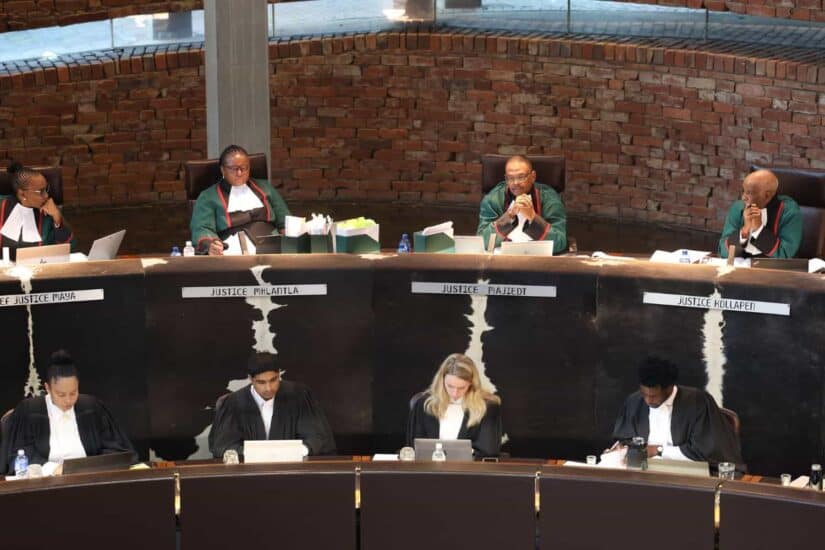
Constitutional Court (ConCourt) Justices during the hearing of the National Health Insurance (NHI) case on 5 May 2026. Picture: Gallo Images/Sharon Seretlo


The Constitutional Court (ConCourt) has ruled that asylum seekers whose initial applications were rejected on a final basis may not submit fresh bids.
The judgment, handed down on Tuesday, 12 May 2026, stems from a case involving two Burundian nationals.
Burundian nationals push for asylum seeker status
Amina Irankunda and Arava Niyoknkuru entered South Africa illegally in 2008 and 2009.
Their original asylum applications were rejected in 2014, and they were instructed to leave the country.
Despite this, they remained in South Africa and submitted new applications in 2018.
This time, the pair argued that they qualified as “sur place” refugees, citing a deterioration in Burundi’s political conditions in 2015.
The pair alleged that those who stayed behind faced oppression, torture, and sexual violence, claiming that returning would expose them to serious risks to their safety and freedom.
According to the United Nations High Commissioner for Refugees (UNHCR), a sur place refugee is someone who was not a refugee when leaving their country, but becomes one later due to developments back home.
After losing their case in the Western Cape High Court, Irankunda and Niyoknkuru succeeded on appeal in the Supreme Court of Appeal (SCA) in June 2024.
The Department of Home Affairs challenged that ruling, taking the matter to the ConCourt.
The case was heard in November 2025.
ConCourt judgment
In the majority judgment, Judge Jody Kollapen highlighted that the central issue was whether Irankunda and Niyoknkuru, as “failed” asylum seekers, are entitled under the Refugees Act to lodge subsequent applications.
He found that the SCA had failed to properly distinguish between an initial sur place claim and a repeat asylum application.
“The term sur place has been incorrectly used to describe the situation when a failed asylum seeker makes a subsequent application for asylum sur place based on changed circumstances,” the judgment states.
The ConCourt majority explained that while a first-time sur place application is similar to a normal asylum claim and should be processed the same way, later sur place claims rest on a different footing.
Therefore, the two are treated differently.
“Both claims are premised on protection from persecution, the only difference being that in the latter instance the cause of the persecution arose when the claimant for asylum was in the country of origin, while in the former instance it arose after the claimant had left the country of origin,” Kollapen said.
Concerns over legal framework and system abuse
The apex court also found that the Refugees Act does not currently make provision for repeat asylum applications once an initial claim has been fully rejected.
Kollapen warned that allowing unrestricted repeat applications without a clear legal structure could create serious problems for the system.
He pointed out that such a scenario could lead to a “never-ending cycle” that delays deportations and places strain on administrative processes.
However, the court clarified that the main judgment does not imply that all unsuccessful asylum seekers will try to “exploit” the opportunity to file another application and “enjoy” the benefits without valid grounds, but rather highlights the risks inherent in an open-ended process.
“While the first judgment does not suggest that abuse would be inevitable, it cautions that in the real world, if a system, by its design, is open to abuse, then the risk of abuse will be real.
“Certainly, in a world fractured by poverty and lack of opportunity, many people seek a better life through economic migration, and if the system of asylum is open to providing them with ongoing protection, they will consider and will likely opt to use its benefits – even in instances where they have no prospects of obtaining asylum.
“The revolving door scenario will undermine the integrity of the system. To force the Act to bear the weight of subsequent asylum applications as it stands will place [them] in a framework which was not designed to accommodate them.”
The ConCourt ultimately upheld the Department of Home Affairs’ appeal and overturned the SCA ruling.
Home Affairs reacts
Home Affairs described the outcome as a “significant victory against abuse of the asylum system”.
“The court’s ruling prohibiting endless repeat applications by asylum seekers whose original applications have been rejected comes just weeks after Cabinet approved the revised White Paper on Citizenship, Immigration and Refugee Protection, which introduces the first-safe country principle to similarly end the practice of asylum seekers ‘picking and choosing’ South Africa as their preferred destination in the region.”
“These recent breakthroughs demonstrate that the department is making rapid progress in rebuilding these systems from the ground up to better serve South Africa’s interests,” Home Affairs said in a statement.