The university says international employees account for 9% of its workforce.
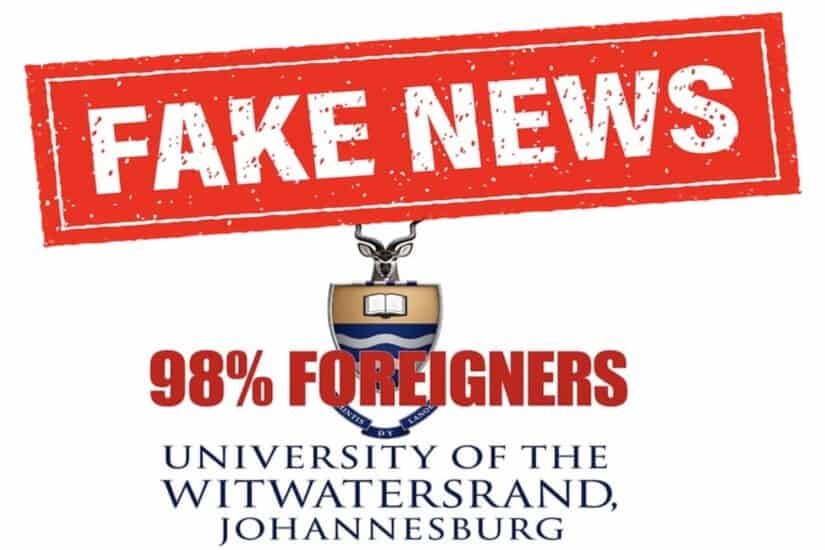
Picture: Wits/X


The University of the Witwatersrand (Wits) has rejected claims circulating on social media about the number of international staff employed at the institution, saying they account for 9% of its workforce.
Wits responded on Sunday, after social media users questioned the university’s employment of international academics and called for more South Africans to be hired.
The university said the claims being circulated were false and warned against sharing information it said could create divisions within the institution and the country.
“Wits is aware of fake news being shared regarding the number of international staff employed at the University. The total number of international staff is in fact 9%,” it said.
“Please refrain from sharing misinformation which seeks to sow division in our community and our country.”
Wits defends internationalisation approach
The university also rejected suggestions that its approach to internationalisation undermines transformation or the development of South African talent.
“Our approach to internationalisation does not occur at the expense of transformation or the development and employment of South African talent,” Wits said.
It said its objective was to strike a balance between developing South African leadership and bringing in expertise from around the world where necessary.
“Our objective is therefore neither localisation nor internationalisation in isolation, but a strategically balanced institution that develops South African leadership while drawing on the very best expertise available globally, where necessary,” it said.
Activist questions hiring of foreign academics
The university’s response followed criticism from civic activist, law student, and founder of the anti-illegal immigration movement March and March, Jacinta Ngobese.
Ngobese questioned why Wits employed international academics when South Africans with postgraduate qualifications were available.
She also posted a list of Wits lecturers with foreign-sounding names.
“Wits University Lecturers… so you mean to tell me that no other South Africans have Masters Degrees and can lecture these, you had to get Nigerians?” Ngobese said.
Another X user, Ramaphiri Mpho, accused Wits of misleading the public and called on the university to prioritise South African employees.
“Stop lying, Wits University. It’s not fake news, and you know damn well. This is on your website,” Mpho said.
“South Africans are not stupid, and gullible people like you think they are. Hire South Africans Wits University and stop sidelining them.”
Meanwhile, @_Tee__G called on Wits to publish a breakdown of its employees according to nationality and employment status.
“We have investigated this matter and found that 98% of its staff are allegedly foreign nationals,” the user claimed.
“If Wits wants to prove us wrong, they should simply publish a breakdown of their staff by nationality and employment status.”
User defends international recruitment
Andile Speaks offered a different view, arguing that having a master’s degree does not automatically qualify someone for a university lecturing position.
“A Master’s degree does not make someone qualified to teach at a university,” he said.
“To get a lecturing job, Wits University requires a PhD and a strong record of published research.”
He highlighted specialised fields such as chemical metallurgy, molecular cell biology and general surgery, arguing that universities need academics with appropriate expertise.
“This is especially true for highly specialised fields like Chemical Metallurgy, Molecular Cell Biology, and General Surgery; you cannot simply put a Master’s degree holder in History into one of these roles,” he said.
Andile Speaks also argued that South Africa’s pool of PhD graduates was insufficient to meet the needs of universities.
“South Africa only produces about 3 500 PhD graduates a year across all subjects. In specialised science and medical fields, that number is tiny,” he said.
“Even if every single one of those graduates was South African, Wits has over 5 000 staff members. Hiring international experts isn’t optional; it is the only way to keep university departments open.”
He further argued that international academics could contribute to research funding, global rankings, and international partnerships.
“These Nigerian professors bring in international research funding, boost global rankings, and build partnerships that help Wits,” he said.
“Higher university rankings bring in more money, which directly helps local South African students.”
Andile Speaks also disputed claims that Wits had a predominantly foreign academic workforce.
“She did not bother to check the actual numbers. If she had, she would know that over 80% of Wits academics are South African, and foreign staff make up a tiny fraction,” he said, referring to Ngobese.
He accused her of using the names of Nigerian academics to fuel anger online.
“Instead, she just filtered a list of Nigerian names to stir up anger online,” he said.
“This is not real activism; it is lazy, anti-intellectual xenophobia.”
He argued that the focus should instead be on strengthening South Africa’s postgraduate education system.
“The real problem is not a foreign professor; it is that South Africa’s own postgraduate system does not get enough funding.”