



Recent tax statistics showed Cape Town had roughly 975 000 formally assessed taxpayers opposed to Johannesburg's 970 000.


Thriving business and property sectors are not far removed from the political choices made by the electorate.
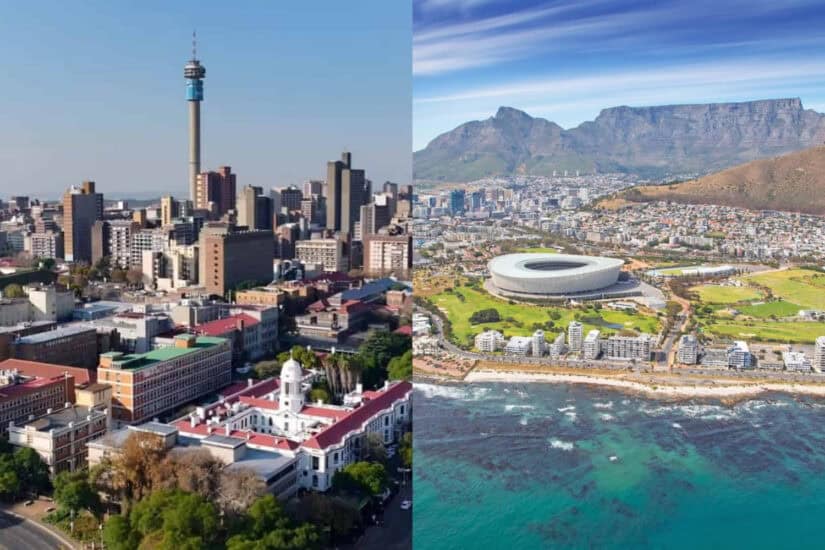
South Africa’s two most popular cities have had differing fortunes over the last decades, with the coming elections providing another marker in the relationship between Johannesburg and Cape Town.
Johannesburg may seem to have lost the property war to its far-south rival, and may too be clutching to its identity as the economic capital of the country.

LIVE interactive map, latest news, multimedia and more!
View MapData shows the earnings gap between professionals has all but closed, as one city embraces the future of employment and the other’s municipal decay leaves businesses seeking alternatives.
Those with their fingers on the pulse of their respective industries illustrate how business and property sentiment hinges on the outcomes of 4 November.
‘Major shift’ in employment trends
Jacques Moolman, President of the Cape Chamber of Commerce and Industry, explained why Cape Town had caught up to Johannesburg as an employment and business destination.
The most recent unemployment figures from StatsSA showed the Western Cape had an unemployment rate of 21.9%, compared to Johannesburg’s 35.9%.
Moolman said this created a tighter market for skilled labour and competitive compensation, especially in high-value, knowledge-intensive industries such as technology, software, financial services, and the creative industry.
“The shift is best understood through net disposable income, job security, and total compensation growth.
“Cape Town has solidified its position as the continent’s technology capital, hosting a disproportionate share of South Africa’s software engineering, e-commerce, and venture-capital-backed scale-ups,” Moolman told The Citizen.
He highlighted that while Johannesburg had historically led Cape Town in taxable earnings, recent tax statistics show Cape Town had surpassed Johannesburg’s number of assessed taxpayers for the first time.
“This reflects a major shift in formal income generation. In specialised knowledge sectors, the pay gap has completely reversed.
“Industry benchmark data shows that intermediate and senior tech talent in Cape Town now earn roughly 7.9% more than their counterparts in Johannesburg.
Cape Town companies are increasing their competitiveness by “deploying specific talent strategies”, most notably setting pay benchmarks at national and international rates.
“While Johannesburg may still hold a slight edge in traditional C-suite base salaries for massive industrial corporate headquarters, Cape Town-based firms are closing the executive total compensation gap rapidly using equity, performance incentives, and global market rate matching,” explained Moolman.
Aging Johannesburg property owners
While younger professionals flock south, the older generation of homeowners in Johannesburg may be watching the election result the closest.
Pam Golding Properties CEO Andrew Golding notes that Lightstone property data shows that 63% – almost two out of every three homes – in Johannesburg are owned by people over 50 years old, with 25% of home owners being 65 or older.
Golding said that while buyers are motivated by price and location over political climate, sellers are more cautious.
“Some sellers are holding back on listing their properties until after the elections, hoping that an outcome they view as positive for the city will enable them to achieve a higher price.
“Mature sellers naturally seek to protect the value of what is often their largest asset, and the quality and reliability of municipal services can play an important role in maintaining that value,” Golding told The Citizen.
Demand for well-located property in Cape Town has driven up property prices, but Golding stressed that stock on Johannesburg’s established suburbs were still highly sought after, especially by new entrants into the market.
“In Johannesburg, the first-time buyer market is also active, with average purchase prices up 7% year on year to R1.29 million in the first nine months of 2026 as per ooba Home Loans.
“Homeownership remains a strong aspiration, and demand from buyers, especially first-time purchasers and families, continues to drive activity across the city,” said Golding.
The ‘ideal scenario for South Africa’
Cape Town has traditionally held the monopoly on aesthetics, but Moolman says it is growing as a strategic business location thanks to “risk mitigation and institutional reliability”.
This was characterised by perceptions of “energy resilience, global connectivity and clean governance” identified by firms and business owners.
“Consequently, businesses expanding into or relocating to Cape Town are not just seeking lifestyle benefits; they are strategically placing themselves in an environment where basic municipal service delivery actively protects their bottom line and operational continuity,” Moolman said
Golding added that the property market will have eyes on the results, and more importantly, the tone set by whoever leads the new administration.
“In Johannesburg, there is considerable work to be done, and this will take time, with momentum expected to build gradually over the following years.
“We saw a similar pattern in Cape Town after the change in local government in the 2006 municipal elections, when confidence and property values strengthened steadily over the years that followed, rather than changing overnight,” Golding advised.
The cities may forever be intertwined in an economic and cultural rivalry, but Moolman said Cape Town needed a healthy and competitive Johannesburg.
“From a macroeconomic standpoint, a struggling Johannesburg is not in Cape Town’s interest, nor is it something the business community welcomes.
“South Africa requires a multi-engine economy; one region cannot prosper long-term on the systemic decline of another.
“The ideal scenario for South Africa is for Gauteng’s commercial engine and the Western Cape’s trade and innovation hub to perform at full capacity, simultaneously,” Moolman concluded.