



Here's how the country's four biggest political parties plan to fix the police, take down violent gangs and make communities safe.
 Elections 2026
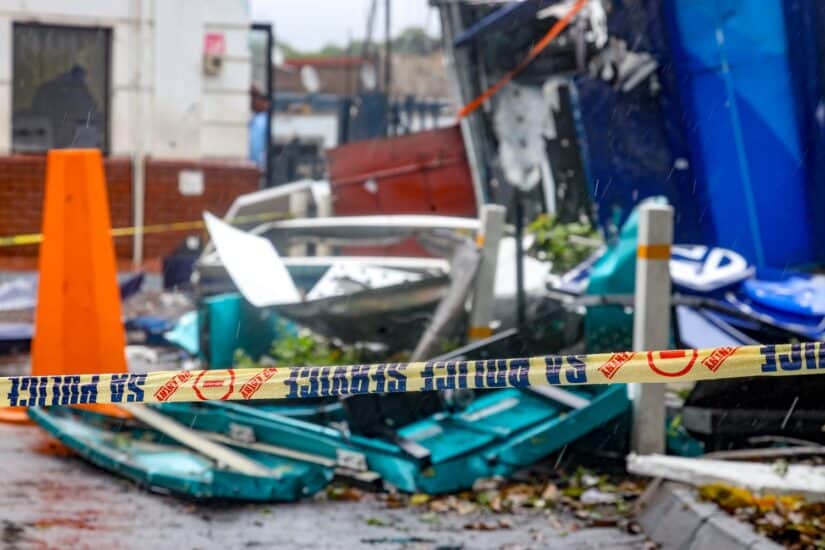
A crime scene after a ATM was bombed at Engen Garage in Meadowlands Zone 2 on 30 September 2026 in Soweto, South Africa. Picture: Gallo Images/Sharon Seretlo


South Africa continues to face a severe violent crime crisis that touches every corner of society.
Official police statistics show that approximately 58 people are murdered every day in South Africa, alongside dozens of daily rapes, kidnappings, and violent assaults.
Just recently, this reality was laid bare in the Vusimuzi Informal Settlement in Thembisa, Ekurhuleni, where 18 dead bodies were discovered over an 18-month period. Highlighting the failure of local policing, the DA revealed that out of 18 murder cases opened in Vusimuzi, 15 remain completely unsolved without a single arrest.

LIVE interactive map, latest news, multimedia and more!
View MapBecause crime and lawlessness threaten lives and economic stability nationwide, public safety is one of South Africa’s biggest issues today.
Here is how the country’s four biggest political parties plan to fix the police, take down violent gangs, and make communities safe if elected to govern:
ANC
The ANC bases its public safety agenda on deep community integration, state-led municipal interventions, and protecting state infrastructure.
“Convening and strengthening Community Safety Forums (CSFs) in every municipality within the first 100 days” is among its objectives. These forums bring together the police, local residents, business owners and traditional leadership under a shared safety strategy.
A primary pillar of the party’s strategy involves modernising public spaces and protecting vital public assets.
The party’s manifesto commits to establishing monitored CCTV networks in crime hotspots and using specialised law enforcement units to “strengthen municipal law and traffic enforcement visibility, combat infrastructure theft, and protect municipal projects from extortion networks”.
The party’s manifesto places special focus on combating gender-based violence and femicide (GBVF) through localised care networks and strict alcohol trade monitoring.
Additionally, it wants to target urban decline and illegal land occupation by “reclaiming hijacked buildings and combat criminal syndicates and slum lords to restore safe usage for housing”.
DA
The DA wants to fix policing by shifting power away from the central government and into local hands.
The DA argues that running the entire police force from a head office in Pretoria makes leadership too slow, out of touch, and unable to fix local issues. To solve this, they want provincial and city governments to manage their own police stations so officers can respond quickly to what their neighbourhoods actually need.
Its manifesto includes the policy of “devolving policing powers to provincial governments to ensure local stations are properly resourced, staffed, and held accountable”.
Under this local approach, the DA focuses heavily on fixing the physical problems in high-crime neighbourhoods. By putting up bright streetlights, opening up accessible road networks in informal settlements, and cracking down on illegal drinking spots, the DA aims to eliminate the conditions that enable violent crime to thrive.
To clear massive backlog dockets and raise South Africa’s low conviction rate, the DA proposes deploying expert investigation teams that work directly alongside court prosecutors to prepare strong cases.
“[The party will] implement the CCC approach – Catch, Convict, and Clean – to speed up investigations and secure judicial outcomes,” its manifesto notes.
Finally, the party prioritises integrating private security networks, neighbourhood watches, and community policing forums (CPFs) directly into precinct security grids, ensuring that victims receive swift interventions rather than empty political promises.
“South Africa does not need more announcements… Victims deserve more than statements. They deserve outcomes.”
MK party
The uMkhonto weSizwe (MK) party approaches public safety through mass state recruitment, stricter legal penalties, and militarised border security.
Identifying the severe shortage of police officers as the primary reason for widespread disorder, the MK party proposes adopting “a multifaceted approach that involves increasing investments in law enforcement recruitment, training, and equipment.”
To tackle gender-based violence, the MK party mandates establishing dedicated, specialised investigation units across all precinct stations nationwide to ensure rapid prosecution.
“[The party will] ensure that each police station has a well-resourced specialised unit dedicated to the investigation of gender-based crimes,” its manifesto reads.
The party advocates for radical constitutional changes to deter violent offenders, including putting the return of capital punishment directly to the South African public. It advocates for “holding a referendum on the death penalty.”
EFF
The EFF centres its safety manifesto on deploying technology, building accessible policing infrastructure, and fast-tracking municipal justice. The party demands a complete structural renovation of local police stations and holding facilities to ensure universal accessibility for all citizens.
These upgrades would include equipping municipal security hubs and courts with smooth entrance ramps, automated doors, and accessible holding facilities.
To curb rising violent crime rates, the EFF prioritises targeted anti-GBVF programmes at high-incident police stations across the country.
The party heavily emphasises modernising law enforcement through real-time tech, while creating local municipal courts to rapidly process local by-law violations without overloading regional court dockets.
“[The party will] establish municipal courts for fast-tracked by-law enforcement and deploy modern tech, including CCTV, drones, gunshot detection systems, and real-time monitoring centres,” the manifesto reads.
The EFF also plans to fight internal police corruption by conducting compulsory financial background checks on officials and requiring all police officers to pass physical fitness tests twice a year.
“[The party will] conduct lifestyle audits of municipal officials to root out internal corruption.”
The road ahead
The tragedy of Vusimuzi serves as a grim reminder that South Africa’s policing crisis requires urgent, decisive action.
Whether through the DA’s localised decentralisation, the ANC’s community-integrated safety forums, the MK party’s hardline militarisation, or the EFF’s tech-driven municipal oversight, South Africans are demanding a shift from political rhetoric to visible, life-saving protection.