A time for an honest conversation about South Africa’s future
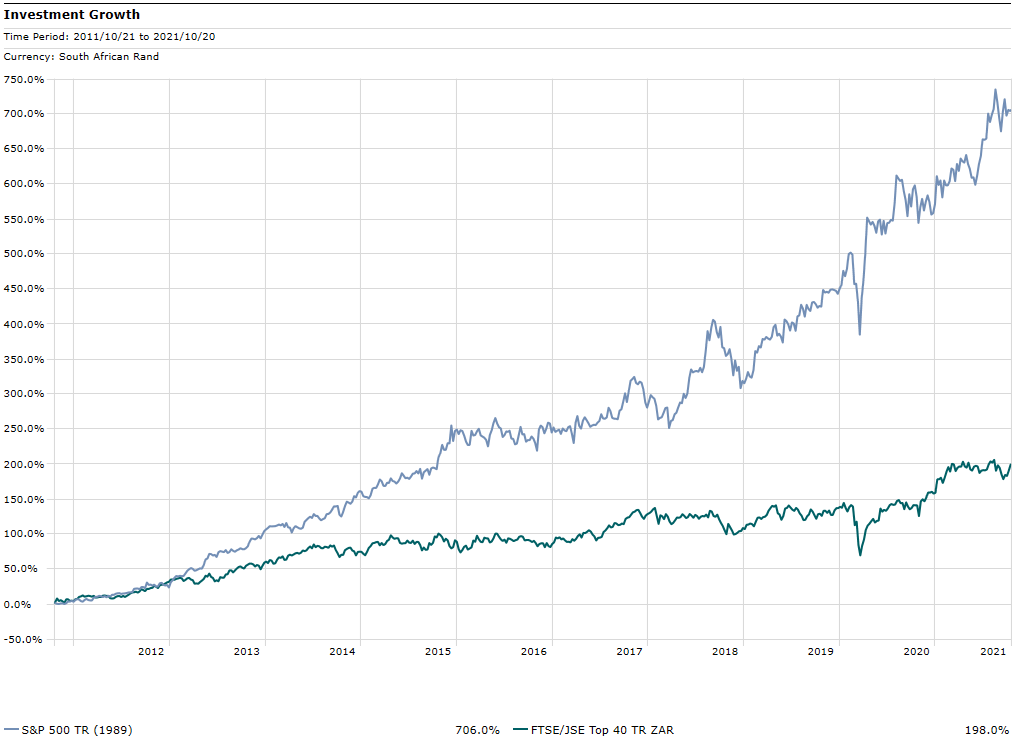
No one likes to be the one who says “I told you so” 10 years after the fact and then gloat about it. But have a look at the accompanying graph which shows the S&P 500 index growing 706% over the last 10 years while the JSE Top 40 index struggled to gain just 200%.
I won’t be so bold as to say the next 10 years will be a repeat of this pattern, but I would not discount it either. The lesson is clear: those who bet on a rosy future for SA are likely to be disappointed. You’re betting on a miraculous and almost religious conversion in the ruling party to the virtues of free enterprise and light-touch policy.
That’s unlikely to happen. After 25 years in power, the ANC has shown no real willingness to embrace the harsh reality that it is business that makes the economy function, not a meddling bureaucracy.
You don’t have to stretch the mind too far to come up with a list of scandals relating to the SA government: Bankrupt municipalities, Eskom’s ongoing maintenance issues, load[1]shedding and mismanagement, Transnet following the same ill-fated path our SOEs have taken before, state capture and the riots that followed Zuma’s arrest.
Non-profit organisation Open Secrets estimates that state capture has cost the economy R5 trillion and cost the country five million jobs. Yet the recipients of this larceny walk around untouched. Bank of America expects debt-to-GDP to sail past 100% by 2024 from the 77.06% at the start of 2021.
Difference between S&P 500 and JSE Top 40 indices in ZAR
That will impact all South Africans in the form of higher taxes and ultimately inflation. Then there is the prescribed assets issue – which could lock more of your savings into government-backed projects and state[1]owned companies, with the possibility that the returns will not even keep pace with inflation.
Make no mistake – SA is still a great country with some of the sharpest and most enterprising people in the world, but to live comfortably in this country you need to protect and grow your wealth. As the graph shows, investing in SA Inc is a lost cause. Some of the more interesting investment stories in the world are denied South Africans who confine their investment choices to the JSE.
Take financial services, for example. Five of the top 20 stocks in the S&P 500 are banks and financial services groups: JP Morgan Chase, Visa, Mastercard, PayPal and Bank of America. These stocks are in the throes of a robust recovery after being hammered at the start of the Covid crash in April 2020.
The FTSE/JSE Top 40 index is massively weighted in favour of a few large shares: BHP Group (12.14 %), Richemont (11.96%), Anglo American (9.96%), and Naspers (12.38%). These four stocks account for almost half the total weighting in the index, with 10 companies making up close to 70% of the index.

The entire universe of stocks of the JSE numbers around 400, as opposed to the thousands of stocks available to the offshore investor. More important than the number of opportunities offshore is the quality of these stocks.
The world’s largest retailers, tech companies, banks and consumer goods companies form part of the S&P 500. These are opportunities denied to South Africans who do not take advantage of their offshore investment allowances.
To protect and grow your wealth you need to invest in offshore markets to gain access to the likes of Microsoft, Amazon, Apple and the universe of global stocks that are simply not available on the local market. Consider that Amazon’s share price is up an astonishing 83% since the start of lockdown in March 2020. Microsoft is up 92%. Apple has more than doubled.
These extraordinary gains have been denied South Africans pinning their hopes on a JSE with a tiny pool of 400-odd stocks, accounting for less than 2% of the world market. I’ve been advocating an offshore investment approach using low-cost passive index funds for the best part of a decade. And the graph above illustrates the wisdom of this advice.
Need I say more! Many South Africans have demurred about taking a more aggressive offshore position believing that the country would eventually come right. While I certainly hope this is true, I am not prepared to bet on it. South Africa’s GDP contract by 7% in 2020 as a result of the pandemic and Treasury estimates that the economy will grow by 3.3% in 2021.
To give this some context, this will put us at 2014 GDP levels. Leaving your savings in SA exposes you to all sorts of risks: that the rand will hold it’s value against hard currencies (it will not); that the JSE will rebound on the back of a strong economic recovery (maybe briefly); that the fiscal cliff facing the country will be masterfully navigated by the Department of Finance (doubtful).
And that the thieves who stole the state capture jewels will be sent to jail (we have seen how that has played out with former president, Jacob Zuma).
My view today is the same as it was 10 years ago. Move as much funds offshore as you are legally allowed if you want to protect and grow your wealth by investing in high quality, income producing assets (in hard currencies).
Those South Africans who have achieved wealth have done so in precisely this manner. Don’t wait another 10 years to learn this lesson.
About International Wealth & Prosperity
International Wealth & Prosperity (IWP) are specialist investment advisors, delivering a highly personalised approach to managing your investment portfolio, and aims to achieve long term growth both in your investments and in client relationships.
All decisions are based on a detailed understanding of each client’s risk profile and investment objectives.
Each client is embarked on a highly individual life journey, and the IWP investment approach reflects this – each step of the way, with the aim of bringing home the returns safely and without fail. IWP is a licensed financial service provider (FSP 43982).
For more information contact:
Pierre Cloete on 083 601 1380 or send an email to pierre@iwpsa.com. Alternatively you can visit the website.