A skirmish between SANDF members and Tshwane Metro Police in Pretoria has raised concerns about military discipline.
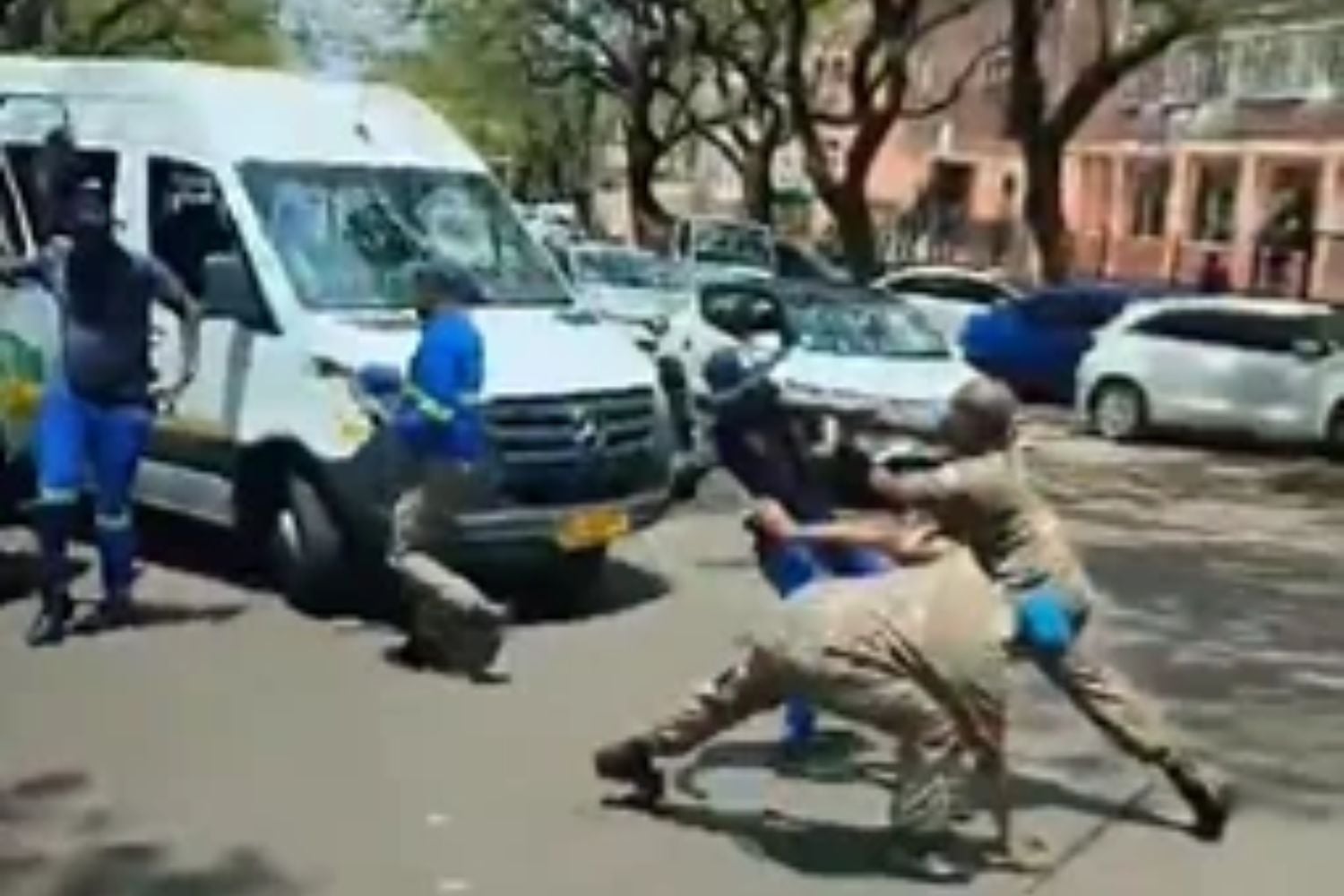
The TMPD has condemned the alleged assault and intimidation of its officers by SANDF members during an operation to remove illegally parked vehicles obstructing traffic on Visagie Street in Pretoria. Picture: Screengrab


A skirmish between members of the SA National Defence Force (SANDF) and Tshwane Metro Police Department (TMPD) officers in Pretoria has raised concerns about military discipline and the relationship between the military and civilian law enforcement.
The incident, which occurred in Visagie Street on Tuesday, erupted when TMPD officers attempted to remove illegally parked vehicles obstructing the road.
According to the TMPD, SANDF members confronted the officers, with one soldier allegedly disarming one and pointing a firearm at others.
SANDF and Tshwane Metro Police clash on Visagie Street
A criminal case has been opened, as the SANDF described the confrontation as “regrettable”, adding the circumstances must be established.
This is not the first clash between TMPD and the SANDF.
In May 2021, TMPD publicly scolded the SANDF after a military change-of-command parade at Thaba Tshwane caused traffic congestion.
TMPD said the military had not sought permission for the event, which affected traffic management.
Criminologist Kholofelo Rakubu, said the incident raised serious questions about whether SA’s security institutions understood and respected one another’s constitutional mandates.
“What concerns me is that two institutions entrusted with protecting the public reportedly became involved in a confrontation over a routine traffic enforcement matter. This suggests a breakdown in professional coordination and respect for institutional mandates.
Soldiers are not above the law – experts
“In a constitutional democracy, security institutions should complement one another, rather than compete over authority.”
The presence of armed soldiers did not automatically give the military authority over civilian law enforcement agencies, Rakubu said, adding the constitution and the South African Police Service Act establish distinct responsibilities for the military and policing institutions.
The SANDF’s primary responsibility is to defend and protect the country, while municipal police have statutory functions that include traffic policing and municipal by-law enforcement.
“The presence of armed soldiers does not displace civilian law enforcement authority. If military personnel believe a municipal officer is acting unlawfully, the appropriate response is to invoke legal and command procedures, not to resort to intimidation or force,” Rakubu said.
The confrontation should not be dismissed as an isolated disagreement over illegally parked vehicles.
“Ultimately, the legitimacy of any security institution rests not on the authority it claims, but on its ability to exercise lawful power with discipline, restraint and respect for constitutional principles,” Rakubu said.
Concerns of maintenance of discipline within SANDF
Defence and security expert Dean Wingrin said the incident raised concerns about the maintenance of discipline within the SANDF and brought the country’s troubled civil-military relationship into sharp focus.
Soldiers were not above the law and could not use military authority to obstruct civilian law enforcement, he said.
“SANDF members do not have carte blanche when operating in civilian spaces. They do not enjoy blanket authority over civilian authorities, nor are they above civilian law,” Wingrin said.
Military vehicles could be moved or impounded if they obstructed traffic, as military personnel were not exempt from traffic laws, municipal by-laws or lawful police instructions.
“Basically, this comes down to education and training, on both sides. The military operates in a different environment to that of civilians, with very little attention being given to training soldiers to operate in a civilian environment,” Wingrin said.
Some soldiers appeared to believe civilian authorities had no authority over them, he said.