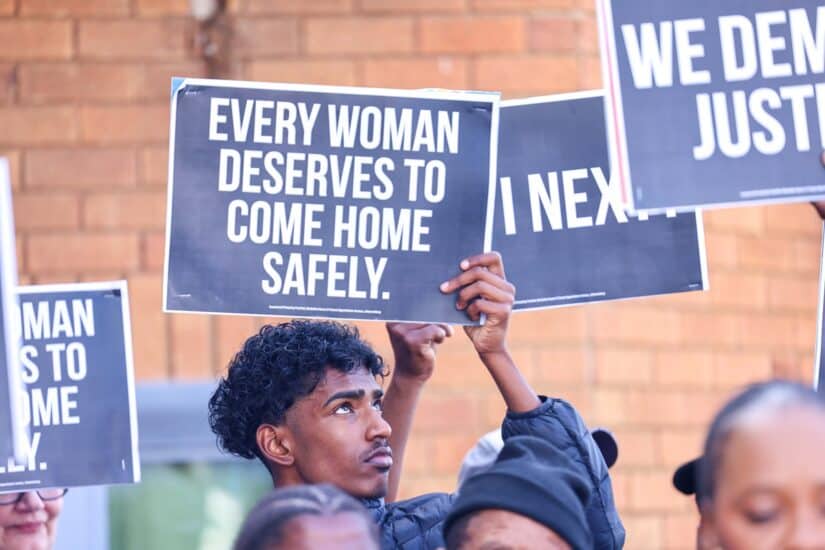
The lifecycle of state response in South Africa from report to rehab remains fundamentally broken. Why? These human rights bodies probe.
South Africa’s systemic failure to protect women has reached a catastrophic breaking point, reducing constitutional rights to mere paper guarantees while blood flows in the streets of Ekurhuleni.
Driven by this operational collapse, the South African Human Rights Commission (SAHRC) – alongside two fellow Chapter 9 institutions – will launch a historic Joint National Inquiry on September 28 to interrogate the country’s entire criminal justice machinery.
State failure triggers historic constitutional intervention
The decision to probe state mechanisms follows a brutal string of killings in Gauteng, where nine women were murdered within two months in Ekurhuleni alone.
Expressing profound horror at the ongoing bloodshed, the Commission declared that the country remains inherently unsafe for female residents. They have condemned a system that leaves victims to battle this devastation in isolation.
According to SAHRC, the persistent terror highlights a fundamental breakdown in basic rights:
“Violence against women remains a societal ill that robs women of their basic human rights to life, safety, dignity, and freedom, as enshrined in the Constitution.”
An enemy hidden in plain sight
Crucially, the inquiry targets the pervasive myth surrounding the profiles of offenders. Here GBV is framed not as an isolated anomaly, but as an embedded crisis inside homes, workplaces, and local communities.
Quoting Justice Khampepe’s landmark ruling in S v Tshabalala, the Commission reminded the nation of the grim reality regarding perpetrators:
“The notion that rape is committed by sexually deviant monsters with no self‑control is misplaced… Often, those who rape are fathers, brothers, uncles, husbands, lovers, mentors, bosses, and colleagues.”
A group of women sing the national anthem during a march against GBV in Kempton Park following a spree of murders in the area. @TheCitizen_Newspic.twitter.com/C5r3UQvijI
Despite presidential declarations framing GBV as a national disaster, recent police statistics present an appalling reality.
569 women were murdered between April and June 2026.
1052 women survived attempted murder within the exact same three-month window.
8814 rape cases were formally logged in the first quarter of the year alone.
The crisis extends into learning institutions, where the SAHRC’s 2026 report on school safety uncovered rampant abuse carried out by educators, peers, and external service providers.
Scheduled to run from 28 September to 2 October, the joint inquiry – conducted alongside the Commission for Gender Equality (CGE) and the CRL Rights Commission – will dissect the complete lifecycle of state response.
Investigators will examine case reporting, victim support, police investigations, prosecutions, sentencing, and offender rehabilitation.
Municipal accountability will also face scrutiny, with commissioners pointing out that broken streetlights, unmaintained fields, and abandoned buildings directly enable violence.
“The Commission’s investigative reports on service delivery in municipalities have also stressed municipalities’ role in ensuring open fields are properly maintained, long grass is cut, abandoned buildings are rehabilitated, streetlights are working and water and sanitation infrastructure is accessible in safe spaces.”
The Commission is urging civil society and individual citizens to present evidence to help dismantle the systemic shortcomings hindering justice.