
Johnson said the arrest was a result of a criminal complaint filed by National Coloured Congress leader Fadiel Adams.
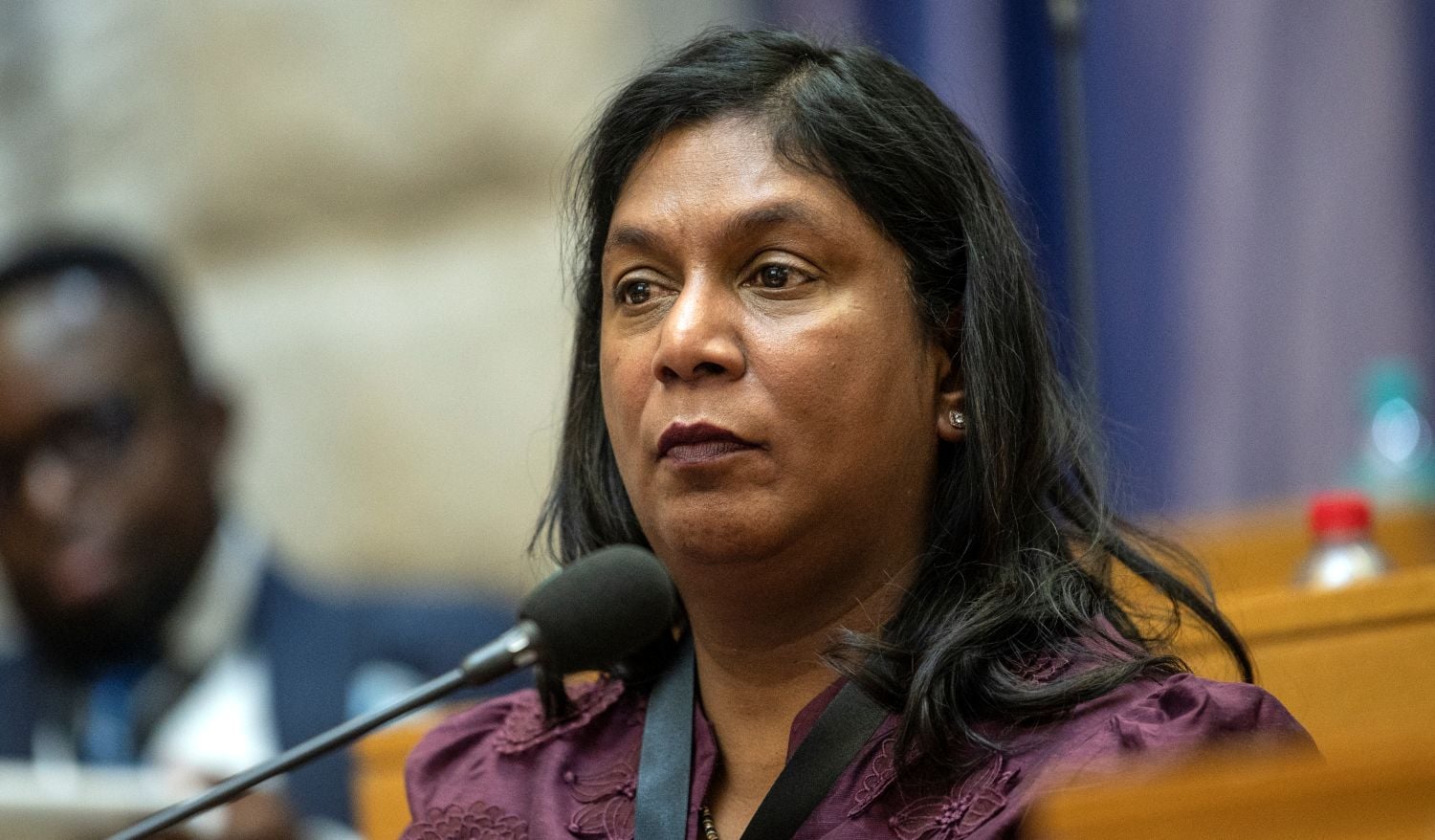
IDAC Head Andrea Johnson testifies at the Parliamentary Ad Hoc Committee inquiry into alleged corruption and political interference in the criminal justice system at Good Hope Chambers on November 06, 2025 in Cape Town, South Africa. (Photo by Gallo Images/Brenton Geach).


Head of the Investigating Directorate Against Corruption (Idac), Adrea Johnson, has dismissed accusations that Crime Intelligence head Dumisani Khumalo was arrested due to his involvement with the political killings task team (PKTT).
Johnson appeared at the Madlanga commission on Tuesday to respond to allegations Idac unlawfully operates outside of its mandate and that it pursued a criminal case against Khumalo and other officials at Crime Intelligence due to interference at the South African Police Service (Saps).
Khumalo was arrested on 26 June 2025 in connection with the alleged irregular appointment of a former BMW employee to the rank of brigadier. Johnson said the arrest was a result of a criminal complaint filed by National Coloured Congress (NCC) leader Fadiel Adams.
However, Khumalo has previously maintained that the corruption case against him was a labour-related dispute rather than criminal conduct.
He has since lodged representations with the office of National Director of Public Prosecutions (NDPP) Andy Mothibi, requesting a review of the decision by the National Prosecuting Authority (NPA) to prosecute him.
‘No drama’
Johnson dismissed claims that Khumalo was arrested in a “dramatic” fashion to embarrass him.
“Nothing can be further from the truth. Lieutenant-General Khumalo was arrested after he had landed at the Oliver Reginald Tambo International Airport. I do not recall where he was travelling from,” Johnson explained.
“The investigators went to OR Tambo to inform General Khumalo that there was a warrant for his arrest and for him to hand himself over. They had a warrant of arrest for him. Warrants of arrest had also been sought and obtained for his co-accused before they were requested to hand themselves over at the Brooklyn Saps.
“Upon finding him at OR Tambo, the two investigators explained who they were, why they were there, why he was sought and what his rights were. They then asked Lieutenant-General Khumalo to accompany them to Brooklyn Police Station in Pretoria. He cooperated and was taken there.
“There was nothing dramatic about it. At all times during his arrest, Lieutenant-General Khumalo’s security detail was with him. He was not threatened and was accorded all the respect that could be accorded a person of his profile. This speaks to anything but the conduct of a unit that is motivated by ulterior motives, other than to address alleged criminality.”
Johnson ‘not aware’ of Khumalo’s PKTT links
Johnson further defended her office from suggestions that Khumalo’s arrest was due to his involvement with the PKTT. KwaZulu-Natal police commissioner Nhlanhla Mkhwanazi told parliament’s Ad hoc committee in October last year that Khumalo’s arrest was an attempt to stop a criminal investigation in Gauteng.
“The arrest of Khumalo is a project to stop criminal investigations in Gauteng. The letter from the minister to disband PKTT is a project to stop criminal investigations in Gauteng,” said Mkhwanazi at the time.
However, Johnson said this was not true, saying that Khumalo was arrested for his conduct in his capacity as Crime Intelligence head. She said that at the time, she was not aware of Khumalo’s role in the PKTT.
“This suggestion is anything but true. It is false and unfortunate. The truth is that Idac was investigating Lieutenant-General Khumalo in his capacity as the Divisional Commissioner of Crime Intelligence for alleged unlawful conduct that manifested itself in the execution of his duties in that capacity.
“The fact that Lieutenant General Khumalo also held another portfolio in relation to the PKTT was not within our knowledge. At no stage was I, as the head of Idac, aware that Lieutenant General Khumalo had anything to do with the PKTT, let alone being its convener.
“In any event, even had I been aware of the same, such would have been irrelevant because of the reasons for his arrest.”
Referrals
Johnson said the Idac acted against Khumalo and his co-accused following a referral by Adams and was not treated “any differently”.
An Idac investigation revealed sufficient evidence to conclude that there was reasonable and probable cause for the prosecution.
“When one looks at all the cases referred to Idac by Mr Adams, they depict the capture of systems and processes for private interests by the head of CI and other senior managers. This too is an issue I intend to testify about, should I be granted leave to do so,” explained Johnson.
“The picture that has emerged is that the appointment and installation of certain persons in certain positions within the Crime Intelligence Unit, CIU, by Lieutenant General Khumalo and his co-accused persons helped them strategically to access funding without following proper processes.
“This is because the token appointments would not stop them from their unlawful acts. This is what Idac, upon looking at all the matters holistically, established.
“However, if one looks at an individual case, this bigger and clearer picture does not emerge. When looked at holistically, the cases depict state capture, fraud, corruption, and defeating the ends of justice.”
Although Johnson spoke of other “matters” connected to this case, she conceded that only one appointment was referenced by Adams in relation to the Khumalo matter.