Will political parties be able to put egos aside and form working governments?
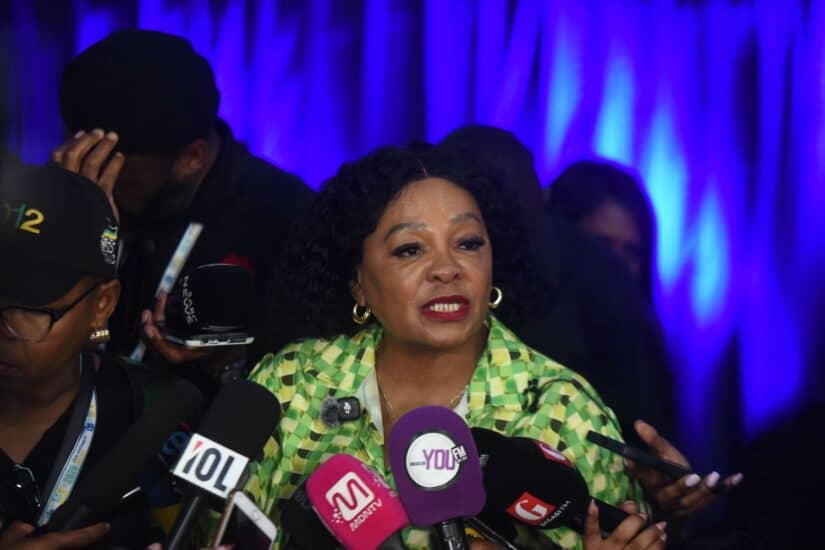
ANC Deputy Secretary-General, Nomvula Mokonyane briefs the media at the National Results Operation Centre (ROC) in Johannesburg, 5 November 2026, as results for the 2026 local government elections come in. Picture: Nigel Sibanda /The Citizen


With all but one of the country’s major metros lacking a clear winner and hundreds of municipal councils hung, the focus has shifted to coalition negotiations.
A hung council arises when no political party wins more than 50% of the seats in that legislature, and parties need to form a partnership to govern. Key to this is choosing a speaker of the council and a mayor.
A number of parties, including the DA, have confirmed that preliminary coalition discussions have already begun.
Political parties will all hold meetings this weekend to decide on possible coalition partners and how they will negotiate.
Here’s what some of the major political parties are saying so far about coalitions:
ANC
The ANC emerged from the 2026 Local Government Elections as still the country’s single biggest party, with around 30% of the total votes cast.
It fell from 45.59% in 2021 and now needs help to govern many of the areas where it once held an outright majority.
The ANC has said it will hold off on formal coalition talks until the results are officially announced on Sunday, but its deputy secretary-general, Nomvula Mokonyane, said the party is open to speaking with whoever wants to work together.
“As long as we ensure that there is stability and those six pillars that are contained in our manifesto are also reflected [in] what that political party stands for,” she said on Thursday.
She labelled speculation that it may have already started negotiating a local team-up with its biggest partner in the government of national unity (GNU), the DA, as “gossip”.
ANC Chief Whip Mdumiseni Ntuli did not rule out a coalition with the DA but said it had been bruised by DA mayoral leader Helen Zille’s campaign against it in Joburg and suggested it had left a bad taste in many leaders’ mouths.
He pointed to a possible coalition with current partner ActionSA in several areas, including in major Joburg metros.
He said the ANC was “not desperate” and did not “need saving”, and it should not be seen as such when it entered coalition discussions.
ANC Youth League (ANCYL) president Collen Malatji told The Citizen that the mother body should negotiate with political parties that respect black people and those that are previously disadvantaged.
He said the ANCYL supports coalitions with parties that are not “racist” or “extreme right-wing fringe groups” which are geared at “destabilising” the democratic system.
DA
“We have already reached out to many parties over the last 24 hours and will continue to do so today. At the moment, those talks are informal. They are more discussions about having discussions. The more formal and serious work will begin probably today or in the coming days.”
Hill-Lewis said the DA would enter negotiations with “respect and humility” and respect for the mandates other parties had received from voters.
“We will approach these coming negotiations with an attitude of deep respect and humility and respect, most importantly, for the mandate those parties have received from their voters.
“I want to invite other parties who want to put South Africa first, and residents of towns and cities first, to join us in these talks.”
Hill-Lewis suggested that his party will likely push for control of mayoral offices in coalition governments across South Africa’s hung municipalities.
Zille later said she preferred to work with the ANC or ActionSA to form a smaller, more manageable coalition.
“If we have to run a nine-party coalition dependent on the EFF, we will go into opposition because that is ungovernability defined. I’m not going into unworkable coalitions,” she also said on election day.
MK party
The country’s third-biggest party, the MK party, said it would work with parties who are “ideologically aligned”.
“We didn’t come here for coalitions. We came in because our people mandated us to represent them.
“We are mandated by the people of South Africa not to sell out. Not to sell out on the land question,” MK party acting deputy secretary-general Sifiso Mahlangu said.
“We’re going to have conversations with people who are aligned with us.”
He added that it would be difficult to negotiate with parties that hold fundamentally different views on transformation.
Party president Jacob Zuma added that the party was open to working with others, especially in eThekwini, where they hold around 34% of the votes so far.
“We are open. That is what we do because we want to rule and want the country to be worked on properly by the citizens who would feel that this country is what they need it to be,” he said.
He said the party’s national leadership would meet to discuss coalition arrangements
EFF
The EFF dropped support in the 2026 Local Government Elections but said its coalition plans would not change.
EFF secretary-general Marshall Dlamini said on Friday that the party will reflect on the results before deciding who to work with.
“You have seen in the previous term that we participated in government; we had MMCs in local government, and we are going to take that same direction.
But it’s not going to be coalitions at all costs, even at the destruction of the EFF.
“So we must make sure that what we put on our manifesto will be our priority, especially in areas that are not serviced and where unemployment is high. These areas have issues with land and housing. We will deal with those and put them on the table,” he told broadcaster Newzroom Afrika.
He said the party is open to coalition negotiations centred around service delivery, but would not talk to those who put forward “racist” budgets.
“We are not going to sit at the table with those who want racism. They want to see our people remain isolated and disrupted.”
He referenced Cape Town, where he said most of the budget goes to servicing areas where white people live, while townships remain underdeveloped.
“If the majority of the budget does not go to our people, then there is no point. We represent our people: the forgotten, the unemployed, the downtrodden, the landless, and the homeless. We cannot be in a coalition for the sake of it with people who are clearly saying they want to prioritise state land. The strategic resources should belong to our people
“We are still an organisation with an identity and policy.
“We will put that on the table. We will not sell out our people in the interest of coalitions or because we want to be in a coalition at all costs.”
ActionSA
ActionSA is likely to be a kingmaker itself in the hung Gauteng metros, and has said it is open to negotiating coalitions. It currently works with the ANC in the province but has not ruled out discussions with the DA, despite tensions between the parties.
Leader Herman Mashaba said the party would not be dictated to on who they should work with, amid calls for them to team up with the DA rather than the ANC.
“This is very annoying. DA members think that they have a self-imposed superior thinking to determine the rights of others. They openly work with the ANC through a front door, including protecting their corrupt activities, but others must not work with the ANC. They are certainly antagonising some of us who are independent,” he said.
Tshwane mayor Nasiphi Moya said discussions would be held at a national level but that the secret to coalitions is to focus on what is important and put egos aside.
“It is never about you; it is about the collective. It is about how you move each other on a daily basis and reaching consensus on difficult subjects”.