The taxi boss claimed he experienced 'hope' when his rival, Jotham 'Mswazi' Msibi, died in 2024.
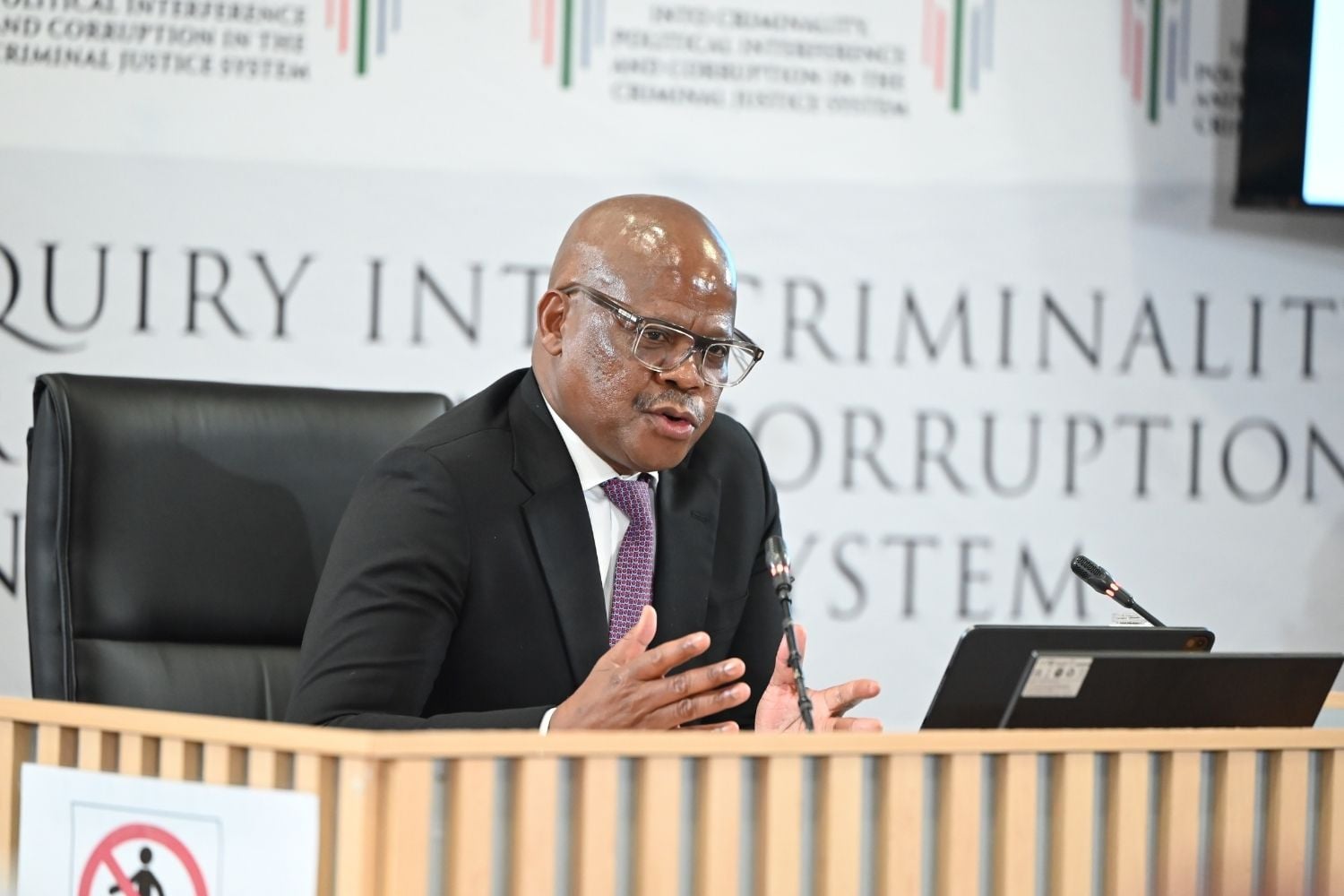
Johannes ‘Joe Ferrari’ Sibanyoni appears before Madlanga commission at Brigette Mabandla Judicial College in Pretoria on 28 August 2026. Picture: Gallo Images/Frennie Shivambu


Taxi boss and businessman Johannes “Joe Ferrari” Sibanyoni has told the Madlanga Commission of Inquiry that alleged Big Five cartel leader Jothan “Mswazi” Msibi tried to have him killed.
Sibanyoni appeared before the commission at the Brigitte Mabandla Justice College in Pretoria on Friday, 28 August 2026, where he gave an account of his longstanding involvement in the minibus taxi industry, his business interests and two alleged attempts on his life.
Joe ‘Ferrari’ Sibanyoni testifies at Madlanga commission
Sibanyoni, who is out on R70 000 bail relating to an extortion case, used his testimony to distance himself from criminal networks.
He introduced himself as a businessman with interests in transport and property, saying he had built his empire over more than four decades through “legitimate commercial activity”.
The taxi boss also highlighted his Christian faith, describing it as a source of strength during what he characterised as years of danger and institutional failures.
“I have walked with God throughout my adult life, and my faith has been the bedrock of my endurance through circumstances of extraordinary personal danger and institutional failure.
“I do not regard my survival of two assassination attempts as mere fortune. I regard it as providence. This faith is not peripheral to who I am.
“It is constitutive of it. It shapes the way I conduct my affairs, the way I treat people, and the way I approach this commission,” Sibanyoni said.
Sibanyoni also addressed his nickname, “Joe Ferrari”, telling the commission that it had developed naturally over the years as a result of his lifestyle and personality.
“It is a social nickname. It carries no criminal connotation whatsoever,” the taxi owner remarked.
He went further, emphatically denying any association with organised crime.
“I deny, emphatically and absolutely, that I am or have ever been a member of any criminal organisation, cartel, syndicate or grouping.
“I have never directed, financed, commissioned or participated in any unlawful activity.”
‘Cycle of assassination’
Much of his testimony focused on violence within South Africa’s taxi industry and what he described as sophisticated attempts to eliminate those involved in organised killings.
He said some murders were followed by further attempts to kill hired assassins, allegedly to prevent them from revealing who had commissioned the original killings.
“This cycle of assassination, counter-assassination, silencing of witnesses and the hiring of new izinkabi (hitmen) is self-perpetuating and extremely difficult to investigate.”
Sibanyoni further told the commission that he had raised concerns about criminal networks allegedly operating alongside law enforcement officials with former police minister Bheki Cele, particularly in May 2022.
But Cele allegedly dismissed his concerns.
First alleged assassination attempt
Sibanyoni told the commission that he survived a shooting in either 2006 or 2007, after having had a social engagement with Msibi.
Msibi died in January 2024 following a short illness.
Sibanyoni alleged that he was shot by an “ally” of Msibi, who has been described as the alleged leader of the Big Five cartel.
The shooting prompted him to temporarily leave the taxi industry and enter the truck sector. He returned to the taxi business in 2008.
“A person who is protected does not need to hide. A person who is powerful does not need to flee.
“The fact that I fled and that I returned is itself evidence of the position I occupied: not as a predator within the industry, but as a target within it.”
Agreement leads to friendship
After returning to the taxi industry, Sibanyoni entered into a partnership with Msibi.
He told the commission that he was given responsibilities within a taxi association, including ensuring that widows and elders were cared for.
The two men also agreed that they would retire when they reached the age of 60, with Sibanyoni expected to succeed Msibi.
“Though he was a little bit older, we became friends and, therefore, as we planned, [we decided that] we need to have an exit plan because the industry is not a nice space to be in.”
However, according to Sibanyoni, that arrangement changed in 2019 when Msibi allegedly called him and sought to reverse the agreement.
He alleged that Msibi also threatened him.
“His words, as I clearly recall them, were to the effect that ‘this is taxi business, we die working’.
“I received those words not merely as a change of plans. They were spoken by a man who had, years earlier, already sent people to kill me.
“In that context, ‘we die working’ was not simply an expression of commitment to the industry.”
Cutting ties with Msibi
Sibanyoni told the commission he began distancing himself from Msibi and eventually cut ties with him in 2020.
He alleged that, after their relationship broke down, Msibi allegedly increased the number of hitmen around him and continued associating with controversial figures, Katiso “KT” Molefe and Vusimuzi “Cat” Matlala.
Both men have been alleged to be linked to the Big Five cartel.
Sibanyoni testified that the August 2022 attempt on his life, during which he was shot twice at the Centurion Residential Estate and Country Club, should not be viewed as an isolated incident.
According to him, the shooting was the culmination of an “escalating campaign” against him following the breakdown of his relationship with Msibi.
“What unfolded in the months preceding August 2022 was not spontaneous. It was planned, organised and executed over an extended period,” he said.
Matlala and several others have been charged in connection with the 2022 attempted murder of Sibanyoni.
The matter is due to return to the Gauteng High Court in Pretoria on 31 August, when the trial is scheduled to resume.
Sibanyoni confirmed to the commission that he expects to testify at the trial.
He stated that when Msibi died, he felt hopeful.
However, this was “short-lived” because of renewed instability within the taxi industry.