Minister rejects calls for apology over drug den remarks, defends South Africa's right to enforce its own immigration laws.
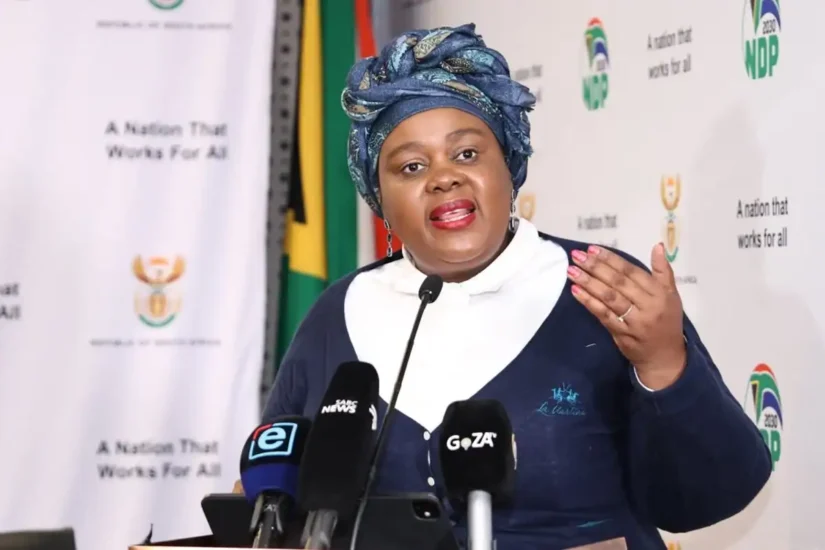
Minister of Justice and Constitutional Development, Mmamoloko Kubayi. Picture: X/@DOJCD_ZA


Justice and Constitutional Development Minister Mmamoloko Kubayi has rejected calls for Minister in the Presidency Khumbudzo Ntshavheni to apologise to Nigerians, insisting her earlier remarks about drug dens had been misrepresented.
Kubayi said this during a heated exchange with a Nigerian journalist at an Interministerial Committee (IMC) on Migration press conference held at Tshedimosetso House in Pretoria on Sunday.
Earlier this month, Ntshavheni addressed a Cabinet briefing, during which she answered questions about compensation for foreign nationals and migrants who had abandoned informal or legally acquired property.
At the time, Ntshavheni said, “We will be interested to know where the drug dens of Nigerians are.”
Exchange over Ntshavheni remarks
On Sunday, the journalist pressed Kubayi on whether Ntshavheni would apologise for the comment, arguing that it was inappropriate at a sensitive and volatile time for South Africa’s relations with Nigeria.
According to Kubayi, no apology was necessary because Ntshavheni had spoken in her official capacity.
“I don’t think Minister Ntshavheni needs to issue an apology. When she spoke, she spoke on behalf of South Africa,” she said.
Kubayi maintained that Ntshavheni’s comments reflected complaints raised by South Africans themselves about drug dens in areas such as Hillbrow and Sunnyside, rather than an accusation against an entire nationality.
“Minister Ntshavheni never said all Nigerians are drug dealers in the statement. Never. There’s no way she said that,” she said.
Kubayi defends South Africa’s sovereignty
As the journalist repeatedly interjected during her responses, Kubayi asked for the exchange to be conducted with greater decorum.
“I am going to appeal to you, as a minister of the Republic of South Africa,” she said, adding that she was requesting to be allowed to complete her answers before further questions were raised.
She argued that criticism of South Africa from multiple countries at once was placing unfair pressure on the government, and said the country would not stay silent in the face of such criticism.
“We want to reiterate here, as the South African government, that it does not help for all countries to attack South Africa unwarrantedly.
“We will have to defend ourselves as a country and defend South Africans as their elected representatives,” she said.
Kubayi added that any formal complaint from the Nigerian government should be raised through diplomatic channels via the Department of International Relations and Cooperation (Dirco), rather than aired in public confrontation.
Ntshavheni addresses regional cooperation
Ntshavheni herself also responded to questions during the briefing, focusing on government’s engagement with the home countries of migrants to address the root causes of illegal immigration.
She said the matter went beyond repatriation and deportation, pointing to work already underway through the draft white paper on immigration, refugee protection and asylum seekers, as well as South Africa’s commitments as chair of SADC and as a member of the African Union (AU).
On the drivers of migration into South Africa, she said, “It’s part of the issues that Minister Cachalia has just referred to now of the instability that makes the governments not being able to protect their own nationals.”
Ntshavheni added that the country’s approach was tied to continental development goals aimed at reducing the push factors behind migration.
Cachalia cites misinformation directed at government
Acting Police Minister Firoz Cachalia also weighed in, telling the same journalist that criticism of South Africa needed to be balanced against what he described as a wave of misinformation targeting the country.
“There is a lot of misinformation and inflammatory rhetoric being directed at this government,” he said.
Cachalia said he understood the journalist’s frustration over unresolved cases involving Nigerian nationals but cautioned against framing isolated crimes as evidence that Nigerians were being singled out.
“I can indicate to you that we have a problem like your country. We have a problem of criminality. We don’t look at the nationality of the victim,” he said.