Ipid had become concerned about what it described as a surge in extra-judicial killings since 2023.
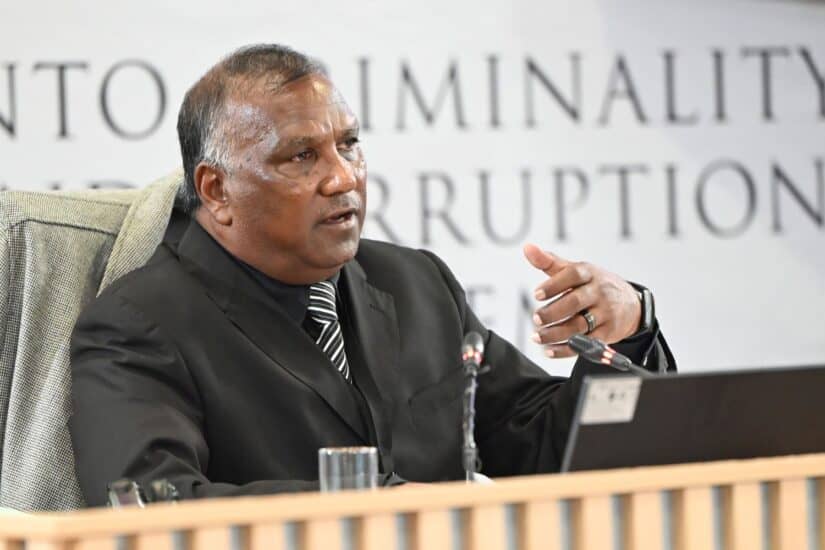
Independent Police Investigative Directorate (Ipid) Deputy Director Len John testifies before the Madlanga commission at the Brigitte Mabandla Justice College in Pretoria on 12 August 2026. Picture: Gallo Images / Frennie Shivambu


Serious allegations about the conduct of specialised police task teams in KwaZulu-Natal (KZN) have emerged before the Madlanga commission, with an Independent Police Investigative Directorate (Ipid) official claiming that some officers may be deliberately killing suspects.
Len Barnabas John, Ipid’s deputy director for investigations in KZN, appeared before the commission at the Brigitte Mabandla Justice College in Pretoria on Wednesday, 12 August 2026.
His evidence centred on three specialised task teams operating in the province and their alleged involvement in extra-judicial killings as well as their links to criminal syndicates.
Ipid questions police shootings at Madlanga commission
John told the commission on Wednesday that Ipid had investigated numerous shootings involving the task teams, including the unit responsible for probing cash-in-transit (CIT) robberies.
The CIT task team is headed by Hawks officer Lieutenant-Colonel Deena Govender, while Colonel Mbongeni Samuel Khalishwayo leads the team dealing with drug syndicates and Captain Pedro Rodrigues heads the unit focused on the taxi industry.
John testified that he believed the three task teams fell under the authority of KZN Police Commissioner Nhlanhla Mkhwanazi.
He warned that the alleged involvement of the task teams in organised crime investigations created the possibility that criminal syndicates would attempt to influence police operations to eliminate rivals.
“There is clear evidence that this risk has materialised in KwaZulu-Natal,” John remarked.
Alleged links between police and tow-truck industry
The Ipid official also raised concerns about alleged relationships between police officers and individuals operating in the tow-truck industry.
John referred to the April 2023 shooting in which alleged drug lord and tow-truck operator Bevan Loftus and four other people were killed by police.
He told the commission that allegations had been made that Govender was instructed by alleged drug and tow-trucking gang leader Clive Naicker to deploy the task team against Loftus, whom Naicker allegedly viewed as a competitor.
Ipid, John continued, had identified instances in which police officers were allegedly connected to particular tow-truck companies, which he claimed appeared to have “free rein” in criminal activity.
“It’s a known fact that certain police officers at station level are linked with certain tow truck businesses.
“We also identified that… you’ll get police officers who will give jobs to certain tow trucks in order to get a payment, more like an incentive, from them.”
According to John, some tow-truck businesses were allegedly being used to facilitate the movement of drugs.
“The reason they do that is because they have police friends that don’t ever stop and search them. Even at roadblocks, they have a free pass to go through.”
More than 300 cases investigated
John provided the commission with figures highlighting the scale of the shootings investigated by Ipid.
Between 1 April 2023 and 31 May 2026, Ipid had investigated more than 300 cases of extra-judicial killings involving the three task teams.
Of these, 77 cases involved 149 deaths resulting from police action.
John testified that Ipid was concerned that some of those killed may not have been legitimate suspects and could have been unlawfully targeted.
Police accounts commonly stated that suspects had been killed after exchanging gunfire with officers.
However, Ipid’s investigations sometimes uncovered evidence that did not support those versions of events.
“You’ll get a case where there are nine people that are shot, and you find only three firearms,” John told the commission.
John further questioned the failure by police to provide basic information about the suspects allegedly targeted during operations.
Many of the shootings, the Ipid official said, could not be properly linked to case numbers or identified suspects.
“In some cases, they cannot even give you the names of the deceased that they shot.
“So we believe that the police are not doing proper investigations to arrest the suspects. We can look from the examples that we have that they go out to kill the person.”
Concerns over possible crime-scene interference
The commission also heard that Ipid investigators sometimes face delays when attempting to reach scenes where members of the task teams have shot suspects.
John alleged that some Saps members allegedly delay notifying Ipid about such incidents.
These delays raised concerns that crime scenes could potentially be manipulated before the investigators arrived.
According to John, one of the concerns was that weapons or primer residue could potentially be placed on deceased suspects to support claims that they had exchanged gunfire with police.
John further highlighted the role played by the media in reporting police shootings, saying Ipid sometimes learned about incidents through social media.
He claimed media personnel are allegedly contacted before Ipid investigators are, resulting in journalists sometimes reaching crime scenes ahead of the police watchdog.
“At scenes where task teams are involved in the shooting, almost without exception, there are delays.
“Ipid has identified that media personnel are regularly contacted prior to Ipid officials being notified of the killings. There are instances where Ipid learns of Saps killings through social media posts by journalists.”
John added that a number of investigations into police shootings remained unresolved, with no convictions having been secured against officers in the pending matters.