


Residents of Tehran described sleepless nights, fear and exhaustion as tensions between Iran and Israel threatened to erupt again.
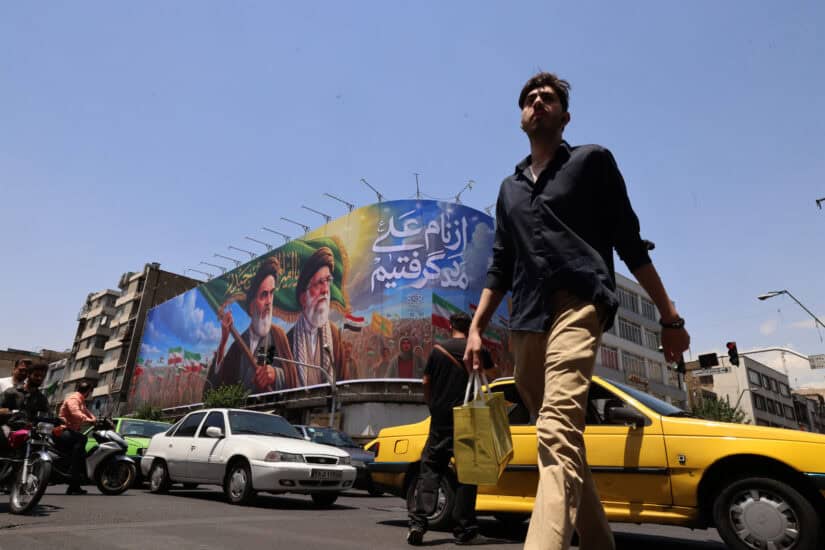
People cross the street past a large billboard showing portraits of Iran’s late supreme leader, Ayatollah Ruhollah Khomeini (L) and slain supreme leader Ayatollah Ali Khamenei (R) in central Tehran on June 8, 2026. Picture: Atta Kenare / AFP


Residents of Tehran awoke on Monday anxious and drained by the prospect of full-scale war resuming, following tit-for-tat strikes between arch-foes Iran and Israel that marked the greatest threat to the fragile ceasefire thus far.
“We don’t know if there will be a war, nor if a peace deal will last,” said Maryam, a 41-year-old accountant speaking to AFP in Tehran’s central Valiasr Square.
‘Uncertainty and confusion’
She described a pervasive “sense of uncertainty and confusion” after Israeli strikes on Tehran on Sunday, which came in response to Iranian strikes on Israel.
“Nothing is clear. People don’t know what to do, they are angry. Ultimately, it needs to be decided: are we at war or at peace?” she said, shortly before Iran announced it was ceasing its strikes on Israel.
Since Sunday evening, Iran had launched about 30 missiles at Israel, according to an Israeli military official, in response to deadly Israeli strikes on Beirut’s southern suburbs.
Israel meanwhile said it had struck and destroyed Iranian defence systems.
It marked the sharpest escalation since a ceasefire in the Middle East war took hold on April 8, and amid stop-start efforts to bring the fighting to a durable end.
On the ground, there was a marked sense of frustration as Iranians grappled with the possibility of renewed fighting.
“Today there were a lot of sounds in Tehran, mostly in the south. My body was shaking for an hour,” said Mahtab, a 62-year-old hairdresser. “If things continue this way, we will leave Tehran again.”
‘Don’t have hope’
Mahsa, a 31-year-old chemical engineer from Isfahan, said: “I have completely changed in these 100 days. From my former self, I only carry my name.
“I don’t have hope for anything anymore — not politically, not economically, not even for international help.”
In Tehran, a 36-year-old artist named Maryam said she was “unable to sleep” following last night’s attacks.
“Everything is headed towards destruction and ruin,” she lamented. “I pray that God will come to our aid.”
The normally buzzing traffic in the capital had quieted down on Monday morning, as some sheltered in their homes.
Life in the capital appeared to oscillate between fear and normality — cafe terraces were packed under the sun while elsewhere scooters lined up at petrol stations to refuel, fearing shortages.
Iranians nonetheless seemed unanimously exhausted by the fighting.
“The economy is paralysed, society is suffering from post-traumatic stress, morale is at rock bottom,” said Farhad, 35, a chef.
“No one knows what tomorrow has in store.”
Amir, 24, an IT technician, meanwhile noted that “at the beginning, we were afraid of the war, but we Iranians are known for our flexibility and we adapted”.
“It will be the same in the next war, because there’s nothing we can do about it,” he added.



