Why is the first thing we tell women when other women are killed that they need to be more careful, asks women's rights activist.
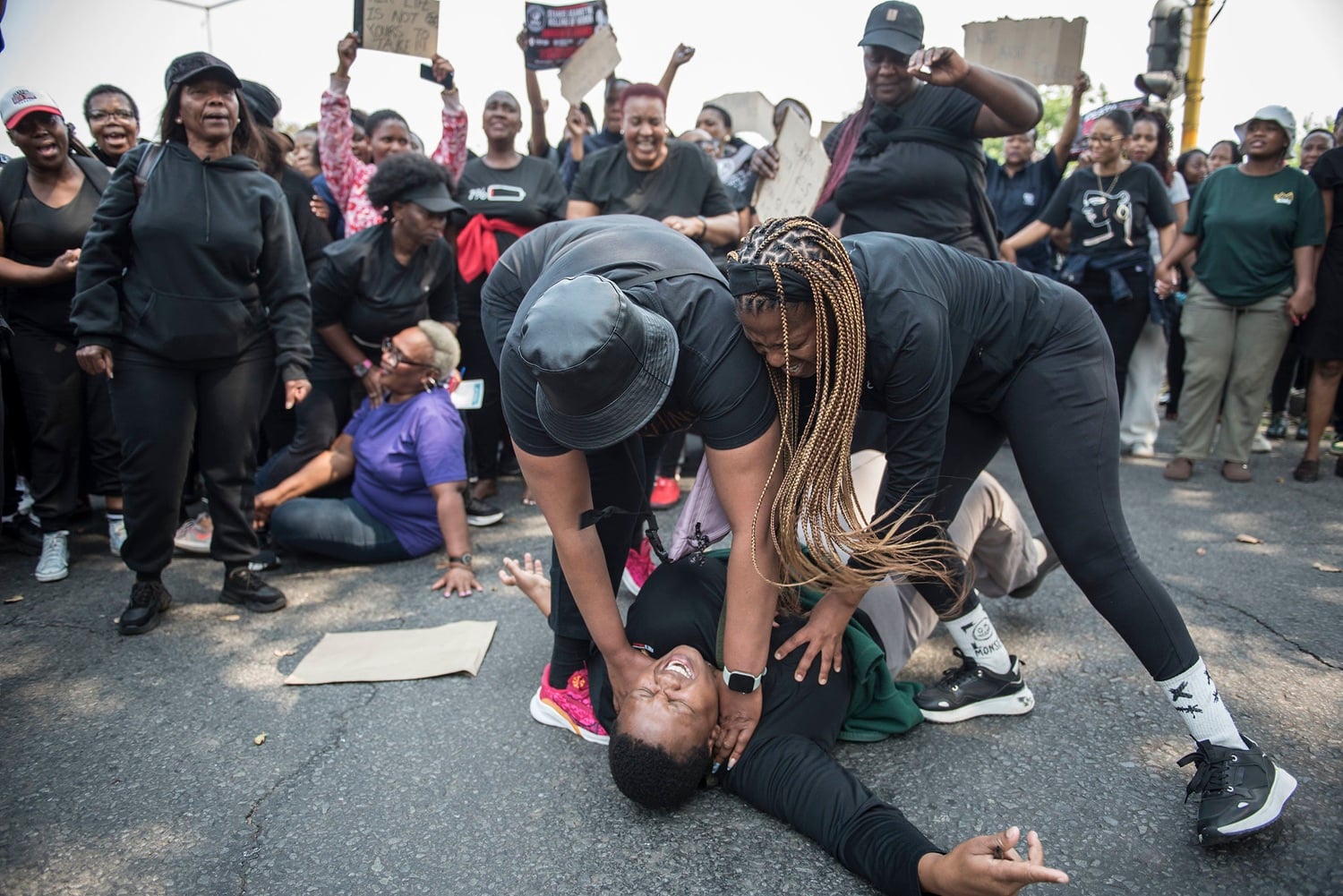
A group of women demonstrate against gender-based violence and femicide and re-enact scenes of an attack last week in Kempton Park, following a spree of killings. Picture: Michel Bega


I have felt afraid these past few weeks in a way that is difficult to explain. Why is it that the first thing we tell women when other women are being killed is that they need to be more careful?
Why is our first question not, what are we doing to stop the killing?
I have spent years working on women’s rights, human rights and gender-based violence. I know the statistics. I know the laws and the policies.
And yet, I have felt afraid because a woman went for a run and did not come home.
Elizabeth “Tsontso” Moselakgomo, a 38-year-old mother, went for her usual run in Kempton Park in broad daylight. She never returned and her body was found three days later.
Her death is one of nine cases being investigated in Ekurhuleni, where the bodies of nine women have been discovered since July.
The fear also makes me angry because once again, we know what is coming.
Do not go out alone. Do not run alone. Share your location. Change your route. Travel in groups. Be vigilant. We have heard these messages our whole lives.
Practical safety advice has a place, especially when there is an imminent threat. But why does the conversation begin and end with what women must do to avoid being killed?
Women are already vigilant. We share our locations, we look behind us, we call when we get home. At some point, vigilance becomes exhaustion.
A woman should not have to become an expert in risk assessment simply to live an ordinary life. A woman going for a run is not careless and a woman walking home is not prey.
So, I want to move the question to where it belongs: the responsibility of the state. Section 7(2) of South Africa’s 1996 constitution is clear that the state must respect, protect, promote and fulfil the rights in the Bill of Rights.
What does that obligation look like for the woman leaving home for a run, the girl travelling home from school, the family that reports a woman missing?
The scale of the problem is not in doubt. A national prevalence study found that approximately 7.3 million South African women aged 18 and older have experienced physical violence in their lifetime, while more than 2.15 million have experienced sexual violence.
Gender-based violence and femicide were declared a national crisis by President Cyril Ramaphosa in November last year and then classified as a national disaster by the National Disaster Management Centre the following day.
South Africa also has a National Strategic Plan on Gender Based Violence and Femicide for 2020-30. South Africa does not lack declarations, policies, laws or institutions. The question is whether any of them reaches a woman before her body is found.
Last month, the National Council on GBVF was operationalised, and one of its first priorities is to conclude a shareholder compact between the shareholder and the council, to define what success looks like and how it will be measured.
The council must be held accountable to the measures it sets for itself before the next body is found, not after. The state’s responsibility cannot begin when a woman’s body is discovered.
It begins much earlier with prevention, with understanding patterns of violence, with properly responding, with ensuring that communities are not left without information and with making sure that the institutions actually work.
Men have to be part of this too. Changing the conditions that enable violence requires men to reject it. Men and boys cannot be secondary to the prevention of violence against women.
They are critical partners in transforming harmful norms and challenging attitudes, power imbalances and social structures that normalise violence.