



Mapisa-Nqakula is facing 12 counts of corruption and one of money laundering.
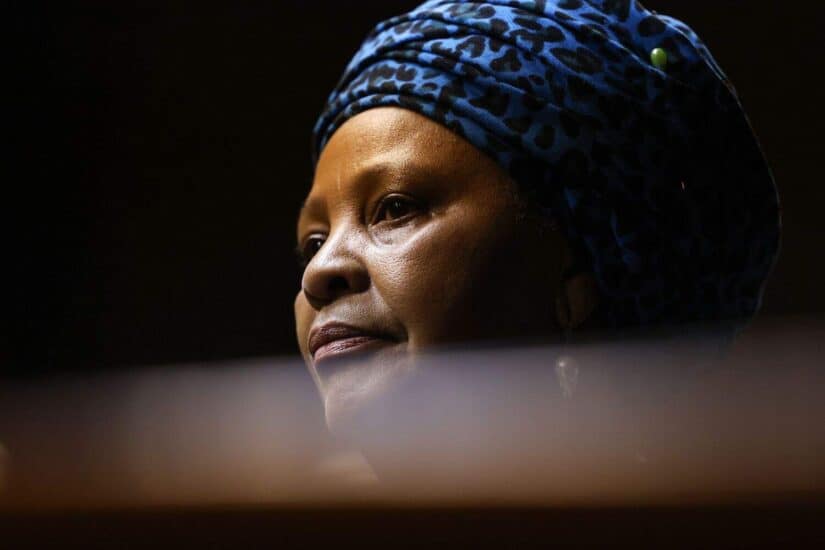
Former National Assembly speaker Nosiviwe Mapisa-Nqakula. Picture: Gallo Images / Deaan Vivier


The High Court in Pretoria has dismissed former National Assembly speaker Nosiviwe Mapisa-Nqakula’s application for a discharge under section 174 of the Criminal Procedure Act.
On Monday, Mapisa-Nqakula returned to court where Judge Mashudu Munzhelele delivered judgment. This means her corruption trial will proceed.
Mapisa-Nqakula is facing 12 counts of corruption and one count of money laundering. She is accused of receiving and soliciting R4.5 million, with R2.1 million allegedly received in cash from Nombasa Ntsondwa-Ndhlovu, a service provider to the South African National Defence Force (SANDF), between December 2016 and July 2019. She has denied the allegations and pleaded not guilty.
Mapisa-Nqakula’s legal representatives approached the court with the application, citing contradictions between Ntsondwa-Ndhlovu’s evidence and that of other state witnesses in the case. Ntsondwa-Ndhlovu entered into a plea deal with the state and has now turned state witness.
The defence also relied on discrepancies between Ntsondwa-Ndhlovu’s evidence and the contents of her statement.
“It is trite that contradictions in themselves do not justify rejecting a witness’ evidence. It was recognised that the purpose of an affidavit or statement is to provide sufficient details of the alleged offence to enable the authorities to determine whether a prosecution should be instituted. Therefore, it is not intended to serve as a verbatim anticipation of the witness’ evidence at trial,” said Judge Munzhelele.
“The defence further attacked Nombasa’s credibility on the basis that she is a section 204 witness and that her evidence in substance amounts to that of a single witness, thereby invoking the cautionary rule applicable to such evidence. However, the cautionary rule applicable to the evidence of a single witness does not arise for determination in the same way at this stage of an application for discharge in terms of section 174.”
‘Admissions’
Mapisa-Nqakula’s defence further challenged the authenticity and admissibility of the WhatsApp communications between her and Ntsondwa-Ndhlovu. They argued that the WhatsApp messages were presented as paper copies of screenshots and that the police official who obtained or reproduced the screenshots was not called to testify.
The defence further contended that the screenshots did not constitute data messages for the purposes of the Electronic Communications and Transactions Act 25 of 2002.
However, Judge Munzhelele also dismissed these arguments.
Mapisa-Nqakula’s alleged admissions also worked against her, as some were allegedly corroborated by documentary evidence.
She admitted that she was the minister of defence during the period in question and that she had no reason to receive money or gratification from Ntsondwa-Ndhlovu. She knew that, as a minister and member of parliament, she was not permitted to accept money or other gratification.
Mapisa-Nqakula did not declare that she had received money from Ntsondwa-Ndhlovu, the judge said.
‘Direct evidence implicates her’
Judge Munzhelele said Ntsondwa-Ndhlovu’s testimony, the state’s circumstantial evidence and documentary evidence directly implicated Mapisa-Nqakula.
The court heard that the two allegedly agreed to use certain sangoma terms as codewords for money, including indumba, impepho, amayeza, snuff and padlock.
Ntsondwa-Ndhlovu testified that the meaning of these terms had to be understood in the context of their relationship.
“Of particular significance is the evidence of Nombasa, a section 204 witness who gave direct evidence implicating the accused in repeated requests for and receipt of substantial amounts of money as gratification,” said the judge.
“This is not merely circumstantial evidence that money might have reached the accused. Nombasa testified that on several occasions, she personally handed the cash to the accused. At the section 174 stage, the evidence must be considered cumulatively and in the context of the documentary evidence which has been submitted as exhibit, the admissions made by the accused, the WhatsApp communications, the evidence concerning the cash withdrawal or the taking of the cash from the safe and the surrounding circumstances.
“Having regard to the totality of the evidence, the state has established more than mere suspicion. Having regard to the totality of the evidence, the state has established a prima facie case. Evidence directly implicates the accused in the alleged request for and receipt of gratification supported in material respect by documentary evidence, financial records, communications and the surrounding circumstances.”
Mapisa-Nqakula’s arrest
Mapisa-Nqakula resigned as National Assembly speaker and member of parliament (MP) in April 2024 and handed herself over to the Lyttelton Police Station that same month.
This followed the Pretoria High Court’s dismissal of her application to block her arrest on corruption allegations the previous month.
At the time, she said she wanted to dedicate her time and focus to dealing with the case against her.
She said the resignation was not an admission of guilt.
“I believe that, at the right time, I will have the opportunity to thoroughly address these allegations as and when they have been formally brought against me in the appropriate forums, at which time I will clear my good name. I maintain my innocence and am determined to restore my good reputation,” she said at the time.



