
Advocate Mpofu argued against the president's submission that the report was reviewable, as the panel's decision was, in effect, final.
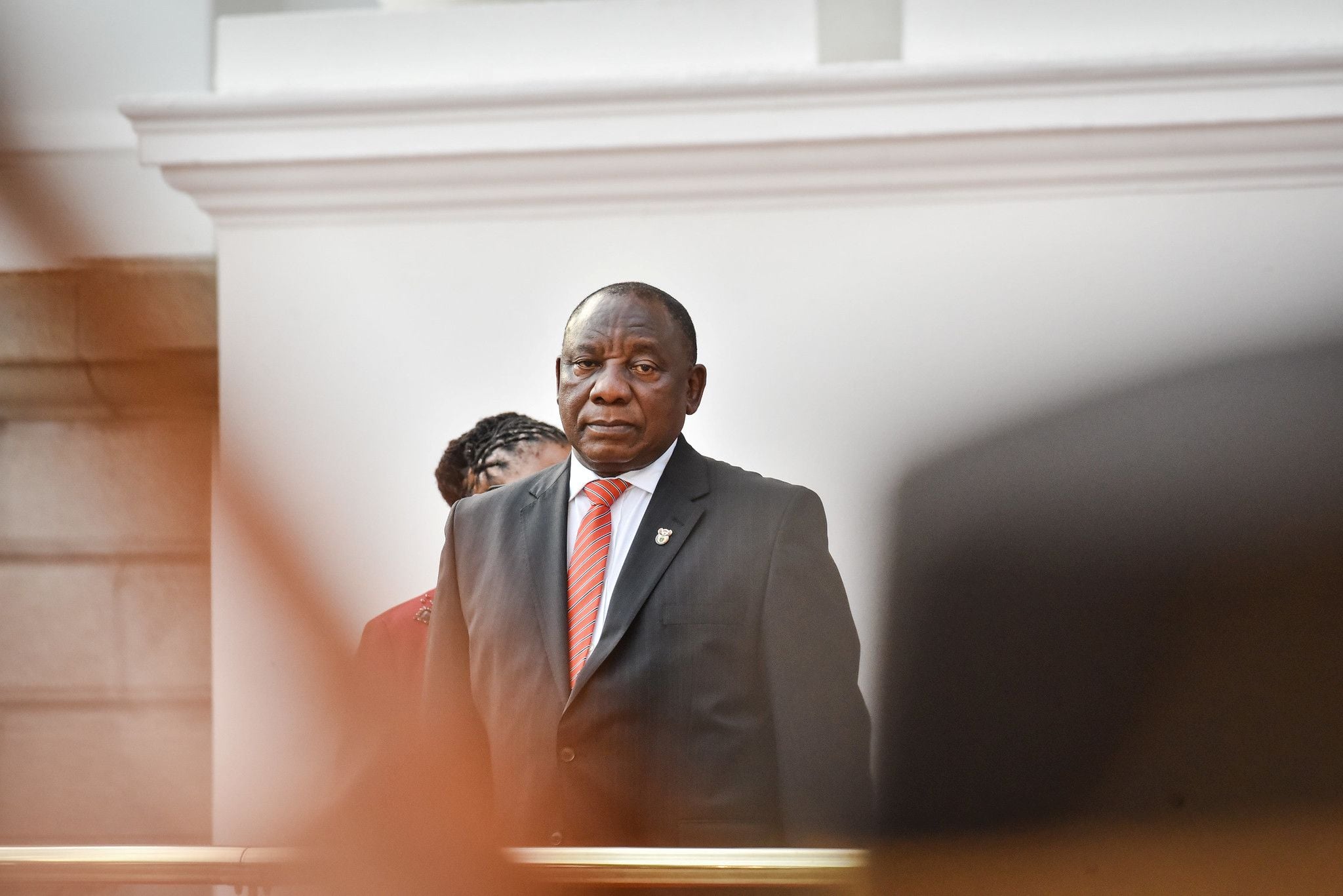
President Cyril Ramaphosa: Picture: Gallo Images/Frennie Shivambu)


MK party legal representative, Advocate Dali Mpofu SC, has argued that the Western Cape High Court lacks jurisdiction to hear President Cyril Ramaphosa’s application to set aside the Section 89 panel report.
On Friday, Western Cape Judge President Nolwazi Mabindla-Boqwana and judges Mark Sher and Ncumisa Mayosi heard arguments in Ramaphosa’s review application of the Section 89 independent panel report on the Phala Phala burglary in February 2020.
In November 2022, an independent panel appointed by then-National Assembly speaker Nosiviwe Mapisa-Nqakula found that there was “prima facie” evidence that Ramaphosa may have violated sections 96(2)(a) of the constitution and 34(1) of the Prevention and Combating of Corrupt Activities Act (Precca), with the aim of keeping the investigation into the burglary private.
Ramaphosa’s legal representative, advocate Wim Trengove, has previously argued that the panel did not consider the entirety of the president’s responses before concluding that he had a case to answer.
Reviewability of panel report
On Friday, Mpofu argued against the president’s submission that the report was reviewable, as the panel’s decision was, in effect, final. He said that the president’s submission could not stand as the panel’s decision was not final in effect.
However, Sher challenged Mpofu’s argument.
“It’s not final and binding on the National Assembly. But it is the imperative, necessary jurisdictional step without which an impeachment cannot take place. And once that decision is there, according to the Constitutional Court’s order, there must be an impeachment,” said the judge.
“Once the panel has made a recommendation, there must be an impeachment, says the Constitutional Court. If the independent panel finds sufficient evidence, there must be an impeachment.”
“Yes, but even if it finds that there’s not sufficient evidence, there may still be an impeachment,” responded Mpofu.
“No, no, that’s something else. If it finds that there is, this is the case that’s before us. If an independent panel finds there is sufficient evidence, there must be an impeachment. It’s final in effect as far as launching an impeachment is concerned,” responded Sher.
‘How can two things be the same?’
However, Mpofu insisted that the panel’s decision was not final.
“It can’t be final in effect because we have to close one eye to the law. The other side of the law says that even if there’s no sufficient evidence, it may still get to the impeachment committee. So how can it be final in effect if there’s still a possibility, despite the finding of sufficiency, that the same outcome is going to happen? How can that be? How can the two things be the same, Justice Sher?
“Let’s say there was a scenario where you only have the order that says if you have sufficient evidence, you must go to Dar es Salaam. We have the other order, but now we know that there’s the other order, so we must just ignore it as if it’s not there. The other order says that even if sufficient evidence is found, you may still end up in the impeachment committee. Why would you think the Constitutional Court put that order there if it’s just to be ignored?”
‘Panel decision binding’ on Ramaphosa
Sher said the panel’s decision was binding on Ramaphosa and everyone involved in the impeachment process.
“Mr Mpofu, I’m not following you. Your argument is this is not final and therefore not reviewable. If I understand the Constitutional Court’s ruling in here, it revised the rule and said if an independent individual has a particular objection, and the panel finds there is sufficient evidence, there must be an impeachment committee hearing. This is what happened. So, in that sense, it’s final and binding.
“The president must go, unless that independent panel report’s recommendation doesn’t stand or is set aside; the president must go to the impeachment committee hearing. As the rules read, it has binding effect on the president; it has binding effect on parliament; it has binding effect on everyone. The Constitutional Court’s order makes it clear. If the panel finds there is sufficient evidence, there must be an impeachment committee hearing. Am I wrong?”
“You’re 100% right, but that’s not all. I’m saying this just to show you you’re 100% right, but that is not all. So, after that, there’s another little order that we must not forget, which says that even if you do not find sufficient evidence, you may still end up in the same place. So, how can the two scenarios be the same as if nothing has happened? As if the Constitutional Court has not said that there’s another, if you like, another door. It closes one door, but it has opened another one,” responded Mpofu.
“The issue on unreviewability, the real point I was making was that if you do not attack the constitutionality of 129P, this is not a case where that defence is available. In other words, in the normal case, as we all know, you have to show that something is not final in effect by looking at the facts.
“Here we have a gift of 129P, which actually tells us that it is not binding. Now, so I put that point aside, and I will qualify it with the exchange I had with Justice Sher. I accept that Justice Sher has put that the wording of 129P is directed more at the National Assembly, but I’m making the broad point. So those will be our submissions on reviewability.”
Mpofu on court’s jurisdiction
Mpofu further argued that, on principle, the report Ramaphosa is challenging is not the same as the one that the National Assembly voted on.
As a result, the Western Cape High Court lacked jurisdiction to hear Ramaphosa’s application.
“We say that this court lacks the jurisdiction to entertain this matter for an analysis, namely that this is a matter that falls into the exclusive jurisdiction of the Constitutional Court in terms of 167.4e of the Constitution,” argued Mpofu.
“This report now is a child of the Constitutional Court. That one was a child of the panel. As we speak now, there’s no such thing as a Ngcobo panel. The thing that revived or resurrected this report was the 8 May judgment of the Constitutional Court. So that makes this, from a jurisprudential point of view, this report – of course it’s the same piece of paper, it’s the same report – but the report now has that quality of being one that has been imposed on the speaker and on the country by the Constitutional Court.”
‘We can’t save Ramaphosa’
Mpofu further submitted that there was no way out for the president until he answers to the country what the money was doing in his couch. Mpofu argued that Ramaphosa owed it to the nation to explain this fact.
“There is no way out; we all would love to save the president, I suppose, but he is unsaveable until he answers what those dollars were doing there. This court is not in a position, in terms of our scheme of democracy, to say when the Constitutional Court tells you that the panel is to determine whether there is a case to answer, to say the Constitutional Court doesn’t know what it’s doing.
“The second reason is that the review that is before you, if you look at it from the eyes of the Gcaba test, Gcaba, as we all know, paragraph 75 says the following, that if in interpreting the pleadings, it becomes clear that this is a matter that ought to have been in another court where a statute or constitution says it should have been, then ipso facto, the High Court has no jurisdiction. So that other court could be the Labour Court, it could be the Constitutional Court, Tax Court, whatever it is.”