Ramaphosa is asking the court to review and set aside the panel's report.
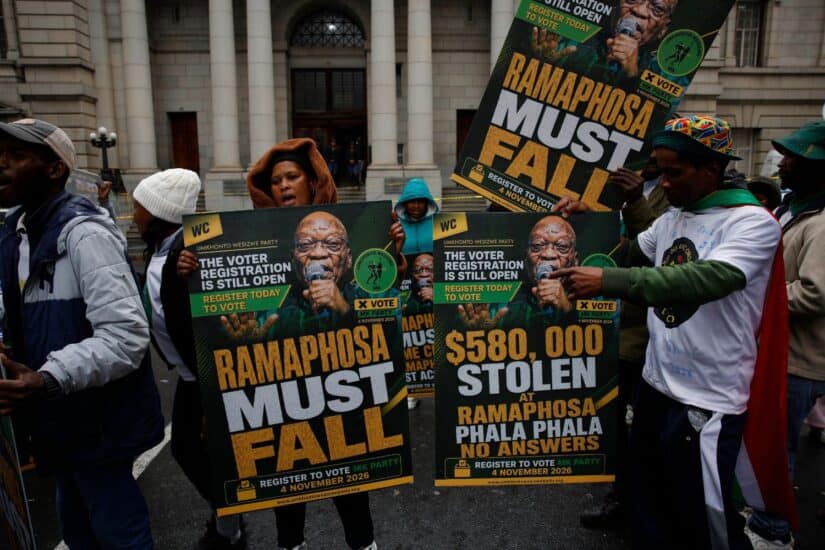
Members of the MK party protest outside the Western Cape High Court in Cape Town on 15 July 2026. Picture: Gallo Images/ER Lombard


President Cyril Ramaphosa has told the Western Cape High Court that the independent panel appointed to assess the Phala Phala allegations failed to properly consider whether he acted deliberately or in bad faith.
The argument was made on Wednesday, 2 September 2026, on the first day of a three-day hearing into Ramaphosa’s review application as it got under way in Cape Town.
Judge President Nolwazi Mabindla-Boqwana, Judge Mark Sher, and Judge Ncumisa Mayosi are hearing arguments in the president’s challenge to the findings of the Section 89 independent panel, chaired by former chief justice Sandile Ngcobo.
The panel concluded that Ramaphosa had a case to answer over allegations stemming from the theft of approximately $580 000 (around R9.6 million) from his Phala Phala game farm in Limpopo on 9 February 2020.
Ramaphosa is asking the court to review and set aside the panel’s report, arguing that its report was flawed and based, in part, on untested evidence.
Ramaphosa challenges Phala Phala panel report
Presenting Ramaphosa’s case, Advocate Wim Trengove contended that the panel failed to properly apply Parliament’s impeachment rules, particularly the requirement that conduct amounting to a serious constitutional violation, gross misconduct or a contravention of the law must have been committed intentionally.
“We can’t emphasise enough that the conduct of the president qualifies for impeachment only if it is done deliberately and in bad faith.
“We shall show how the independent panel overlooked that requirement,” Trengove told the court on Wednesday.
The panel, in its report, identified that Ramaphosa may have been guilty of four charges arising from the allegations.
The first charge related to section 96(2)(a) of the Constitution. This provision prohibits Cabinet members and deputy ministers from performing other paid work.
The panel considered Ramaphosa’s admission that he was involved in cattle and game farming when reaching its conclusion.
Another finding concerned section 34(1) of the Prevention and Combating of Corrupt Activities Act (Precca), which imposes a reporting obligation in relation to certain corrupt transactions.
The panel considered the fact that the theft at Phala Phala had not been reported to the police as potentially amounting to a contravention.
The remaining two charges dealt with section 96(2)(b) of the Constitution, which relates to conflicts between a Cabinet member’s official duties and private interests.
‘He always acted in good faith’
Trengove highlighted that the president had consistently maintained that he believed he had acted appropriately after the theft, as he had reported the matter to Wally Rhoode, the head of the Presidential Protection Unit (PPU).
“He always acted in good faith, and that should be a complete answer to all the charges against him.
“While this is a review of the independent panel report, the question is whether the independent panel asked itself the right question[s].
“If it didn’t ask itself the right question[s], then its report is irregular and invalid.”
He further challenged the panel’s interpretation of the evidentiary threshold it was required to apply.
“The task of the independent panel is to determine whether there is sufficient evidence for a public impeachment hearing.
“The panel again misunderstood that requirement. It equated sufficient evidence with prima facie evidence and, therefore, on this aspect too, asked itself the wrong question.”
‘Prima facie‘ versus sufficient evidence
Trengove placed particular emphasis on the distinction between the two evidentiary thresholds.
He maintained that the terms “prima facie” – a Latin phrase that means “at first sight” or “on the face of it” – and “a case to answer” essentially conveyed the same legal meaning.
“Those things mean exactly the same thing, but it doesn’t mean sufficient evidence to justify an impeachment hearing.”
According to Trengove, the process begins when the Speaker of the National Assembly considers a notice of motion calling for the president’s impeachment.
At that stage, the Speaker must be satisfied that the motion establishes a prima facie case.
The matter then moves to the independent panel, which must consider whether the evidence is sufficient to justify a full impeachment inquiry.
The lawyer further argued that this assessment required the panel to consider the evidence as a whole, including Ramaphosa’s own version of events, rather than simply accepting the allegations at face value.
Impeachment described as a serious step
The president’s legal team also relied on the panel’s own description of the seriousness of an impeachment process.
Trengove referred the court to passages in the report which acknowledged that moving towards an impeachment hearing was a significant step that should not be taken without sufficient evidence.
“They say that step, of an impeachment hearing, must never be taken lightly.
“It is a momentous act, justified only when sufficient evidence exists to show that the president has a case to answer for his conduct.
“The panel, therefore, functions as a filter to ensure that only a motion which establishes, prima facie, that the president has a case to answer, is considered by the impeachment committee.”
ConCourt ruling
The latest court proceedings form part of a much longer legal and political battle surrounding the Phala Phala scandal.
In May this year, the Constitutional Court (ConCourt) found that Parliament had acted unlawfully when it stopped the impeachment process against Ramaphosa through a vote in December 2022.
The ruling resulted in an order compelling the National Assembly to establish a formal impeachment committee to examine the allegations.
The committee comprises 31 MPs from 16 political parties.
It has since been undertaking preparatory work, but its public hearings have not proceeded after Ramaphosa secured an interdict from the High Court on 24 July.