
Judge Matthew Francis said that before Ramaphosa became president, he knew the Section 89 process was in place.
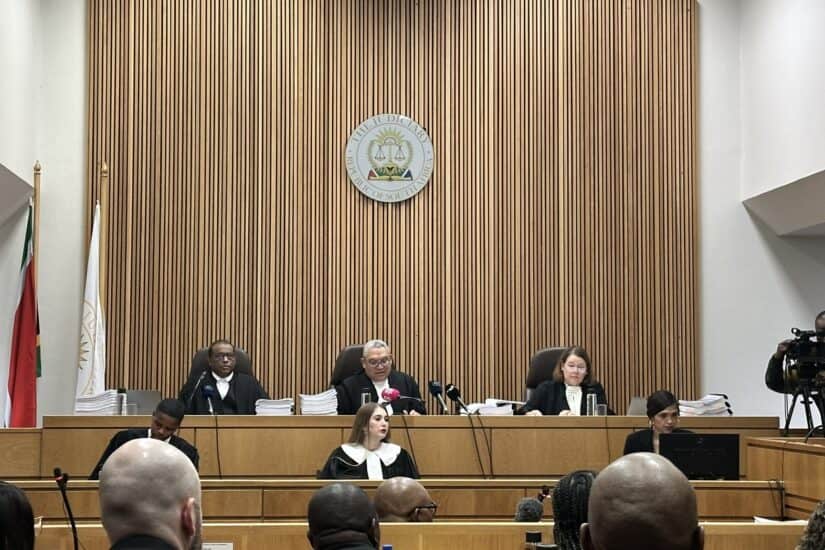
Western Cape High Court hears the urgent interdict brought by President Cyril Ramaphosa. Picture: Impeachment Committee on Section 89 Enquiry/X


Advocate Anton Katz SC for the African Transformation Movement (ATM) and Advocate Dali Mpofu SC, representing the MK party, have argued that President Cyril Ramaphosa has manufactured issues that do not exist regarding Parliament’s Section 89 impeachment process.
On Thursday, Western Cape High Court judges André le Grange, Matthew Francis and Diane Davis sat through the second and last day of the arguments in the president’s urgent application to halt the Section 89 impeachment process pending the review of the Section 89 Independent Panel report, scheduled for September 2 to 4.
‘Wrong test’
Arguing for the president, Advocate Wim Trengove SC insisted that he was not seeking to persuade the court that if the Independent Panel had applied the “proper test” when dealing with the evidence before them, they would have come to a different conclusion. What Trengove is questioning is whether the panel applied the “right test” in reaching the conclusion that the president had a case to answer. This is because, Trengove argued, reaching such a conclusion would require “sufficient evidence”.
Trengove further told the court that the respondents’ interpretation of some sections of the Constitutional Court (ConCourt) judgment was flawed.
“Our learned friends suggest that paragraph 7 of the order, which said the report of the independent panel is referred to the impeachment committee established in terms of the national assembly rules, was an injunction that the impeachment hearing should proceed and therefore if you interdict the hearing, that would contradict the order of the court,” argued Trengove.
“It’s not correct to submit that the ConCourt order said anything about the way in which the impeachment committee should deal with the report.”
‘Humiliation is part of the job’
Trengove further reiterated the president’s fear of a humiliation ritual should the impeachment process go ahead before his review application is heard.
However, Judge Matthew Francis appeared unsympathetic to the president’s concerns, saying that before he became president, he knew the Section 89 process was in place. Francis further commented that humiliation is part of the job. He also cautioned that the review application could take longer as the president could appeal should the ruling not be in his favour.
“There’s a review which is set down in September, there might be further legal processes that continue. Section 89, to hold the president accountable, is really for the people of South Africa. The general populace must also be factored into the issue of harm.
“Can something which happened how many years ago, and is going to continue waiting for a time, when there could be a definitive statement as to whether the president has done something or has not done something, is keeping the populace, the electorate in the wait.
“So, if I understood Mr Mpofu yesterday, he says it’s actually a parallel process, continue with your review but also let the accountability mechanism continue on its part as well. If there is going to be humiliation and so on, that is just the part of the job so to speak. When the president took on the position of president he knew section 89 was was in place.”
‘Delinquent presidents’
Trengove, however, argued that as much as the people must be protected against delinquent presidents, they must also be protected against impeachment proceedings humiliating a president for which there is no justification.
“The people’s representatives in the National Assembly have defined what the criterion is that must be applied, so the people have an equal interest in the disciplining of delinquent presidents, but also in the protection of presidents against unfounded accusations.
“The people are best served if that process is properly implemented, they’re not served by taking shortcuts in breach of the rules which have been designed exactly to serve the people,” said Trengove.
Ramaphosa ‘shouldn’t pay the price’
In response, Trengove said it was unfair to place the blame on the president for the delays in the case. The president was only asking for a three-month delay until his review application is heard.
“The president asks for an indulgence of two to three months, he doesn’t ask for anything more. The fact that there’s already been a delay of almost four years is not the doing of the president, it shouldn’t be laid at his door and he should not be made to pay the price for that delay.
“That delay has been unfortunate, a number of parties were to blame for it, but the president was not one of them, so it is unfair to burden the president because there has already been undue delay in this case.
“Going forward, your lordship has expressed scepticism before about the finality that will be achieved on the judgment in September. Our point is that we can’t predict what the future might bring, but what we can assure you is that this court will be in charge of whatever happens.”
The judge, however, had some doubts.
“Scepticism on whether September would, in fact, resolve this matter is perhaps justified by how matters of this sort tend to snowball and continue, even with the best intentions of the parties. We know the stakes are so high and that is why litigation takes the intensity that it does, so to say that there’ll just be a short adjournment or a couple of months, past experience doesn’t bear that out,” responded Francis.
“If the president is unsuccessful, we may appeal, but whether there is a delay as a result of those attempts it’s entirely in the court’s hands,” said Trengove.
Ramaphosa ‘missed the boat’
Katz argued that the president had already missed the boat in his attempt to halt the impeachment process.
“From the Speaker’s affidavit, it is clear that the impeachment inquiry has commenced; he cannot get the relief to stop something that has already happened. Even with this court to consider granting it, it can’t be in the terms that the president has asked.
“If you look at the papers, you can see he’s not actually asking for the commencement to be stopped, it’s actually the witnesses.
“The facts are, the speaker’s affidavit makes it clear the timeline as to what happened post 8 May 2026 and she makes it clear from her timeline that the commencement was sometime May, and this application was launched on 12 June. So, when this application was launched, the president must have known that he could not get the relief of no commencement, so the court cannot grant an order in respect of something that has already happened, and to try to stop that, you cannot [do so] in court.”
‘Speculative basis’
Mpofu argued that Ramaphosa’s argument that he would suffer irreparable harm because someone is going to defame him was “speculative”.
“Who is this person? Who are these people who are going to shame him and what are they going to say? We don’t know, he doesn’t tell us, he doesn’t tell the court. But on some speculative basis that somebody might say something defamatory, this court must intervene and the intervention of this court must be on the basis that there might be some irreparable harm which is undefined?
“The president says he has put his defence out there, but so has Mr [Arthur] Fraser, so have all the people who are supposed to defame him, so the damage is done. What is it that you must interdict?”
Judgment is expected to be delivered next week.