



The court dismissed a Polokwane independent candidate's bid to contest 2026 local government elections.
 Elections 2026
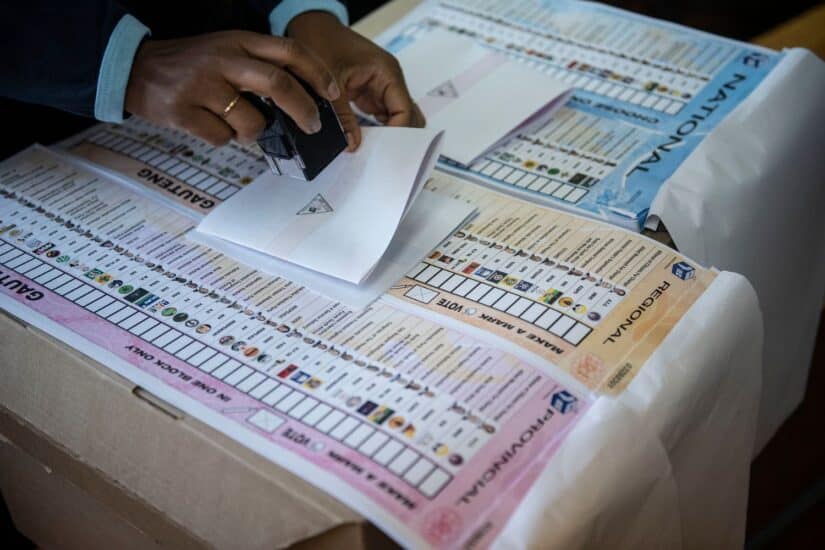
Ballot papers are seen as voters casts their votes at Welizibuko Primary School in Soweto on 29 May 2024. Picture: Michel Bega/The Citizen


A Limpopo-based independent candidate’s attempt to secure a place on the ballot for the 2026 local government elections has failed, with the Electoral Court ruling against his challenge to a decision to disqualify him.
Llala Peter Phoshoko, who intended to stand as an independent candidate in ward 33 of the Polokwane Local Municipality, approached the court seeking an order to compel the Electoral Commission of South Africa (IEC) to include him among the candidates contesting the municipal elections set for 4 November.
Independent candidate seeks to contest 2026 local government elections
The applicant had argued before the Electoral Court that community members had first approached him at the beginning of 2026 about representing them as an independent candidate in the ward.

LIVE interactive map, latest news, multimedia and more!
View MapHowever, the community subsequently settled on another individual, who later chose to contest the elections under a political party.
Residents returned to Phoshoko on 27 August 2026, leaving him with just one day before the IEC’s nomination deadline.
He agreed to stand and began collecting the 50 signatures, with accompanying identity numbers from those supporting him, required to validate an independent candidate’s nomination.
Phoshoko submitted 53 signatures before the 5pm deadline on 28 August, but conceded he had not had enough time to confirm whether all signatories were registered in the correct ward.
The problem only became apparent when the IEC released its candidate lists on 16 September, revealing that Phoshoko had not qualified to contest the elections.
Challenging his exclusion, he described the requirement for independent candidates to obtain 50 signatures as “unfair”.
He argued that political parties could still participate in elections despite receiving fewer than 50 votes in a ward.
On that basis, Phoshoko sought to have the IEC’s decision overturned.
IEC identifies shortcomings in nomination
The IEC opposed the application, maintaining that Phoshoko had not secured the minimum number of valid signatures required by law.
According to the commission, 13 of the 53 people who signed in support of his nomination were not reflected on the voters’ roll for ward 33.
Four were registered in different municipalities, one was not registered as a voter, and eight had supplied invalid identity numbers.
The commission consequently counted only 40 valid signatures, rendering Phoshoko’s nomination non-compliant.
It also disputed his complaint about not being notified of the outcome, arguing that it had no obligation to inform candidates that they had failed to qualify once the submission deadline had elapsed.
Electoral Court judgment
Acting Judge Seena Yacoob, with two other judges concurring, ruled that the IEC could not disregard the legal requirements governing independent nominations.
Her judgment, delivered on 22 October 2026, addressed Phoshoko’s argument that the 40 valid signatures he had obtained should have been accepted as sufficient.
Yacoob pointed to his admission that he had not verified whether the people who signed his nomination documents were registered in ward 33.
The court found that Phoshoko’s handling of the nomination process had contributed to his predicament “by leaving things to the last minute”.
“It is Mr Phoshoko’s own version that he was aware of the local government elections from the beginning of the year, and of the possibility that he might be nominated as an independent candidate.
“He was aware also of the election timetable, and of the requirements that had to be fulfilled.
“In these circumstances, it is difficult to accept his version that he had no way of verifying whether the people who signed in support of his nomination were voters registered in his ward,” Yacoob wrote.
IEC faulted over delayed notification
While the Electoral Court upheld the basis for Phoshoko’s disqualification, Yacoob disagreed with the IEC’s position that it did not need to notify him because the nomination deadline had passed.
The acting judge stressed that the commission should deal with candidates and voters with “proper dignity”.
She noted that Phoshoko and those supporting his candidacy continued to act on the understanding that he was an eligible candidate, only learning of his disqualification on 17 September 2026.
“They conducted themselves as if Mr Phoshoko was a candidate for nearly three weeks.
“Discovering only after three weeks that he had not fulfilled the requirements is embarrassing, and in my view has the potential to undermine public confidence in the electoral system.
“Although the [Local Government: Municipal Electoral Act] does not require the commission to inform people that they did not qualify, it is clearly the appropriate thing to do, within reasonable bounds.”
Despite this, the court ultimately dismissed Phoshoko’s review application.