


Despite its 2.3-tonne mass and supposed underpowered engine figures on paper, the Tasman blitzed not only the Hilux and Ranger, but also beat the 165kW Hilux GR Sport.
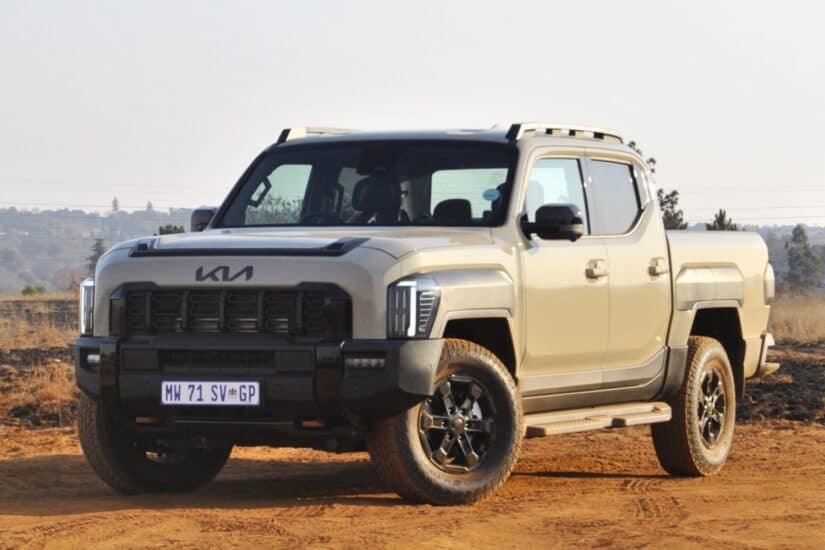
The Kia Tasman has officially become the fastest four-cylinder turbodiesel bakkie tested by The Citizen. Picture: Charl Bosch


With total sales of less than 200 units since the National Association of Automobile Manufacturers of South Africa (Naamsa) started reporting figures in March, the Kia Tasman hasn’t had the easiest of rides in South Africa so far.
With sales having been similarly slow in Australia, the low uptake has not been a surprise for Kia’s long-awaited first bakkie.
Volume not an issue
Viewed as a niche product, the Tasman has not been classed in the same volume-selling mould as the Toyota Hilux, Ford Ranger, Isuzu D-Max and GWM P-Series.
Instead, and broadly similar but not directly aimed at the Volkswagen Amarok, it conforms to a “sell-as-many-as-we-have” principle whereby sales in double digits doesn’t necessarily translate to it being a sales disaster.
As such, the Tasman isn’t under the same pressure as it is in Australia to sell as many units in South Africa given Kia’s own projection in 2024 of wanting a monthly offset between 50 and 100 examples.
Figures, which puts the Tasman on par with the supposed volume-selling Mitsubishi Triton, the arrival of the flagship X-Trek for the week long stay surprised significantly when stacked against its “indirect” opposition.
The good and the bad
Its styling being the most contentious issue attributed to the lacklustre sales in the market, the Tasman proved more accomplished inside and on the road.
While small niggles persist inside, namely the lack of a proper volume dial for the excellent Harman Kardon sound system and the odd feel of the almost quartic steering wheel, the ride failed to disappoint, as did refinement and the actual interior build quality.
More power?
Spacious, well equipped for its R999 900 price tag, and likely to attract attention, the main focus was on the Tasman’s 2.2-litre turbodiesel engine.
Outputting 154kW/440Nm, the R-Series oil-burner has a six kilowatt increase over what it normally develops in the Sorento and Carnival, but without any uptake in torque.
Taking on Gerotek
Together with a kerb mass of 2 312kg, the Tasman seemed underpowered when lined up at Gerotek with Road Test editor Mark Jones behind the wheel. But as it turned out, it had a further surprise up its sleeve.
Eventually clocking a best 0-100km/h time of 10.05 seconds, despite Mark’s best efforts in trying to break into the nines, the Tasman bettered the time of not only the previous generation Hilux 2.8 GD-6 without the mild-hybrid system, but also the now discontinued 2.0 bi-turbodiesel in the Ranger.
In addition, it also beat the more powerful 165kW Hilux GR Sport III and the new generation mild-hybrid assisted Hilux Legend Mark tested earlier this month.
In beating the pre-facelift D-Max 3.0 V-Cross and what would have been its Ranger equivalent, the Wildtrak X, the Tasman officially becomes the fastest four-cylinder diesel bakkie The Citizen has ever tested.
Unsurprisingly slower than the V6 Ranger and Amarok, and well off any petrol or hybrid offerings, the engine’s willingness to rev more than a typical turbodiesel was cited as one of the reasons for the eventual outcome.
As the comparative, including the now discontinued Ranger Wildtrak X and Hilux GR Sport, the Tasman is as follows:
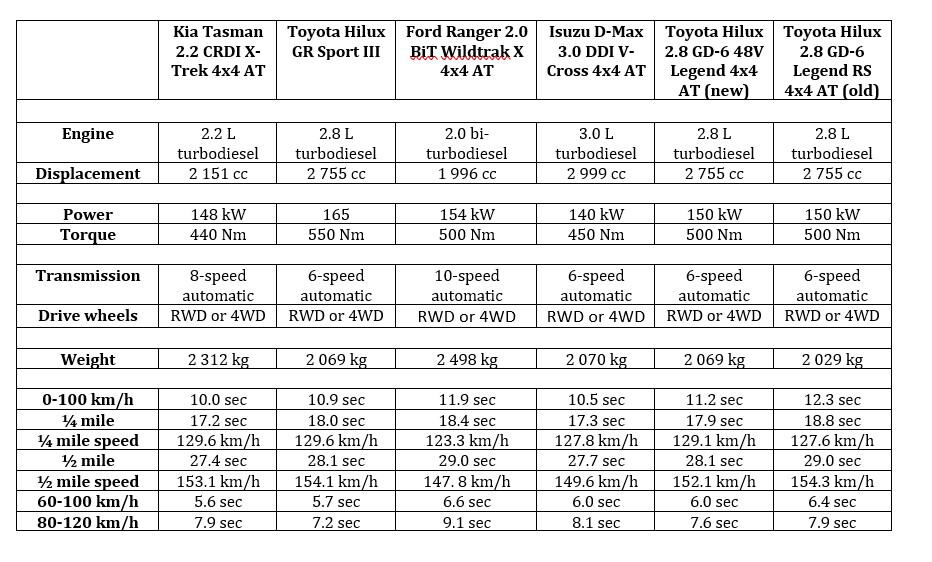
Its urge tapering at higher speeds, though, the eventual outcome still surprised considering the mechanical fundamentals not being in its favour.
Polarising and unlikely to resonate with everyone, the merits of the Tasman prevails, along with with a powertrain not afraid to deliver a bloody nose.



