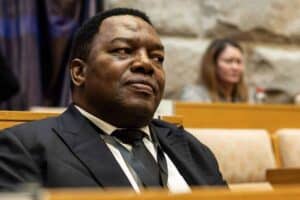
The suspended minister has remained on special leave while his acting replacement performs the role amid an ongoing inquiry.
More than R6.19 million has been paid to suspended police minister Senzo Mchunu and the acting minister, Firoz Cachalia. Picture: Saps


The more than R3.16 million paid to suspended police minister Senzo Mchunu for sitting at home for over a year could have been used to pay about 13 experienced constable-ranked detectives for a year, putting a stinging price tag on the protracted stalemate at the top of the police department.
At the same time, Firoz Cachalia, who was sworn in as acting police minister on 1 August, 2025 after Mchunu was placed on special leave in July 2025, has received over R3.024 million for doing Mchunu’s job – bringing the combined amount paid to the two to a staggering R6.19 million.
Mchunu and Cachalia payments under scrutiny
This revelation comes against the backdrop of the country grappling rampant violent crime, including the scourge of mass shootings and the killing of women.
“On basic salary alone, Mchunu’s R3.16 million paid in absence equals to annual salaries of 13 experienced constable-ranked detectives,” said Ian Cameron, chair of the portfolio committee on police in parliament.
“Those are resources that could instead make a real difference in severely stretched [Family Violence, Child Protection and Sexual Offences] units investigating rape, child abuse and other crimes against women and children.”
Special leave follows Mkhwanazi allegations
President Cyril Ramaphosa was forced to place Mchunu on special leave in the wake of explosive revelations by the KwaZulu-Natal police commissioner Lieutenant-General Nhlanhla Mkhwanazi over political interference in the justice system.
Ramaphosa also established the Madlanga Commission of Inquiry to probe the allegations.
Cameron said South Africa was battling a gender-based violence and femicide crisis and SA Police Service has repeatedly told MPs about financial and personnel constraints.
“Against that background, paying more than R3 million to a minister on special leave while paying another minister more than R3 million to perform the job raises obvious questions about priorities and value for money,” he said.
“Special leave was never supposed to become an indefinite holiday arrangement.”
Cameron said at some point Ramaphosa would have to provide a clear explanation of how long this status quo will continue and what the end point was.
He said every rand spent on prolonged executive uncertainty was a rand that cannot be spent strengthening the policing capacity citizens actually depend on.