The ongoing case is testing whether asylum seekers can be detained while awaiting deportation.
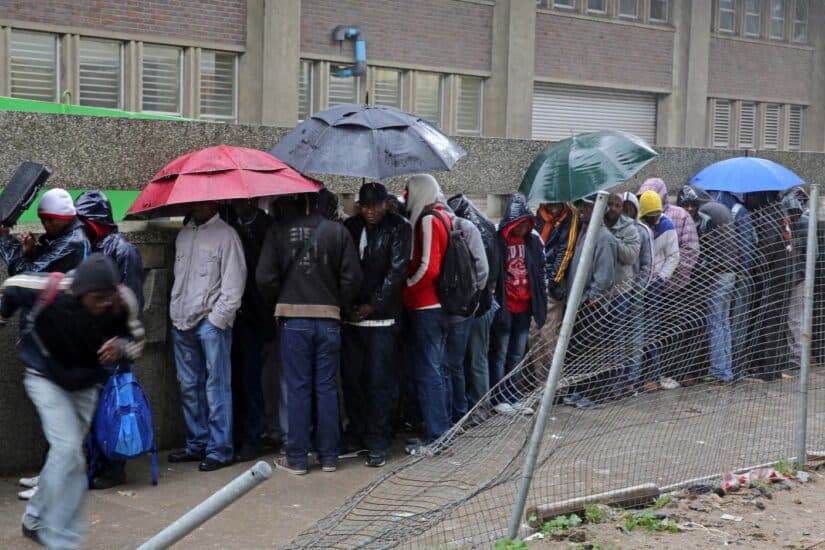
FILE| Asylum seekers queue outside the Customs House building on May 31, 2013 in Cape Town, South Africa. (Photo by Gallo Images / Nardus Engelbrecht)


A National Prosecuting Authority (NPA) advocate told the High Court in Johannesburg that the state was dealing with foreigners who only claimed asylum once they were arrested.
The court on Tuesday continued its hearing of a three-day ongoing case on the detention of undocumented foreign nationals who intend to apply for asylum.
The hearings follow a Constitutional Court ruling that found parts of the Refugees Act unconstitutional and invalid.
The court sat to hear 33 consolidated urgent applications, which came after conflicting rulings on how to apply the Constitutional Court’s Scalabrini judgment from July.
That ruling stopped the state from deporting prospective asylum seekers before their claims were assessed.
NPA says the state targets people who claim asylum only after arrest
Advocate William Rasenga Mokhare SC appeared for the NPA as a friend of the court.
He argued that the state was not dealing with people who presented themselves lawfully at ports of entry.
His concern was with people who stayed illegally for months or years and raised asylum only after they were caught.
“We are dealing with ‘catch me if you can, if you catch me I’ll apply for asylum’. Those are the people we are dealing with because the people who are coming through the port of entry tell us that they are coming because they are asylum seekers,” Mokhare said.
According to Mokhare, people who arrived lawfully were treated differently under the law.
“The law is very clear on that because it says that section 22 kicks in, so we are going to give you the asylum seeker permit or visa, and that now legalises you to be in the country whilst we are processing your application,” he explained.
Magistrates must keep their discretion, NPA argues
Mokhare said there was a grey area between stating an intention to apply for asylum and actually applying.
He pointed to the 48-hour rule, under which a magistrate had to authorise any longer detention.
He said an arresting officer could accompany a person to get an asylum visa during that time, and the person should be released if they got one.
Furthermore, Mokhare argued that a stated intention to apply should not automatically end the process.
“It is not a guillotine point that when it is mentioned then the magistrate must then pack the book and say ‘oh then leave this guy alone please’,” he claimed.
He said only the courts, and not arresting officers or prosecutors, could decide on whether detention should be extended.
“There will be instances where somebody may have to be held in detention for just a little longer, but that must not be at the discretion of the arresting officer or prosecutor,” Mokhare stated.
Mokhare added that a person could appeal such a decision.
“The system is in such a way that it has put in place safeguards, checks and balances to ensure that there is no excess of power and abuse of power,” he said.
Defence says detention does not solve the real problem
The defence took a different view. It argued that asylum seekers were protected under the Refugees Act and could not be detained, creating what it said was a conflict between two legal frameworks.
It claimed many people tried to reach Home Affairs refugee reception offices but were hindered by long queues.
“The problem that lies behind this is a capacity one,” the defence advocate said.
According to the defence, detaining some people and moving them to the front of the queue only pushed everyone else back.
“If the Department of Home Affairs cannot even deal with the people currently queuing at the doors of their ROs [refugee reception office], why are we detaining people for the sole purpose of taking them to the RO that cannot handle them on the Home Affairs’ own version?” the advocate asked.
UNHCR says protections start at the intention to apply
The legal representative for the United Nations High Commissioner for Refugees (UNHCR) argued that the Department of Home Affairs’ interpretation was inconsistent with international law.
The lawyer said the department believed detention stayed lawful until an application was lodged.
“That is the magic moment,” the lawyer said, describing the department’s position.
The UNHCR argued that an asylum seeker included someone who intended to apply but had not yet submitted a form.
“And so we say the protections of the Refugees Act don’t only apply once you lodge,” the lawyer stated.
Judge questions how the law works in practice
Judge Lebogang Modiba described an ideal system in which a person who expressed an intention to apply would not be detained.
That person would receive a transit visa and later a temporary asylum permit once an application was lodged.
“That’s an ideal world; we are not dealing with that in the cases before court,” Modiba said.
The judge noted that the applicants only raised asylum after being apprehended, through letters of demand or court applications.
“There has to be a process of regularising their stay, and that’s the process Home Affairs is telling us the applicants are taken through,” Modiba explained.
Further argument on context and burden
Advocate Khuboni urged the court to consider the context of the 33 applications.
“The context is: they are delinquent individuals who have contravened the law,” he argued.
“They are illegal foreigners as defined in section one of the immigration act.”
Khuboni noted that asylum seekers needed shelter, education and jobs, which the government did not provide.
He added that, by international standards, South Africa’s asylum system was already heavily burdened.
The hearing continues.