


A new environmental report suggests linking access to areas of Johannesburg to a vehicle's emissions rating.
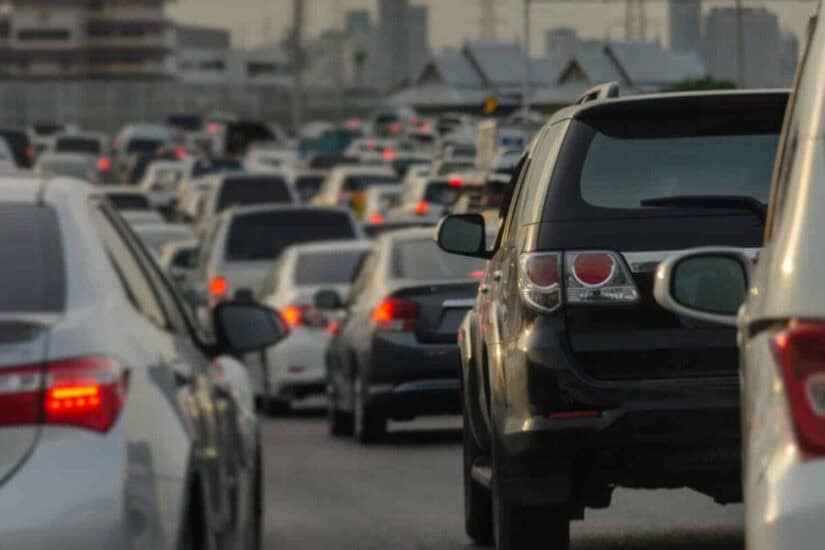
Picture: iStock


The Johannesburg municipality is being urged to adopt European regulations and clean air zones (CAZs) to address the city’s air pollution.
A report on the city’s air quality was released on Monday, detailing the levels of harmful pollutants in the city’s air caused by vehicles.
Compiled by The Real Urban Emissions (TRUE) Initiative and the International Council on Clean Transportation, the report aims to guide new standards for transportation in Johannesburg.
Old cars blamed for pollution
The report used data collected from 250 000 exhaust measurements taken at 11 locations between July and September 2025.
Data showed that petrol passenger vehicles older than 20 years contributed 24% of measured emissions, despite making up 4% of the vehicles sampled.
Pre-2006 petrol-based minibus taxis emitted four times the amount of emissions compared to their new counterparts.
Petrol minibus taxis accounted for 8% of the sampled vehicles, but it was diesel taxis that were found to be 18 times more polluting than their petrol-based counterparts.
Newer diesel passenger and light commercial vehicles were found to emit between four and seven times more than European equivalents.
Recommendations include the adoption of European diesel-vehicle regulatory standards, increased vehicle inspection and maintenance standards, as well as the fast-tracking of electric vehicle adoption.
Additionally, a key recommendation was the implementation of CAZs, which regulate movement and access to promote better air quality.
“The study helps address a critical evidence gap that has historically constrained the development of targeted and effective interventions.
“The study also provides a strong foundation for advancing initiatives such as CAZs and other measures aimed at supporting a cleaner, more sustainable and equitable transport system for Johannesburg,” said the city’s air quality and climate change director Lebo Molefe.
‘CAZ access eligibility’
Harmful emissions tested for were nitrogen oxides, hydrocarbons, carbon monoxide and particulate matter, all common in upper airway and lung irritation, as well as other respiratory challenges.
The Clean Air Fund stated that Johannesburg in 2019 recorded an estimated 5 300 premature deaths due to air pollution, with the number expected to double by 2030.
TRUE Initiative suggests that updating Johannesburg’s existing air pollution control by-law and vehicle inspection and maintenance standards could form the basis of a CAZ.
‘[This] could eventually be leveraged to operationalise CAZ vehicle entry criteria, permitting only vehicles that pass emission inspection to enter the CAZ.
“Under such a system, vehicles that have undergone inspection could receive categorised emission labels, which could be used to determine CAZ access eligibility,” TRUE Initiative’s report said.
CAZs are similar to London’s Ultra Low Emissions Zone (ULEZ), with the difference being the operation windows and penalties applicable for breaching emissions standards.
A Transport for London (TfL) freedom of information request from 2022 – the peak of the system’s expansion – stated that the ULEZ implementation cost was between £120 million (about R2.6 billion) and £130 million.
“This cost includes improved access to public transport, staffing and the signs, cameras and back-office systems needed to make the scheme operational,” TfL said.
That would total at least R2.6 billion in today’s exchange rate, but revenues extracted could far exceed that.
London’s ULEZ’s operating cost in 2025 were roughly £100 million, but generated £180 million in total revenue.
“Daily charge payments accounted for £123 million and penalty charge notices contributed the remaining £57 million, which is after adjustment for bad debt,” TfL confirmed.
‘Regressive taxation’
Johannesburg is known for its vast man-made tree canopy, with Food and Trees for Africa (FTfA) noting that roughly 16% of the city is covered by tree tops.
However, the spread of trees is concentrated in higher-income areas; 24.2% in areas like Bryanston and Houghton, compared to 6.7% in Soweto.
“Urban greenness indices show an 83% rating for affluent Rosebank versus 14% for Soweto,” FTfA states.
A social equity report on the implementation of CAZs in Johannesburg was compiled by Real Corp 2026 for the 31st International Conference on Urban Development, Regional Planning and Information Society
The Real Corp 2026 report suggests the CAZs could hit poorer households hardest due to increased public transport fares, lack of affordable fuel alternatives and higher food prices due to compliance costs.
“Our analysis reveals that CAZ regulations, if uniformly imposed, would function as regressive taxation on the urban poor, extracting compliance costs from populations least able to bear them.
“[This causes] a cascading vulnerability spiral that transforms environmental policy into socio-economic destabilisation,” the Real Corp 2026 report states.
Real Corp 2026 presents a matrix of region-specific metrics on unemployment, utility payment patterns, social grant decency, and more, that it believes should form the basis of CAZ implementation.
“The matrix provides an empirical foundation for a phased, equity-centered rollout that addresses Johannesburg’s persistent inequality patterns while advancing environmental sustainability,” the report concludes.



