
According to Umalusi, 1.08 million candidates are registered for the 2026 year-end examinations.
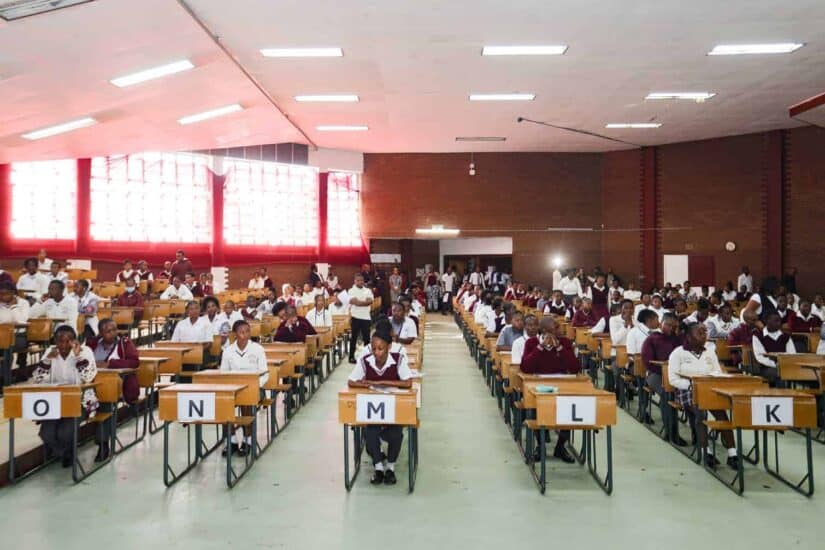
Matriculants during an examination monitoring visit at Forte Secondary School in Dobsonville on 23 October 2025 in Soweto, South Africa. Picture: Gallo Images/Fani Mahuntsi


Quality assurance body Umalusi has said it is satisfied that the assessment bodies have sufficient marking capacity. However, the Department of Basic Education (DBE) has reported marker shortages in Afrikaans Home Language, English Home Language and History.
Despite the shortage, Umalusi says it is confident that the DBE’s plan to start marking early and phase the process will adequately mitigate the risk.
The same shortage was reported in 2024. At the time, Umalusi said that while it had contingencies in place, it would also conduct a fresh recruitment drive before considering phased marking or extended marking sessions.
“In future, we don’t want stop-gap measures. They’ve got adequate time to plan so that next year there is a full complement,” Umalusi CEO Dr Mafu Rakometsi said at the time.
Two years later, the shortage persists, and the department has settled for an early start and the phasing out of the process of marking.
The Department of Higher Education and Training (DHET) will only be able to finalise its marker appointment process later this month. Umalusi will be able to pronounce on DHET’s marking capacity on or before 19 October.
Matric exam readiness
On Thursday, the quality assurance body confirmed the readiness of the DBE, DHET, Independent Examinations Board (IEB) and South African Comprehensive Assessment Institute (Sacai) to conduct, administer and manage the 2026 year-end national examinations, as well as its own readiness to quality-assure the system during and after the examination period.
Umalusi conducted its state-of-readiness audit from 24 August to 30 September 2026. The audit covered candidate registration; staffing at examination and marking centres; external moderation of internal assessments and question papers; security measures for printing, packaging, storage and distribution of question papers; mark-capturing systems; and structures for managing examination irregularities.
According to Umalusi, 1.08 million candidates are registered for the 2026 year-end examinations. The NSC accounts for the largest share, at about 92% of the total candidature. All candidates have received their examination admission letters and timetables.
Of these, 46 416 are Adult Basic Education and Training (Abet) candidates, 44 322 NC(V) Level 4 and 989 141 (964 201 DBE, 18 631 IEB and 6 309 Sacai).
These candidates will collectively write 283 subject question papers that Umalusi externally moderated and approved. The candidates will write at 9 183 examination centres across four assessment bodies.
“Relevant concessions and accommodations such as extra time, adaptation of question papers into braille and large print have been granted to eligible candidates in accordance with applicable policies and regulations,” said Umalusi.
Cheating scandal
Umalusi further confirmed that it had received the final report of the National Investigative Task Team (NITT), established by the Minister of Basic Education, Siviwe Gwarube, to investigate the breach involving the 2025 NSC Mathematics Papers 1 and 2, Physical Sciences Papers 1 and 2, and English Home Language Papers 1 to 3.
The report found that, of the 600 000 candidates who wrote the three subjects nationwide, the breach involved only 40 Pretoria-based candidates. The DBE’s disciplinary processes are underway in accordance with relevant policies.
The quality assurance body wished the Class of 2026 strength and determination ahead of its final matric exams.
“Our advice to you: approach these examinations with confidence, discipline and integrity. This is the final stage of an important journey, and the country wishes you every success.”