



Hill-Lewis stressed that stable government, accountability and service delivery must take precedence over political rivalry.
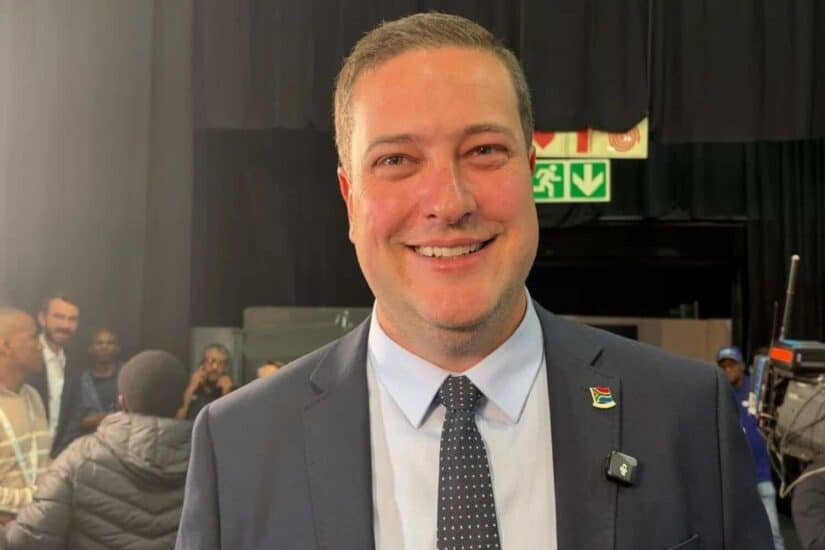


The DA has signalled it will likely push for control of mayoral offices in coalition governments across South Africa’s hung municipalities, with DA leader Geordin Hill-Lewis arguing that parties bringing the largest electoral mandate into a coalition should have a “natural expectation” of leading it.
Hill-Lewis addressed the media at the Electoral Commission’s Results Operations Centre (ROC) at Gallagher Convention Centre in Midrand on Friday as attention shifted from counting votes to the coalition negotiations that will determine who governs dozens of municipalities across the country.
As parties prepare for what is expected to be one of the most complex coalition negotiation processes in democratic South Africa, Hill-Lewis outlined the DA’s approach to coalition talks, stressing that stable government, accountability and service delivery must take precedence over political rivalry.

Get your results on
our Election Hub
Live results
The DA leader said coalition governments are set to become a defining feature of local government, with as many as two-thirds of municipalities expected to require power-sharing agreements.
“That is really an epoch-changing development in our politics,” Hill-Lewis said.
“Previously, coalitions would be needed here and there in a scattering of places around the country. Now they will be needed in nearly two-thirds of all local municipalities.”
Coalition discussions
Hill-Lewis said the party is open to discussions with “many, many political parties” and has already begun engaging potential coalition partners.
“We have already reached out to many parties over the last 24 hours and will continue to do so today. At the moment, those talks are informal. They are more discussions about having discussions. The more formal and serious work will begin probably today or in the coming days.”
Hill-Lewis said the DA would enter negotiations with “respect and humility” and respect for the mandates other parties had received from voters.
“We will approach these coming negotiations with an attitude of deep respect and humility and respect, most importantly, for the mandate those parties have received from their voters.”
Government of local unity
One of the most significant developments from the briefing was Hill-Lewis proposing the possibility of a broad-based “government of local unity”, similar in principle to the government of national unity (GNU) at national level.
He said several models remained under consideration, ranging from minority governments and traditional coalition agreements to wider multi-party arrangements involving several political parties.
“There are a number of different models that are under discussion. You could have just a minority government model.
“You could go to the other side, where you have a government of local unity approach, where you bring in a multiplicity of parties, and you have much more than 50%,” he said.
However, Hill-Lewis stressed that negotiations were still at an early stage and that different municipalities could ultimately require different coalition structures.
“There are still enormous amounts of details to work out in the coming two weeks.”
Mayoral positions
At the centre of the upcoming negotiations is the question of who gets the mayoral chain.
Asked whether the DA would be prepared to surrender mayoral positions despite being the biggest party in a coalition arrangement, Hill-Lewis pointed to the principle of proportionality, which the party previously championed during GNU negotiations.
“One of the principles that we stood up for quite firmly was this idea of proportionality,” he said.
“The allocation of seats in the government should be proportionate to the number of seats that you bring to the government.”
While avoiding firm negotiating positions ahead of formal talks, Hill-Lewis strongly hinted that parties with the largest share of voter support should lead coalition governments.
“I think that most voters would say, quite rightly, that those parties who are the largest party in the coalition should have a natural expectation.”
The comments are likely to shape coalition negotiations in key municipalities where no party has secured an outright majority and where control of the mayoral chain is expected to become one of the biggest battlegrounds.
Hill-Lewis also made it clear that the DA would not negotiate through public statements or media briefings.
“If you conduct your coalition discussions via the media, then you are just telling all of your potential partners what your negotiating lines are, and that’s not healthy. That’s not good practice for any negotiation anywhere.”
Accountability
The DA leader said coalition agreements would be built around governance principles that focus on accountability, financial discipline and service delivery.
“There must be accountability. That is not negotiable. It is essential.”
He said municipalities in distress required governments capable of restoring public confidence and reversing years of infrastructure decline and poor management.
“We know what those towns and cities need if they are going to turn around. They need governments that are based on integrity, with a zero tolerance for corruption.”
Hill-Lewis also issued a broader appeal to political parties to place residents ahead of political interests during coalition negotiations.
“The voters have given all of our political leaders a mandate to start turning our towns and cities around. It is incumbent on us as leaders now to take that chance. The voters will not forgive us if we do not.”
Public coalition agreements
One of the most significant commitments made by the DA was a pledge to publish all coalition agreements once negotiations have been concluded.
The move aims to increase transparency and allow the public to hold coalition partners accountable for the promises they make during negotiations.
“One commitment that I will make is that when we have concluded these coalition discussions and agreements, all of our agreements will be published publicly for everyone to see and for the public to hold us accountable to.”